New Data Shows the Impacts of the Pandemic on Caribbean Businesses
The Caribbean region has been hit particularly hard by the pandemic, with a deeper economic contraction than Latin America as a whole. The impact has been worse for women-owned/led firms and smaller firms, and supply chain disruptions have significantly affected firm performance.


Something novel happened in Ocho Rios, Jamaica on August 16th: a cruise ship arrived in the country for the first time since March 2020. This was a sight for sore eyes for many businesses in this tourism-dependent economy, which saw international tourist arrivals drop by nearly 70% in 2020.
This recent bright spot aside, the Caribbean region has been hit particularly hard by the COVID-19 pandemic. The International Monetary Fund estimates that economic activity in the region fell by 9.9% in 2020, higher than the average economic contraction in Latin America for the same period (6.8%). Caribbean tourism-dependent economies are also expected to be the last to recover.
Just how hard have businesses in the Caribbean been hit? We can now more decisively answer this question using newly released data from the Innovation, Firm Performance, and Gender (IFPG) survey carried out with nearly 2,000 firms in thirteen Caribbean countries. While recent studies have quantified the short-term impacts of the pandemic on businesses around the world—showing how small firms and those in lower income countries have fared worse than their larger and richer counterparts—the Caribbean has been absent from these analyses given scant country-level data. Our new study helps to fill this gap.
What are the five main takeaways from the results?
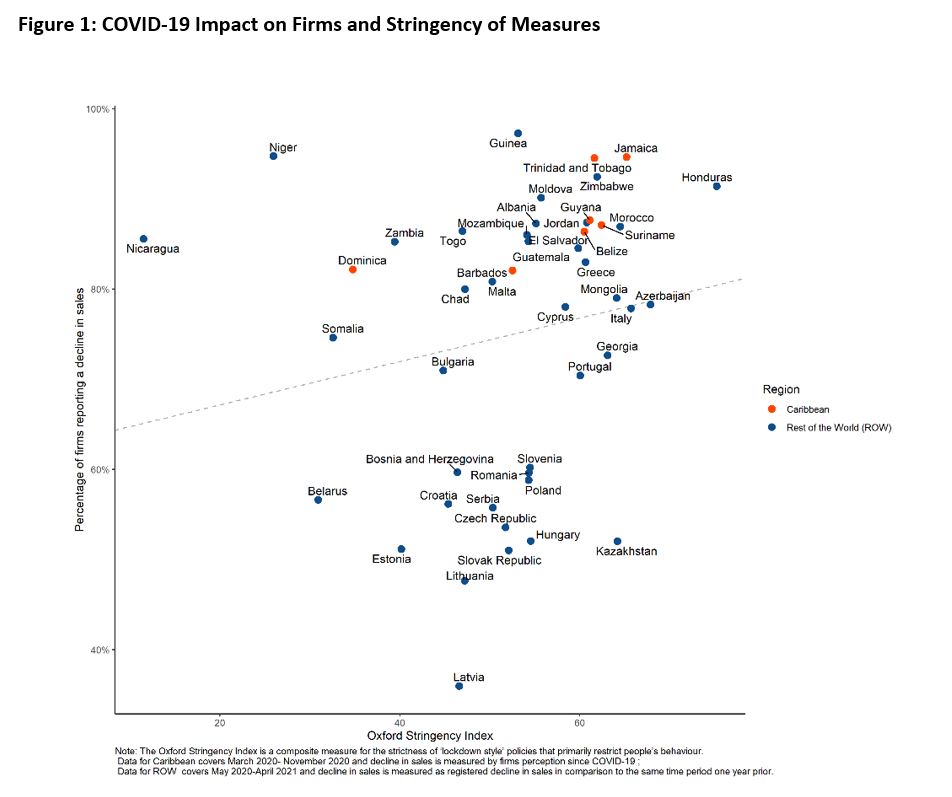
- Social distancing measures are correlated with decreased economic activity. Combining the IFPG survey with data from the World Bank’s COVID-19 Follow-up Enterprise Surveys and the Oxford University Stringency Index, which is a measure of the strictness of lockdown policies, we see a positive correlation between social distancing policies and the proportion of firms reporting a drop in sales. This pattern is observed across countries worldwide and the correlation seems to be stronger for countries in the Caribbean.
- 90% of Caribbean firms report being negatively impacted by COVID-19. The three most common impacts were lower sales (89% of firms), lower capacity utilization (85%), and a reduced workforce (34%). This last result suggests that firms have tried to maintain jobs as much as possible. In addition, almost one-third of firms see bankruptcy or insolvency as a major risk brought on by the crisis and, on average, firms expect it will take at least 13 months before they make a complete recovery.
- Consistent with what has been observed in other countries, the pandemic has disproportionally affected women-owned/led businesses and smaller firms. Women-owned/led firms were more likely to report reduced sales (93% of firms) and capacity utilization (90%) when compared to the rest of the firms in the sample (88% and 83%, respectively). In terms of size, while 36% of small and medium enterprises (SMEs) report a workforce reduction, 20% of large firms report experiencing these cuts. Interestingly, women-owned/led firms do not report cutting more jobs than the rest, a finding that calls for further analysis.
- Supply chain disruptions caused by COVID-19 have significantly affected firm performance. Firms that adopted measures to avoid supply chain disruptions, such as securing raw materials, using inventory, and obtaining substitutes for supplies, among others, were more likely to retain or increase their workforce, their sales, and their capacity utilization during the pandemic.
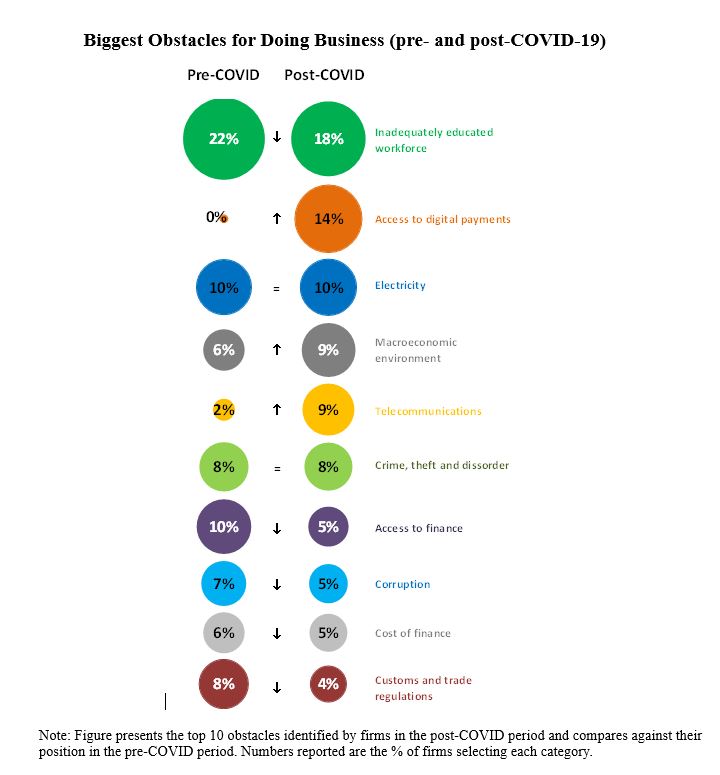
- Firm priorities have shifted, and targeted firm support will be needed for a private sector-led recovery. Pre-pandemic, less than 1% of firms perceived access to digital payments as a major obstacle to doing business. Now, access to digital payments has become the second highest ranking challenge for firms (14%), behind the top concern of an inadequately educated workforce. To ramp up their operations post-COVID, 34% of firms consider that they will require technical assistance and have mostly called for employee training programs on digitalization and online production and operation.
With this picture in mind, public policies and development finance institutions (DFIs), such as IDB Invest, have a key role to play in supporting firms’ recovery in the Caribbean. On the policy side, improving the business environment and worker skills in this new highly digital economy, as well as continued support for infrastructure and logistics investments are among the top priorities. Governments in the Caribbean have already begun to mobilize support to the private sector including expanding credit to SMEs.
For DFIs, spurring recovery calls for continuing to expand access to short- and long-term financing for businesses, particularly for SMEs, in the most affected sectors and segments. It also means increasing technical assistance to help firms ramp up and digitalize their operations and embark on a path to sustainable growth.
Maria Cecilia Acevedo and Joaquin Lennon also contributed to this post.
For more details, see the study by Acevedo et al., (2021), The Impacts of the COVID-19 Pandemic on Firms in the Caribbean, which is part of IDB Invest’s Development through the Private Sector Series. A DEBrief summarizing the study can also be found here.
Authors

Stefano Pereira
Stefano Pereira is Senior Development Impact Advisor at FinDev Canada where he is a contributor the organization’s thought leadership agenda. Prior to joining FinDev Canada, he worked in the Development Effectiveness Division at IDB Invest. His areas of research include private sector development, productivity and green economics and his work has been featured in books, technical papers and academic journals. He holds an M.A. in Economics from the University of Toronto and B.A. in Economics from the University of the West Indies.

Patricia Yañez-Pagans
Patricia Yañez-Pagans is a Principal Economist in the Development Effectiveness Division of IDB Invest. With extensive experience in impact measurement across multiple areas, both in the public and private sectors, she currently leads the work on ex-post evaluation for the IDB Invest portfolio and the impact knowledge agenda. Patricia joined the IDB Group under the Young Professionals Program and served as an Economist in the IDB's Office of Strategic Planning and Development Effectiveness and as Research Fellow for IDB’s Research Department. She has also worked as a consultant for different institutions, such as the World Bank, UNICEF and the Ministry of Development Planning of Bolivia, and as a Professor of Economics at the Universidad Católica Boliviana. Patricia has a Ph.D. in Applied Economics from the University of Wisconsin-Madison, a Master’s in Applied Economics from Pompeu Fabra University, and a Master’s in Social Policy and Development from The London School of Economics and Political Science.
LIKE WHAT YOU JUST READ?
Subscribe to our mailing list to stay informed on the latest IDB Invest news, blog posts, upcoming events, and to learn more about specific areas of interest.
SubscribeMinerals
Related Posts
How IDB Invest Is Helping Latin America Capture More Value From Its Minerals
Through capital mobilization and strategic partnerships, IDB Invest supports mineral value chains, from mining and processing to enabling infrastructure and other value-added activities.