
The Sustainability Week Knowledge Hub offers resources and tools on sustainable finance in Latin America and the Caribbean. We help businesses meet sustainability goals and make a lasting impact.
Knowledge Sharing Sessions - Virtual Day
May 25th, 2026 - Online via Zoom (Registration required)
Join sustainability matter experts on virtual sessions from across the Region on a diversity of topics and learn the most up-to-date trends on management and best practice implementation.
This session moves past the family protocol and focuses on the structures that make family governance functional: when and how to create a family council, how it should be composed, and — critically — how it connects to the operating company or group of companies without creating parallel power centers.
Through practical frameworks and illustrations, participants will explore the governance architecture that fits different stages of family business evolution.
Practical design and implementation of integrity compliance tailored for small and medium-sized enterprises (SMEs).
The discussion will highlight how SMEs can develop right‑sized effective compliance frameworks that match their size, complexity, and operational realities, strengthening resilience, competitiveness, and long‑term sustainability.
Panelists will highlight common challenges SMEs face, share actionable solutions and good practices, and showcase IDB Invest’s experience supporting these efforts, including through capacity building.
Discover how AmazoniaForever360+, the IDB Group’s territorial intelligence platform for Amazonia, can transform the way you understand and use data for decision‑making. The platform brings together more than 140 territorial indicators across eight Amazonian countries, converting complex information into clear, actionable insights through two AI‑powered tools, Report and Grid. Designed for users with no expertise, AmazoniaForever360+ makes territorial intelligence accessible, intuitive, practical and fun.
During this interactive session, you will experience a live demonstration of the platform, learn about its value for analysis and planning, and will be able to register and start exploring the platform in real time.
This course, divided into seven modules, analyzes the requirements of Performance Standard 1 and establishes guidelines for its practical application. It examines what Environmental and Social Management Systems (ESMS) are and how they can be designed and adopted based on project characteristics; provides recommendations for formulating a practical Environmental and Social Policy; suggests ways to operationalize and monitor the implementation of Environmental and Social Management Programs (ESMPs); presents methods for managing the risks associated with project execution; analyzes some ways to prevent and respond to contingencies and emergencies; examines the capacity and competence requirements of human resources for managing ESMS; and reviews the minimum requirements necessary for community engagement.
This session examines the role of boards and senior management in governing technology, innovation, and artificial intelligence, drawing on insights from IDB Invest’s Technology, Innovation, and AI at Boards (TIAB) initiative and its practical toolkit.
The discussion will focus on the shift from awareness to effective oversight: setting clear guardrails for innovation, aligning technology with strategy, overseeing AI-related risks, and strengthening accountability as digital transformation accelerates.
Grounded in real world experience and informed by regional evidence, the session will highlight what boards and senior management are prioritizing, where challenges persist, and what effective governance of AI looks like in practice.
Investors increasingly rely on a wide range of information when evaluating opportunities, risks, and long-term value. Disclosure practices in the private sector have also evolved, raising questions about how transparency can shape investment decisions.
Panelists will discuss how investors use available information when assessing projects and risks, as well as whether greater disclosure influences capital mobilization toward sustainable investments.
The session will also examine practical challenges related to reporting, comparability, and standardization of information, as well as the balance between transparency and confidentiality.
Practical strategies to strengthen the integration of MSMEs into sustainable supply chains. Discussions will focus on bridging financing and capacity gaps through the strategic use of guarantees, the role of local intermediaries, and the importance of building local capabilities. Particular attention will be given to how intermediaries can facilitate access to finance, technical assistance, and market opportunities at scale.
Present the CARIBEquity Toolkit for Early-Stage Investors, a unique interactive knowledge product tailored to the Caribbean’s nascent innovation ecosystem - and present an implementation model which combines the delivery of knowledge, networking opportunities, and investor capacity building to mobilize capital for Caribbean innovators.
As sustainable finance moves faster and expectations grow higher, impact reporting must evolve—from static disclosures to data that truly informs decisions.
This interactive session equips impact investors and partners with practical insights on market trends, reliable data foundations, and ethical AI—showing how better data turns sustainability intentions into measurable impact.
This session offers a pragmatic look at the internal governance mechanisms that allow State-Owned Enterprises (SOEs) to maintain strategic continuity regardless of changes in government.
From the critical but often overlooked roles of the Corporate Secretary and Board Chairman in managing handovers, to the design of institutional memory systems and transition protocols, participants will leave with concrete tools they can apply immediately.
The session closes with the presentation of the new IDB Invest Corporate Governance Principles for SOEs — a landmark framework for the region.
Expectations of corporate reporting are changing. Sustainability reporting is shifting from largely voluntary disclosures toward mandatory requirements built on shared frameworks that allow regulators, investors and other stakeholders to better assess and compare risk, performance and long-term resilience.
This increases the responsibility on reporting teams to demonstrate greater confidence in their data, processes and claims —often while working with tighter budgets and leaner resources.
When applied well, technology can help organizations meet higher expectations, while also improving efficiency, improving collaboration across teams and strengthening the credibility and reliability of reported information.
In this session, Flag will explore how technology is being used in practice to support modern reporting, including where software, tools and AI can help teams across their reporting processes - from data collection to content development and design, through to assurance.
What you'll learn:
- Why reporting teams are increasingly turning to technology, and what problems it can realistically solve
- How technology can support day‑to‑day reporting work, including data management, drafting, review and design
- The variety of technology options available and the different problems they solve for
- Aspects to think about when introducing or scaling reporting tools, from timing and governance to training and change management
A practical deep dive into blue bonds for both issuers and investors. We’ll cover the fast-evolving landscape of blue guidance, how issuers define eligible activities and exclusions, and how investors assess integrity through governance, KPIs, reporting, and assurance. Using concrete examples from market practice—including IDB Invest’s experience issuing blue bonds under its Sustainable Debt Framework—this session highlights what builds credibility, attracts demand, and supports a scalable pipeline of blue assets.
This session offers a practical introduction to sustainability reporting and its growing strategic relevance for businesses across the region. Participants will explore why sustainability reporting matters today, the role of the Global Reporting Initiative (GRI), and different approaches to materiality including impacts, risks, and opportunities. The discussion will cover the GRI Standards in practice, key concepts such as stakeholder engagement and due diligence, and the growing interoperability with other global frameworks (ISSB, TNFD, ESRS), closing with an interactive Q&A and practical resources to support participants on their reporting journey.
Do you have a project concept that needs support to become investment-ready? This session will introduce the IDB Group’s ONE Caribbean Project Preparation Coordination Mechanism (PPCM) and its offer of support to help governments, regional partners and the private sector move projects from early-stage ideas to bankable, financeable opportunities across the Caribbean. The discussion will focus on the common challenges that delay or prevent projects from reaching financing — including limited project preparation capacity. Participants will learn how the PPCM works with partners to provide technical assistance and project development support to help advance high-impact projects. Participants will gain insights into how stronger project preparation can unlock public, private and PPP investments and accelerate resilient and sustainable development across the Caribbean, as well as practically where to access that support and how.
Sustainability has evolved rapidly from a niche consideration into a core pillar of financial decision-making across Latin America and the Caribbean. This session will explore how global frameworks such as IFRS S1 and S2, TNFD and Green Bond Principles are being translated into regulatory requirements across key markets including Brazil, Chile, and Mexico, and a core demand from institutional investors.
Moving beyond theory, the discussion will highlight how these developments are reshaping risk management, capital allocation, and client engagement in the financial sector, ultimately influencing corporate behavior and real-economy outcomes. Participants will gain practical insights into how regulatory convergence can support more resilient portfolios while unlocking measurable positive impact.
| Social Impact and Sustainable Development
-
 December 2023
Women Rising: A study of the growing financial power of the women’s market in LAC, and what this means for financial institutions
-
 February 2025
Development of Social KPIs for the Financing of a Blue Economy in the Caribbean
| Adaptation and Resilience
-
 April 2026
What Works to Strengthen Productivity and Climate Resilience among Small-scale Agricultural Producers?
-
 October 2024
Building Climate Resilience in Latin America and the Caribbean: Physical Climate and Natural Disaster Risk Assessment of IDB Invest Projects
-

-
 November 2023
Interventions to Increase Climate Resilient Investments In Barbados, Jamaica and Trinidad and Tobago: Identification of Hazards and Resilience Measures
-

-
 November 2024
The Circular Economy in Motion: How Multilateral Development Banks are Advancing the Transition
-
 September 2025
Verifying Biodiversity Offset Outcomes: Guidance for Offset Proponents
| Sustainable Finance and Capital Mobilization
-
-
-
-
 April 2025
Driving Market-level Changes in Impact Investing: Steps for Investors and a Call for Action
-
 June 2023
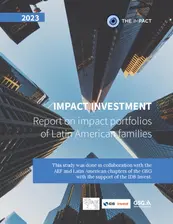
Impact Investment: Report on Impact Portfolios of Latin American Families
-

| Enabling Environments, Governance and Innovation
-
-
-
 February 2023
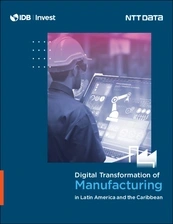
Digital Transformation of Manufacturing in Latin America and the Caribbean
-
 January 2023
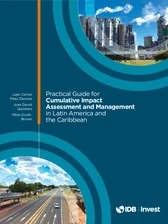
Practical Guide for Cumulative Impact Assessment and Management in Latin America and the Caribbean
-
-
 November 2023
How New Technologies Are Transforming Telecommunications in Latin America and the Caribbean
-
 August 2024
Smartphones꞉ Unlocking Potential And Overcoming Challenges In Latin America And The Caribbean
-
-
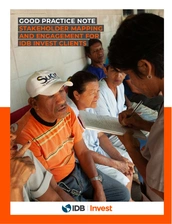 December 2024
Good Practice Note. Stakeholder Mapping and Engagement for IDB Invest Clients
-
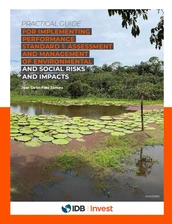 December 2024
Practical Guide for the Implementation of Performance Standard 1: Assessment and Management of Environmental and Social Risks and Impacts
| Nature, Oceans and the Blue Economy
-
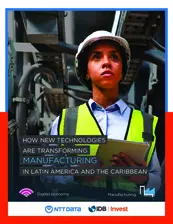 October 2023
How New Technologies Are Transforming Manufacturing in Latin America and the Caribbean
-
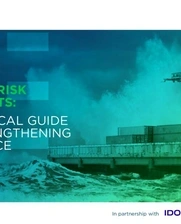 September 2021
Climate Risk and Ports: A Practical Guide on Strengthening Resilience