
Climate Shareholders: Corporate Climate Action using Blended Finance in Equity Investments
Blended finance in equity investments can not only offer preferred returns to commercial investors, making deals in developing markets more attractive for them, but also bring to the decision-making table corporate climate action as a priority for companies of all sizes.


Let’s say you run a small or medium size company in growth stage. You’re probably thinking you shouldn’t yet be worrying too much about your corporate responsibility regarding climate change, right? Wrong.
Climate change has become one of the key drivers for business sustainability. To achieve significant progress in climate change mitigation and adaptation, companies of all sizes can adopt corporate actions such as measuring their carbon footprint, decarbonizing their internal operations and their value chain, identifying and reporting on their climate risks or reacting and adapting to these risks.
This is the right thing to do and is not a pipe dream for a company that is strapped for cash and looking to increase revenue at a fast pace. There are risk-capital products that can support the growth and competitiveness of companies with relevant socioeconomic and environmental impact in Latin America and the Caribbean (LAC).
These products can also improve the development impact of each investment by mobilizing private capital while influencing the adoption of better governance practices and social and environmental standards into companies. The idea is that, once these companies achieve scale, they can consolidate their market position and become agents of innovation. The faster these companies achieve scale, the more impact they can achieve if properly influenced by value-adding patient capital investors.
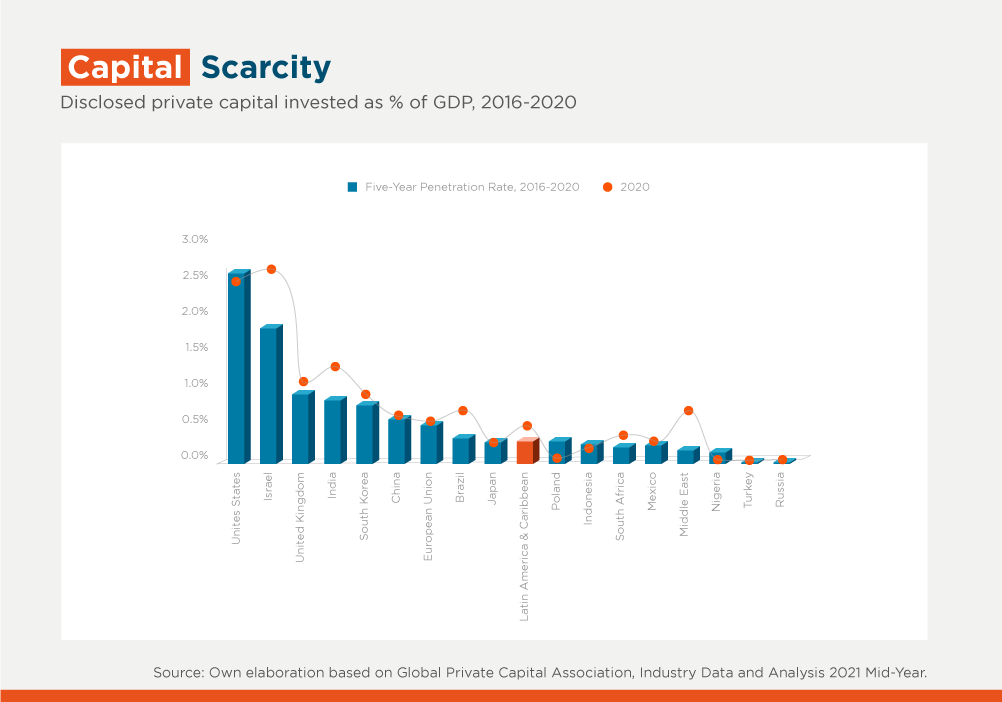
This matters because capital is scarce in developing regions like LAC: in spite of the recent growth of venture capital investment in tech, private capital activity in the region is still nascent compared to developed markets. The region has a five-year private capital investment penetration rate of only 0.24% over annual gross domestic product compared to 2.56% in the United States. In a context where bank lending is scarce, this translates into lower levels of productivity and employment.
In response, since 2018, IDB Invest has deployed over $100 million in equity investments to support the growth of ten companies in the technology, financial, energy, health, telecommunications, and retail sectors in LAC with a cross-sectoral approach to the digital economy.
Additionally, IDB Invest manages through its blended finance practice third-party concessional funds targeted at investments where real or perceived risks are too high for standalone commercial finance. These funds play a catalytic role to overcome barriers to access private capital in developing markets.
Going back to growth-stage companies, this is where the use of blended finance resources to invest in an equity round, together with other sources of commercial capital, may help address the main impediments to growth that companies with a high-impact potential face at that stage.
These impediments include: first, a lack of capital available to bridge the gap between early-stage investment and mature-stage financing; second, a lack of patient capital to support the company develop a solid business model, in a context where capital providers prioritize and incentivize quick growth; and third, the struggle of aligning the short-term growth needs of the business with its long-term impact.
Blended finance in direct equity investments can offer preferred returns to other commercial investors, signalling the opportunity and making it more attractive for them to invest, if there are real or perceived risks that they are not willing to take. Once a shareholder in a company, concessional funds can also be structured to offer incentives for the company to steer their operations towards corporate climate action, prioritizing the actions with the highest impact as the business grows. This approach makes companies stand out from the crowd too: LAC is still lagging in terms of corporate climate action if we look at the most relevant international standards.
In the last year, $11.5 million blended finance resources have been invested in 3 equity transactions involving IDB Invest, alongside $18 million from IDB Invest’s own capital and $104 million of external private investment.
As an example, in 2020, IDB Invest closed an equity investment in Cargo X, LAC’s largest trucking freight digital platform. Cargo X leverages technology and data to connect large shippers with small carriers in Brazil. IDB Invest invested US$9.9 million on its own account and $4.5 million with blended finance resources from the Climate Investment Funds (CIF).
The CIF investment included an incentive mechanism to give shares back to the company’s stock option plan upon the achievement of certain milestones, supporting the company’s commitment to the development of a robust methodology to measure the greenhouse gas emissions reductions derived from their business model through load consolidation and route efficiency.
With the development of this methodology, IDB Invest supported Cargo X to formalize their commitment to measure the largest risk on their business model, making it a strategic priority at a time of rapid growth as well as helping bridge an existing knowledge gap, providing a more rigorous framework for this growing industry.
IDB Invest’s investment structure in Cargo X showcases the value proposition that this approach brings to investee companies, leveraging IDB Invest’s signalling effect in the market by providing innovative incentives as a tool to increase corporate commitments towards climate action strategies and specific targets. Through these commitments, investee companies are not only better prepared to identify climate risks, but also to turn those risks into business opportunities in the long term.
Authors

Carlos Sánchez Reboiro
Carlos is an Investment Management Officer in the Equity & Mezzanine Finance Team at IDB Invest, which he joined in 2018. He is responsible of sourcing, selecting, originating, structuring, closing and supporting the supervision of the equity and mezzanine transactions (including venture capital), across all sectors of IDB Invest. Before joining the IDB Group, he worked for Banco Santander as an Export and Agency Financial Analyst, at the Spain’s Economic and Commercial Office in China, and for the economic consulting firm, Intermoney, in Madrid. Carlos earned a master’s degree in International Business Management from the Instituto Español de Comercio Exterior and has an undergraduate degree in Business Administration from Universidad Autónoma de Madrid with an specialization in Finance from Syracuse University.

Joan Miquel Carrillo
Joan Miquel is a Blended Finance Lead Investment Officer in the Financial Products and Services Division at IDB Invest and is based in Washington DC. Joan Miquel joined IDB Invest in 2017 and since 2018 acts as a focal point in the institution of the Climate Investment Funds (CIF). Joan Miquel participates in the design of blended finance solutions across the region with a focus on infrastructure and energy projects with a climate change mitigation or adaptation component. Prior to joining IDB Invest, Joan Miquel developed his professional career at Isolux Corsán Concesiones in the highway concession sector in Spain and Brazil and at Invall Green Energy in the development of wind farm projects in Spain and Eastern Europe. Joan Miquel has a Master of Science in Civil Engineering from the Universitat Politecnica de Catalunya – Barcelona Tech (Spain) and completed the Executive MBA of the ESADE Business School in Barcelona (Spain).

Pilar Carvajo Lucena
Pilar is an Investment Management Officer, Blended Finance Team at IDB
Invest, which she joined in 2017. She provides
support to the origination and structuring processes
of the concessional tranche of investments in the
energy, agribusiness, manufacturing and financial
services sectors, especially in Central America and
the Caribbean. She is also responsible for managing
the relationship with donors, including fundraising
and project portfolio monitoring.
Before joining the IDB Group, she worked at Acción
Global Investments, where she participated in the
origination and structuring of equity investments in
financial institutions in Asia and Latin America. She
previously worked at Deloitte providing advice to
infrastructure and renewable energy clients, among
other sectors, and managing their financial risks. She
has more than five years of experience in the
management of financial and equity investment risks
in emerging markets.
Pilar earned a master’s degree in business
administration (MBA) from the MIT Sloan School of
Management in Cambridge, MA (USA) and a
professional degree in law and business
administration from Universidad Pablo de Olavide in
Seville (Spain).
LIKE WHAT YOU JUST READ?
Subscribe to our mailing list to stay informed on the latest IDB Invest news, blog posts, upcoming events, and to learn more about specific areas of interest.
SubscribeFinancial Institutions
Related Posts

How Santander Brasil and Eco Invest Mobilize Private Capital at Scale
IDB Invest provides financing to Banco Santander Brasil to support sustainable agriculture, land restoration efforts, and resilient infrastructure.
S&P’s AAA Rating Validates IDB Invest’s Strength and Strategic Direction
The AAA rating expands the institution's access to a broader investor base, supporting its ability to finance and mobilize private impact investment in Latin America and the Caribbean.

Beyond the Cash Gap: How Reverse Factoring Is Unlocking Growth for MSMEs
An IDB Invest study in Mexico estimates that adopting reverse factoring is associated with a 27% increase in companies' sales.