
The Other Half of Equality
The path that will lead our societies to prosperity can only be based on sustainability and inclusion. To achieve this, all of us should play a part. We men must remember that we are the other half of equality.


What path should Latin American and Caribbean (LAC) countries follow to overcome the economic crisis caused by the pandemic? Now that there is a glimpse of confidence on the horizon after almost two years, that is the question to answer in 2022—the year set to launch the region's recovery.
The path that will lead our societies to prosperity can only be based on sustainability and inclusion. To achieve this, all of us should play a part. We men must remember that we are the other half of equality.
Although many companies in the region recognize that equity is needed to increase their business competitiveness, only a few engage men as allies in the process. This is a missed opportunity with negative implications on the overall progress and growth of LAC countries. Gender equity cannot be achieved if only half of the population is doing something about it.
According to a new IDB Invest study, Equality needs everyone: The role of men in gender equity, diversity and inclusion, prepared in conjunction with Mercer and Promujer, eight out of ten people working in the private sector in Latin America and the Caribbean confirmed that men play an important role in advancing gender equity. However, 43% do not believe that these advances will benefit them. This is a mistake.
Equality entails significant gains, such as decreased social and family pressure on men as sole household providers, increased confidence among co-workers, stronger physical and mental health, and improved family relationships through the equal sharing of care and household chores. These benefits for men add on to other business gains, such as improved performance, productivity growth, the ability to attract and retain talent, and more innovative ideas.
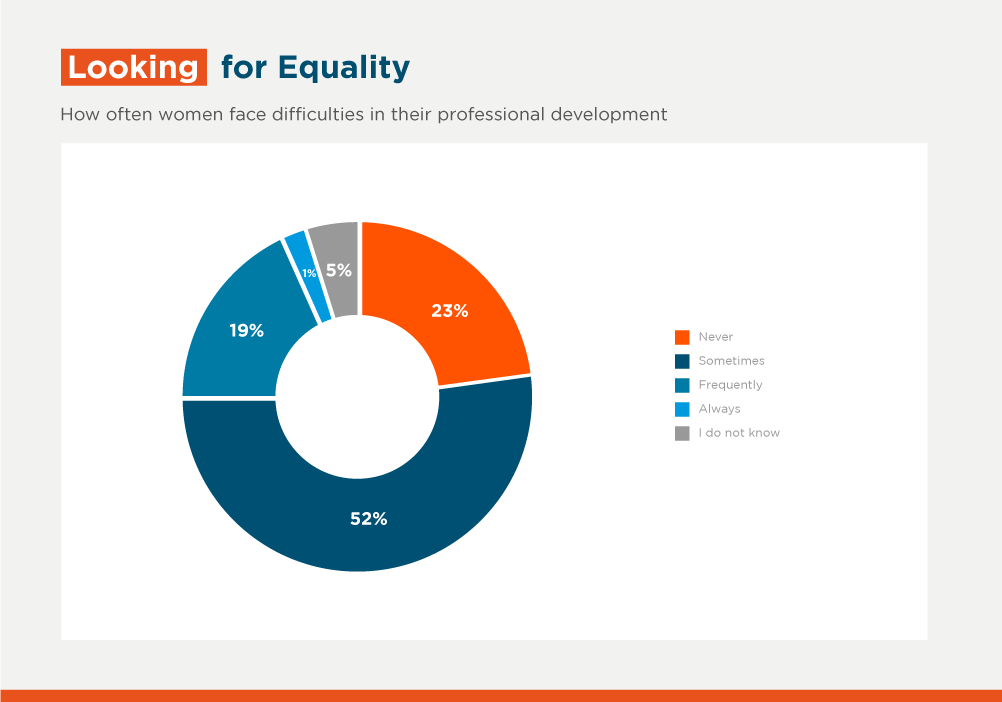
If all of us stand to benefit from equality, how can the private sector promote it? There are two additional facts to be considered: 72% of respondents believe that women face greater career development challenges within companies, and almost 97% confirm that women have greater responsibilities at home and in caring for children, and elderly or sick relatives while teleworking. Company actions, therefore, play a fundamental role in advancing change within organizations and value chains.
Equity in pay, creating opportunities for internal promotion and integrating women in management positions are just some of the actions that can be implemented. Likewise, leveraging international certifications such as EDGE—a global standard for assessing gender equality in the workplace—enables companies to implement equality initiatives. In 2021, the IDB Group was the first multilateral bank in the region to achieve the second level, EDGE Move.
The pandemic, which has largely affected sectors with higher women’s representation, has worsened the current situation, where one out of two women in Latin America and the Caribbean is outside the formal labor market. By implementing the abovementioned measures, the private sector can help create the opportunities required by half of the population in the region to develop their potential, at a time when societies need it most. Only by becoming allies, can men accelerate this process.
To achieve sustainable and inclusive recovery, the other half of equality needs to foster real long-term progress. Let us move forward on that path.
(For the purpose of this article, “men” refers in particular to cisgender heterosexual men, who have historically had specific advantages solely on the basis of their sex. Men encompass a variety of experiences and identities, among which there is a great diversity of gender identities and sexual orientations.)
(This text was originally published in Forbes Centroamérica)
Authors

James P. Scriven
James P. Scriven is the CEO of IDB Invest, a multilateral development bank dedicated to driving sustainable growth in Latin America and the Caribbean through the private sector. A dual Argentine-British citizen, Mr. Scriven has over two decades of experience advancing the role of the private sector to increase development impact.
Before leading IDB Invest, he served as Vice President of Corporate Risk and Sustainability at the International Finance Corporation (IFC), where he held multiple leadership roles. Prior to that, he was Chief Financial Officer of Banco Hipotecario in Argentina.
Mr. Scriven holds a Master’s degree in Finance from Universidad del Centro de Estudios Macroeconómicos in Argentina, and a Business Administration degree from the Pontifical Catholic University of Argentina.
LIKE WHAT YOU JUST READ?
Subscribe to our mailing list to stay informed on the latest IDB Invest news, blog posts, upcoming events, and to learn more about specific areas of interest.
SubscribeAgribusiness
Related Posts

Korea's Cutting-Edge Innovations to Transform Agribusiness in Latin America and the Caribbean
Discover how IDB Invest connects regional agribusinesses with leading innovators in Korea to accelerate smart agriculture, agritech, and sustainable growth.
Digital Transformation Redefines Agricultural Competitiveness in Latin America and the Caribbean
Every time an agricultural company determines when to irrigate, selects what inputs to apply, or decides how to market or transport its production, the use of data and technological solutions becomes a key competitive advantage.

Combating Multidimensional Poverty from the Private Sector Requires Much More Than Jobs
For Danper, a leading Peruvian company in the global agri-food sector, understanding the living conditions of its workers and their families is fundamental to strengthening actions to improve their quality of life.