
Governance and Succession: Securing the Future of Mexico’s Nonbank Financial Institutions
IDB Invest study: key findings and a roadmap to strengthen governance and CEO and senior management succession planning in nonbank financial institutions (NBFIs).


In Mexico, nonbank financial institutions (NBFIs) drive financial inclusion and productive development by expanding access to credit for small and medium-sized enterprises (SMEs) and households underserved by traditional banks.
One in five loans in Mexico comes from NBFIs, which mainly operate as multiple-purpose financial companies (SOFOMs). These entities have been the entry point to credit for 65% of SMEs in the country.
SOFOMs also offer factoring, microfinance, and leasing services, benefiting thousands of entrepreneurs and households – not only through financing, but also with training and growth opportunities.
The SOFOM loan portfolio already accounts for close to 3% of total credit in Mexico’s financial system, underscoring its relevance in financing the country’s productive activities. However, governance challenges persist, including the need for robust structures that ensure business continuity, transparency, and long-term sustainability.
Good governance attracts investors, protects institutions during crises, improves risk management, and ultimately increases their social impact.
A Diagnosis Based on 150 Sector Voices and Global Standards
With support from three local associations (ASOFOM, AMSOFAC, and ProDesarrollo), IDB Invest conducted the first sector-wide corporate governance self-assessment, with participation from more than 150 institutions.
The exercise produced a clearer and more comparable view of the sector, from its structural strengths to the challenges faced by smaller, less consolidated entities.
The study uses a self-assessment tool developed by IDB Invest that integrates and analyzes key dimensions, including board structure, management, succession, controls, transparency, and sustainability, and adopts global standards as a reference.
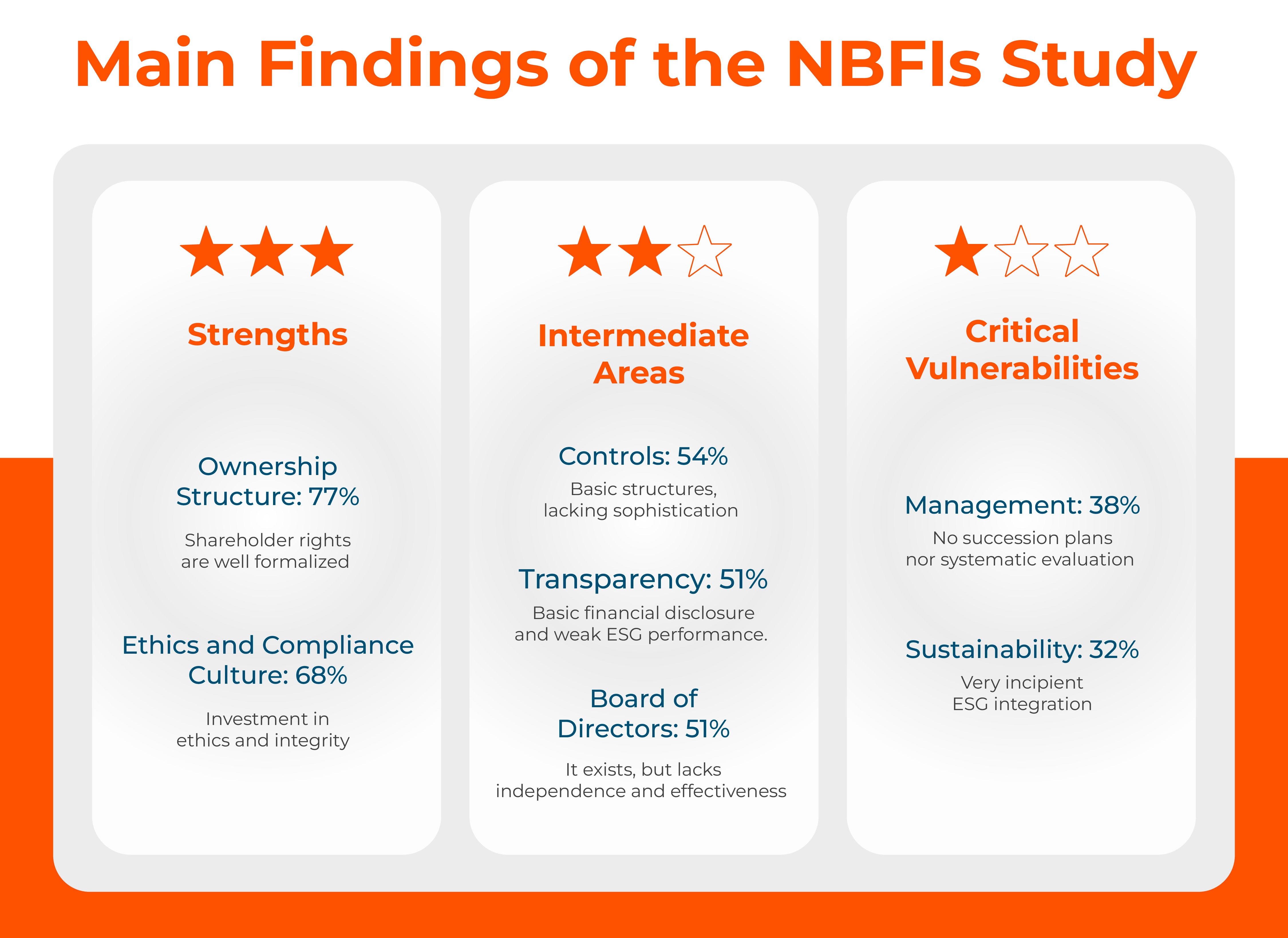
The study shows that most participating NBFIs maintain formal management structures. However, fewer than 30% include independent board members, and only one in three has established clear processes for senior management succession.
When a CEO or other senior leaders leave unexpectedly, institutions without a solid succession plan can face months-long leadership gaps that compromise operational continuity and weaken investor and regulatory confidence.
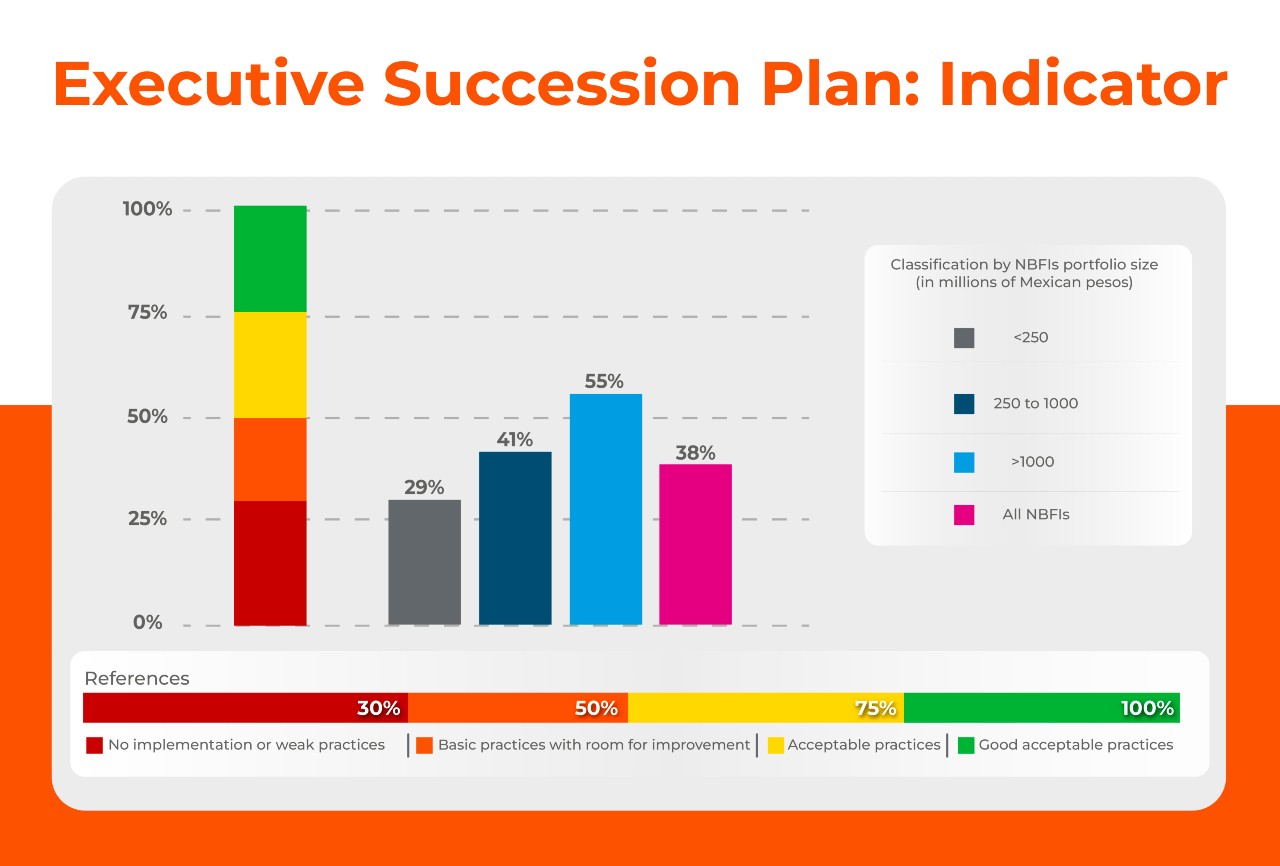
The management indicator assesses whether the board has formally approved a succession plan for key executive positions.
The study also reveals that only one in four institutions integrates sustainability criteria or environmental and social factors into its business strategy. Without professional leadership, management, and a comprehensive sustainability vision, institutions risk relying on individuals rather than systems – limiting their ability to grow and withstand economic cycles.
From Diagnosis to Action: Practical Tools to Move Forward
The value of this initiative lies not only in the data collected, but in what can be done with it. Each participating institution received an individualized report with tailored recommendations, based on its responses and complemented by a comparative analysis against sector averages and peers of similar size. This allows every NBFI to identify its main gaps and strengths and build a practical roadmap to advance its institutional strengthening.
In addition, IDB Invest has developed a series of practical guides that address key challenges, including board composition and operations, risk management, internal controls, ethics, transparency, and succession.
The purpose is clear: to equip institutions with practical tools adaptable to their size and level of institutional maturity. The comparative diagnosis of NBFIs is relevant because, unlike regulated banks, public and comparable information on governance practices is very limited.
A Collaborative Approach: Associations as Agents of Change
The project's success is largely due to collaboration with the associations. Each one – ASOFOM, AMSOFAC, and ProDesarrollo – encouraged its members to share good practices and ensured confidentiality throughout the process.
The IDB Invest team delivered to each association an individualized report with aggregated results from its members, helping drive strengthening actions tailored to their institutional reality and promote collective learning within their networks.
This joint effort reflects the spirit of the IDB Invest development model: providing support, listening, and offering concrete solutions alongside local actors.
Scaling Impact: A Replicable and Upstream Model
The pilot with Mexican NBFIs is not an endpoint but a starting point. The model, based on IDB Invest’s online tool that automates governance assessments and generates comparative analyses, can be replicated in other sectors and countries, primarily through collaboration with business associations.
This upstream initiative identifies gaps before investment, strengthens capabilities, and produces market intelligence cost-effectively. In other words, investing in governance from the ground up helps build stronger, more competitive, and more sustainable financial ecosystems.
A Transformation Just Beginning
Strengthening corporate governance requires discipline, openness, and sustained support – and this diagnosis marks the beginning of a process in which each association can guide its members in implementing improvements and monitoring progress in the coming months.
Beyond the Mexican case, this experience demonstrates the potential of collaboration between IDB Invest and nonbank financial sector associations across the region. Comparable diagnostics, practical recommendations, and concrete tools strengthen internal decision-making but also build confidence among institutional investors and other financial ecosystem players. Ultimately, governance is not a luxury – it is an investment.
Authors

Bruno Sbardellini Cossi
Bruno heads the Corporate Governance practice of IDB Invest, the private sector arm of the Inter-American Development Bank, where he has dedicated the past eight years to advancing impactful and sustainable development throughout Latin America and the Caribbean. He currently chairs the Corporate Governance Development Framework (CGDF), a global platform of over 40 development finance institutions working to promote high standards of corporate governance. Bruno's work is centered around crafting and enhancing governance frameworks that promote transparency, ethical leadership, and equitable growth. His rich background – including an LL.M. degree from Columbia University, a role as a Corporate Law Professor in Brazil, and a CFA in ESG – along with a prior decade as a transactional attorney, equip him with a unique multidisciplinary approach. Bruno's global perspective and comprehensive expertise are instrumental in driving positive change and fostering inclusive financial ecosystems in the communities IDB Invest serves.

Armando Simón Múgica
Lead Investment Officer – Financial Sector (México y Central America). In his role as Lead Investment Officer, is responsible for IDBI’s investment and origination efforts for Financial Intermediaries in Mexico and Central America (currently based in Mexico City). Prior to his current position at IDB Invest, he served as Investments Director for Latin America at MicroVest (DAI Capital) - impact fund based in Washington, DC. During his tenure, Mr. Simón was responsible for the regional management of the fund and project development, subscription, transaction execution, and relationship management for MicroVest's Latin America and Caribbean (LAC) portfolio. He held a similar role for several years at a US-based financial institution with a global portfolio. Originally from Mexico, Mr. Simon holds a Bachelor's degree in International Business Administration from Universidad Iberoamericana and an MBA from Babson College in Boston, Massachusetts. He is fluent in Spanish, English, Portuguese, and French.
LIKE WHAT YOU JUST READ?
Subscribe to our mailing list to stay informed on the latest IDB Invest news, blog posts, upcoming events, and to learn more about specific areas of interest.
SubscribeMinerals
Related Posts

How IDB Invest Is Helping Latin America Capture More Value From Its Minerals
Through capital mobilization and strategic partnerships, IDB Invest supports mineral value chains, from mining and processing to enabling infrastructure and other value-added activities.