
Facing the Storm: How IDB Invest Supports Caribbean Private Sector Resilience
IDB Invest is partnering with the Green Climate Fund to help Caribbean businesses better withstand future climate shocks through blended finance and technical assistance.

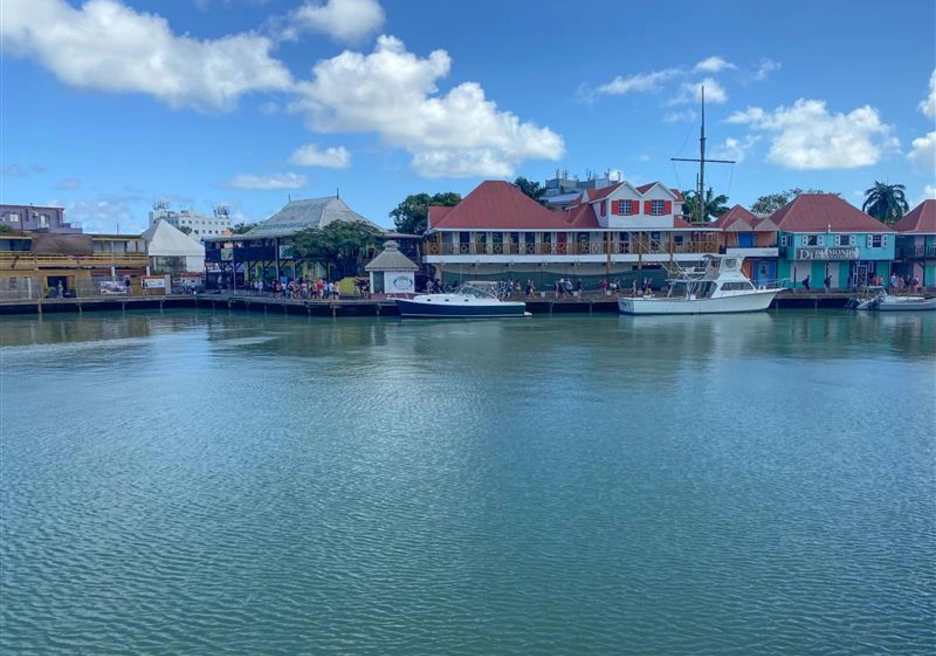
Caribbean Small Island Developing States face persistent vulnerability to extreme weather shocks – a reality underscored in November 2025, when Hurricane Melissa struck. Roofs were torn off, ground floors flooded, and power lines snapped.
Damage to Jamaica alone is estimated at US$8.8 billion, equivalent to approximately 41% of its 2024 gross GDP. Much of this reconstruction cost will be borne by businesses and individuals paying to rebuild their homes and businesses.
With a new Green Climate Fund (GCF)-financed IDB Invest facility, IDB Invest will support post-hurricane recovery and proactively help private-sector entities build stronger resilience to future climate shocks.
What could this new funding enable IDB Invest to accomplish?
Imagine a mid-sized manufacturing facility in Jamaica, the morning after the storm. Thanks to IDB Invest's support, the company will renovate its factory with hurricane-proof roofs, backup power systems, and critical electric systems elevated above the ground floor. After the next storm, the building will still stand. Even if a Category 5 hurricane knocks out the electric grid, the factory's backup power will keep operations running. Orders will be filled. Workers will stay on payroll. This scenario is not a fantasy – it is the resilient future we are building.
To accelerate this bright future, IDB Invest will deploy US$118.9 million of GCF funding to increase the resilience of the Caribbean businesses while promoting environmental sustainability. In addition to providing loans, equity, and guarantees, IDB Invest will provide businesses with technical assistance to strengthen investment readiness for resilience and develop innovative financial mechanisms to drive resilience and adaptation.
Additionally, IDB Invest will work at the market level in these countries, with a variety of associations, to train sectors such as tourism, agroprocessing, and the financial sector to incorporate resilience measures. This approach goes beyond individual projects to tackle sectoral challenges that can contribute to sustainable development in the Caribbean.
Structural vulnerabilities
More frequent and severe weather events bring headwinds to already constrained Caribbean economies, creating a reinforcing cycle of three interconnected constraints:
Public finance pressure: With average debt-to-GDP ratios exceeding 70% in many Caribbean economies, the public balance sheet has generally been under pressure. Successive shocks, occurring too frequently to allow recovery, exacerbate the situation, as rising reconstruction costs increase public borrowing.
Climate risk exposure: Climate-related physical risks are intensifying. More powerful storms, flooding, and coastal erosion are real threats to the sectors that define Caribbean economies: tourism, agriculture, and logistics.
Private-sector constraints: The local private sector struggles to fill the financing gap for resilience. Small, fragmented markets limit scale, and banking systems maintain tight risk limits. Banks prefer short-term loans, while resilience projects require long-term financing. Most financial institutions and companies have limited experience with long-term resilience projects.
The Caribbean Development Trilemma
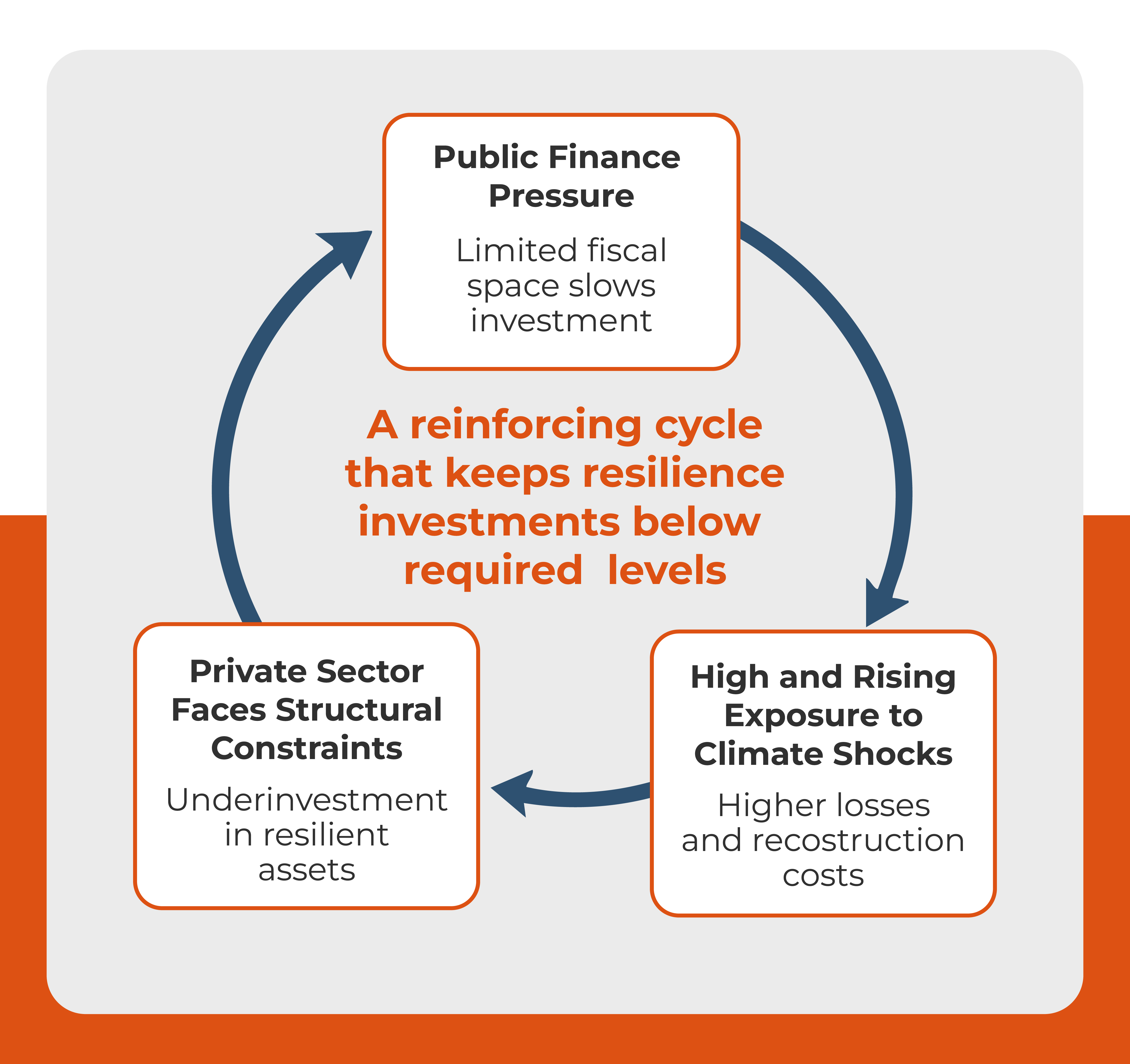
Adapted from: Tackling the Vicious Circle: The Interim Report of the Expert Review on Debt, Nature & Climate, October 23, 2024.
The challenge lies here: Caribbean companies cannot influence the frequency and intensity of future hurricanes. However, they can improve the resilience of their companies' assets before the next storm hits, thereby reducing losses.
Governments face fiscal constraints that limit large-scale investment in resilient infrastructure, and the private sector has not yet bridged this financial gap. The IDB Invest GCF program aims to address all three interconnected constraints, ultimately reducing the long-term vulnerability of businesses in these countries.
The Caribbean manufacturer that restarts production within hours of the next hurricane, keeping workers employed and orders filled, will show what development finance can achieve when it targets systemic constraints.
This program serves as an initial milestone for the IDB Invest Small and Island (S&I) Roadmap, which commits to deploying approximately US$5 billion over five years to build resilient infrastructure, expand financial access, and strengthen business environments across S&I countries.
The IDB Invest GCF program in the Caribbean seeks to mobilize up to US$400 million, leveraging approximately three times the GCF contribution. The facility provides blended finance resources and technical assistance across five sectors: infrastructure, renewable energy, transport, agriculture, and the blue economy.
The GCF capital provides technical assistance and blended finance solutions to help companies transition to sustainable, environmentally responsible, and resilient operations. Through this GCF facility, IDB Invest will help fill financing gaps for eligible investments by being flexible, patient, and risk-bearing.
Enabling More Private Sector Investment
This blog is the first in a series demonstrating how IDB Invest helps the region's private sector build climate resilience and sustainability. For example, IDB Invest is collaborating with the Jamaica Stock Exchange and another leading stock exchange to create local guidelines and deliver a capacity-building series to equip Caribbean companies to issue green, blue, and sustainability bonds.
In Suriname, IDB Invest worked with the national banking association, with representation from all 11 banks, to develop a Sustainable Finance Protocol. This initiative introduces climate risk assessments, new green portfolios, and financial products for the underbanked.
In Guyana, we supported the first EDGE Advanced-certified hotel, and in the Dominican Republic, we launched green lending facilities for local banks. Both projects used technical assistance to certify green standards or quantify and disclose resilience risk – capabilities we are expanding across the Caribbean.
Building on these recent achievements and resources from the GCF facility, we will continue scaling up the provision of blended finance with technical assistance to help banks develop green lending products and support infrastructure project developers and firms, including medium-sized and women-led enterprises.
This strategy shifts from project-by-project interventions to a sustained effort to overcome structural barriers that constrain Caribbean development. The goal is to ensure that Caribbean businesses can rebound quickly when the next hurricane hits.
Authors

Musheer Kamau
Musheer is senior advisor for strategy and blended finance at IDB Invest, where he leads strategic initiatives to mobilize private capital and to revitalize dormant programs into active deployment vehicles. Previously, as principal specialist in the Caribbean Country Department, he spent nearly 20 years designing frameworks for infrastructure finance, faster payment systems, and working capital solutions for small and medium-sized enterprises (SMEs).

Nikolai Orgland
Nikolai Orgland is a Blended Finance Investment Officer in the Financial Products and Services Division at IDB Invest. He specializes in designing innovative financial solutions to support catalytic private sector projects with the potential to achieve impactful outcomes in climate mitigation and adaptation. Prior to joining IDB Invest, Nikolai worked as an energy finance consultant at the World Bank’s global energy practice and the International Energy Agency’s clean energy innovation unit. In 2021-22, he was a fellow of the Mercator Fellowship for International Affairs. An engineer by training, Nikolai holds a Master of Science in Energy Management & Sustainability, as well as a Bachelor of Science in Environmental Engineering, both obtained from the Ecole Polytechnique Féderale de Lausanne in Switzerland.

Malini Samtani
Malini is a Climate Change Specialist in the Advisory Division at IDB Invest. She coordinates internal strategic initiatives such as Paris alignment and the Taskforce for Climate-related Financial Disclosures (TCFD), as well as advises financial institutions clients on integrating climate considerations in their portfolios. Prior to IDB Invest, she held positions as a Program Manager at the Pan American Development Foundation in Suriname and as a Senior Assistant at Deloitte’s Financial Audit Practice in Chicago. She graduated with a Master’s in Development Finance and Latin American Studies from SAIS- Johns Hopkins and a Bachelors in Accounting from Bentley University.
LIKE WHAT YOU JUST READ?
Subscribe to our mailing list to stay informed on the latest IDB Invest news, blog posts, upcoming events, and to learn more about specific areas of interest.
SubscribeFinancial Institutions
Related Posts

How Santander Brasil and Eco Invest Mobilize Private Capital at Scale
IDB Invest provides financing to Banco Santander Brasil to support sustainable agriculture, land restoration efforts, and resilient infrastructure.
S&P’s AAA Rating Validates IDB Invest’s Strength and Strategic Direction
The AAA rating expands the institution's access to a broader investor base, supporting its ability to finance and mobilize private impact investment in Latin America and the Caribbean.
Beyond the Cash Gap: How Reverse Factoring Is Unlocking Growth for MSMEs
An IDB Invest study in Mexico estimates that adopting reverse factoring is associated with a 27% increase in companies' sales.