
What Drives Business Growth in Colombia? Six Key Factors
Initial capital has long been understood as a driver of business growth, but in Colombia, how much capital is needed to grow?


The business landscape in Latin America and the Caribbean is dominated by micro, small, and medium-sized enterprises (MSMEs). While most firms start micro and stay micro, others get bigger. This upward movement, or business mobility, propels job creation, economic growth, and prosperity.
What Drives Some Businesses to Grow While Others Plateau?
To help answer this question, we partnered with Confecámaras, the national network of municipal chambers of commerce in Colombia, to create the National Observatory of Business Mobility in 2023. The goal is to collect data about MSMEs to better understand which factors are associated with firm growth and use these insights to improve public and private business support programs.
Our recent study shows that of the 306,607 companies created in 2019, only about a third, 32%, were still active in 2024. Of these, just 6.8% managed to climb the size ladder. This select group of companies tends to share some key characteristics.
Small and medium-sized businesses were more likely to grow than their micro counterparts. Companies legally established as corporations (sociedades) were far more likely to achieve upward mobility than those created by individuals. The construction, extractive, and agriculture sectors had the greatest share of growing firms, as did the departments of Antioquia, Atlantico, and the capital city, Bogota.
In addition to highlighting these common structural features, which echo those identified in our first study in 2023, our new analysis surveyed 2,100 companies to dig deeper into how internal firm factors, such as organizational structures and management styles, can influence business mobility.
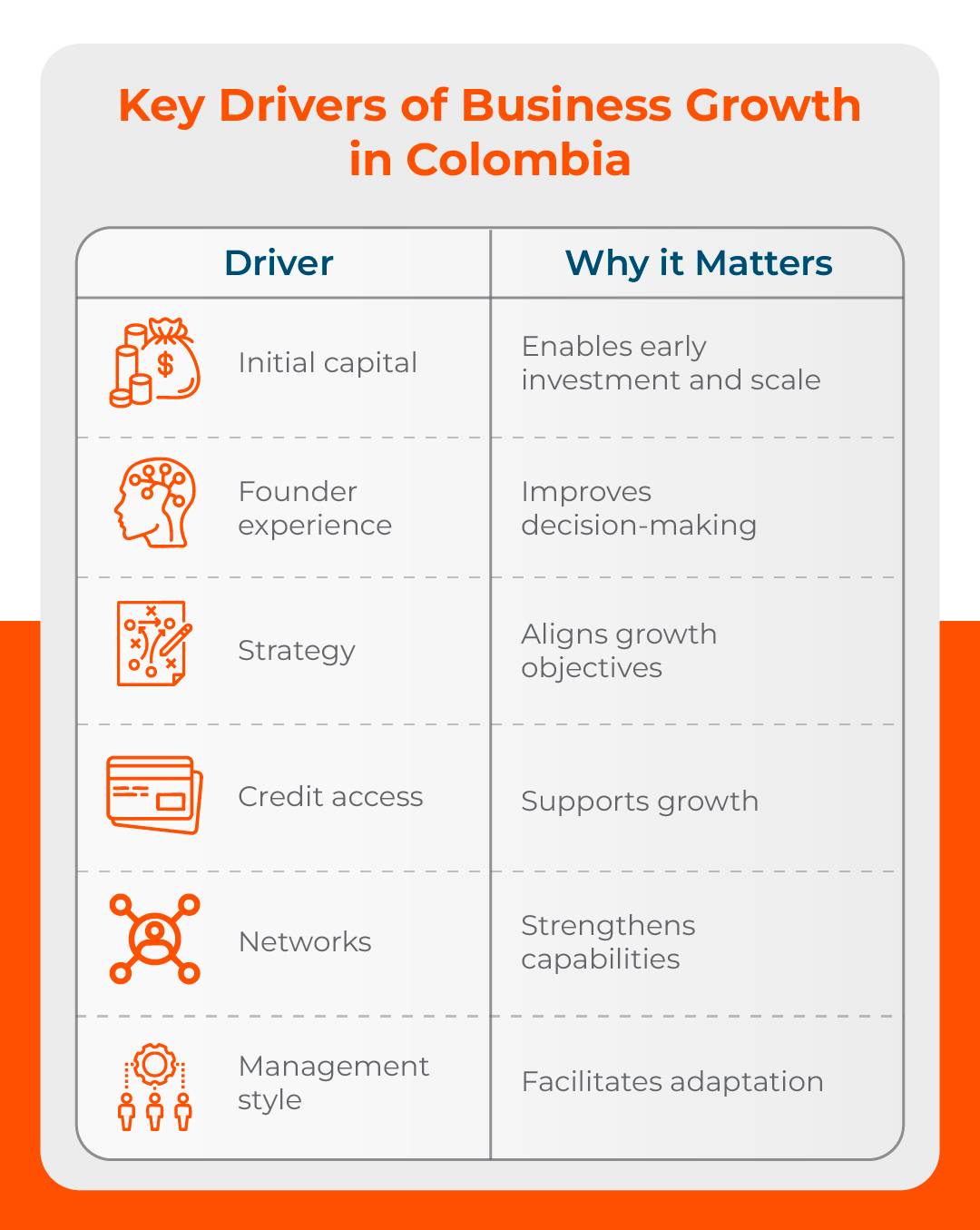
1. Higher Initial Capital
Unsurprisingly, having more capital at launch increases the likelihood of business mobility. More capital allows companies to invest in productive assets, hire qualified personnel, and operate at a larger scale from the start.
In practical terms, firms that start with at least 100 million Colombian pesos (COP) (approximately $26,000) in initial capital are about 9 percentage points more likely, on average, to grow than companies starting with less than half that amount.
The probability of growth rises even further for firms that start with more than 1 billion COP (approximately $266,000), increasing by around 16 percentage points. Conversely, limited access to adequate financing is a major barrier to business mobility, especially for smaller firms.
Overall, the evidence shows that launching with at least 100 million COP in initial capital significantly improves a firm’s chances of growing.
2. Founder’s Previous Entrepreneurial Experience and Business Skills
Entrepreneurs who have previously founded or managed other businesses tend to have higher rates of business mobility. Their knowledge and experience help them navigate challenges and make more effective decisions. Moreover, solid business skills play an important role in the growth of microenterprises.
3. A Clear, Documented Strategy and Growth Mindset
One of the most actionable findings is that having a clear, documented strategy increases the probability of growth by 5 percentage points. Strategic planning helps align internal efforts, set objectives, and structure decision-making, which are crucial for sustained growth. Similarly, businesses that expected to increase their workforce in the first five years were 9 percentage points more likely to move up than those without this growth mindset.
4. Access to Credit Supports Growth, Particularly for Smaller Firms
Firms indicating that access to credit was one of the most important barriers they confronted were 8 percentage points less likely to grow. This was especially true for smaller companies.
5. Strong Networks and Capacity Building
Businesses that belong to associations and industrial clusters, participate in supplier development programs with large companies, and invest in training focused on managerial and technical skills are more likely to grow.
6. Management Styles Combining Structure with Adaptability
The study identified five management styles to characterize Colombian companies. Those that grew tended to have a hybrid management style that combined structure and discipline with continuous improvement processes, allowing them to adapt and capitalize on growth opportunities.
A complex interplay of structural, strategic, and personal or managerial factors shape business mobility in Colombia. Helping more MSMEs not only survive but grow calls for targeted public and private approaches and a clearer understanding of the main barriers they face.
Through the Observatory, we’ll continue building on these insights and delving deeper into the role of managerial capabilities and other factors to help design more effective policies and services to accelerate business mobility.
Authors

Rafael González
Rafael joined IDB Invest in January 2023 and is currently a consultant in the Sustainable Business and MSMEs team within the Advisory division. Before IDB Invest, Rafael worked as a Distribution Executive for the retail and institutional segment in LATAM and US Offshore at Jupiter Asset Management, a London-based asset manager; before this, he was a Financial Services Commercial Officer at the UK Department for International Trade; promoting investment, trade, and technical cooperation between the UK and Colombia, including the analysis of regulatory barriers to market access; and lastly, Rafael worked as an Associate Relationship Manager at Citibank Corporate Banking. Rafael holds a Master's degree in Development Management from the London School of Economics and an undergraduate degree in International Business Administration from Universidad de la Sabana.

Monica Palomino
Monica Palomino is a Development Effectiveness Consultant in the Development Effectiveness Division at IDB Invest. She supports the implementation of the Impact Management Framework, ensuring that IDB Invest operations deliver social, environmental, and economic benefits across Latin America and the Caribbean, with a particular focus on the Andean Region. Previously, Monica worked at Financiera de Desarrollo Territorial (Findeter), Colombia’s national development bank. She holds a Master’s in Public Policy from the London School of Economics and both a Master’s and Bachelor’s in Economics from Universidad de los Andes, Colombia.

Rodolfo Stucchi
Rodolfo Stucchi is Director of Development Impact at IDB Invest. His areas of expertise include development economics, public policy evaluation, and macroeconomics. Rodolfo has extensive experience in portfolio monitoring and management, ex-ante and ex-post economic analysis of public and private sector projects, monitoring and evaluation, impact evaluations, and macroeconomics. Previously, he was Head of Development Impact for the Andean Region and the Southern Cone and Head of Monitoring and Evaluation both at IDB Invest. He also was Senior Economist at the Inter-American Development Bank, consultant for the Inter-American Development Bank and The World Bank, and Economist for the Government of the Province of Córdoba in Argentina. Rodolfo has published numerous papers in peer-reviewed journals, such as the Journal of Development Economics, Journal of Development Studies, Journal of Macroeconomics, The World Bank Economic Review, and Economia, among others. His research focuses on topics related to productivity, employment, innovation, trade, and access to credit. He was also Visiting Professor at Universidad de San Andrés (Argentina), Universidad Católica Boliviana San Pablo (Bolivia), Universidad de Chile (Chile), and Georg-August-Universität-Göttingen (Germany). Rodolfo holds a PhD in Economics from Universidad Carlos III de Madrid (Spain) and a BSc in Economics from Universidad Nacional de Cordoba (Argentina).

Patricia Yañez-Pagans
Patricia Yañez-Pagans is a Principal Economist in the Development Effectiveness Division of IDB Invest. With extensive experience in impact measurement across multiple areas, both in the public and private sectors, she currently leads the work on ex-post evaluation for the IDB Invest portfolio and the impact knowledge agenda. Patricia joined the IDB Group under the Young Professionals Program and served as an Economist in the IDB's Office of Strategic Planning and Development Effectiveness and as Research Fellow for IDB’s Research Department. She has also worked as a consultant for different institutions, such as the World Bank, UNICEF and the Ministry of Development Planning of Bolivia, and as a Professor of Economics at the Universidad Católica Boliviana. Patricia has a Ph.D. in Applied Economics from the University of Wisconsin-Madison, a Master’s in Applied Economics from Pompeu Fabra University, and a Master’s in Social Policy and Development from The London School of Economics and Political Science.
LIKE WHAT YOU JUST READ?
Subscribe to our mailing list to stay informed on the latest IDB Invest news, blog posts, upcoming events, and to learn more about specific areas of interest.
SubscribeFinancial Institutions
Related Posts

How Santander Brasil and Eco Invest Mobilize Private Capital at Scale
IDB Invest provides financing to Banco Santander Brasil to support sustainable agriculture, land restoration efforts, and resilient infrastructure.

S&P’s AAA Rating Validates IDB Invest’s Strength and Strategic Direction
The AAA rating expands the institution's access to a broader investor base, supporting its ability to finance and mobilize private impact investment in Latin America and the Caribbean.

Beyond the Cash Gap: How Reverse Factoring Is Unlocking Growth for MSMEs
An IDB Invest study in Mexico estimates that adopting reverse factoring is associated with a 27% increase in companies' sales.