
How to Measure Job Creation in Development Projects
Development finance institutions need to know how many jobs their investments support and create, yet obtaining reliable data is a challenge. To address this, IDB Invest is piloting a new framework to measure the contribution of development project portfolios to employment in Latin America and the Caribbean.


Job creation is one of the main indicators of a healthy economy. However, in Latin America and the Caribbean, where over half the labor force is informal, creating quality jobs is a significant challenge. Development finance institutions such as IDB Invest are instrumental in addressing this issue by financing projects that drive sustainable growth through the private sector.
Development banks help to unlock employment opportunities that might not otherwise emerge, particularly in underserved sectors and regions. Reliable measurement of employment outcomes is therefore key to effectively capturing this impact. In this context, IDB Invest is piloting a new approach to estimate the direct and indirect jobs supported and created by its portfolio.

Creating and Measuring Private Sector Jobs
Development banks typically want to measure how much their projects contribute to employment, but this is more complex than it may sound. Despite efforts to develop a standardized methodology for measuring job creation, there is currently no universal approach.
Instead, development banks often report related concepts, such as jobs supported or employment sustained by their investments, which are easier to quantify but lack conceptual clarity and scope.
A Pilot Framework to Estimate the Contribution of IDB Invest’s Portfolio to Employment
IDB Invest’s pilot to measure the contribution of its projects to employment draws on client data, country-specific aggregate statistics, and standard economic models. The framework proposes a methodology to estimate both jobs supported and jobs created —direct and indirect.
The methodology estimates contributions to employment at the portfolio level, rather than measuring the impact of each project. Estimating the latter would require rigorous impact evaluations with counterfactual analyses at the project level — essentially, comparing a project’s job effects with the scenario in which it had not existed.
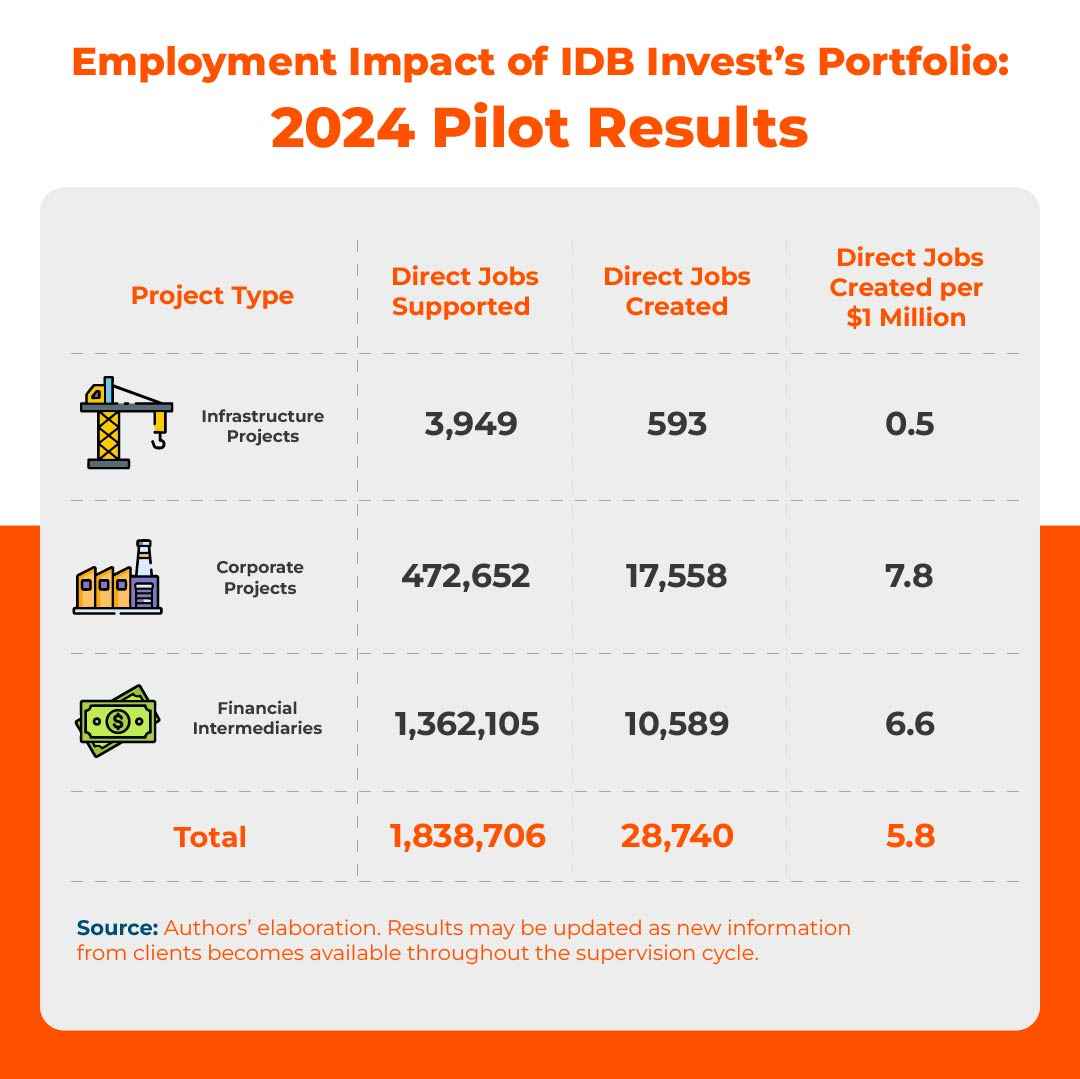
IDB Invest applied the proposed framework to its portfolio of active projects in 2024. It estimated the number of direct jobs supported (defined as the number of employees working within the project, the client company, or the final beneficiaries) and direct jobs created (defined as the number of new employees hired as a direct result of the project).
Pilot Results
The results show that Corporate projects create the most direct jobs, typically through large-scale expansions and scale-ups of established companies. These projects often involve operating new plants, opening new production lines, expanding service offerings, or entering new markets, each driving multiple rounds of recruitment for managerial, technical, and operational jobs.
Similarly, projects through Financial Intermediaries, which enable access to financing for many micro, small, and medium-sized enterprises (MSMEs), also generate a significant uptick in direct employment.
Meanwhile, Infrastructure projects, such as highways, bridges, or wind farms, tend to create relatively few permanent jobs. While they mobilize large workforces during the construction phase and generate indirect employment, long-term staffing needs generally stabilize around small maintenance teams. Additionally, the results show that IDB Invest projects created an average of 5.8 jobs per year for each $1 million invested. This aligns closely with existing research.¹
From Job Quantity to Quality
This framework is a first step towards quantifying how a portfolio of development projects contributes to employment. There is still more work to be done to capture the full spectrum of job effects, such as indirect jobs supported and spillovers across industries. Measuring the quality of jobs in terms of wages, skill requirements, stability, and other factors is also essential.
This pilot aims to propose a standardized approach that can be applied to other development finance institutions facing similar measurement challenges. We encourage the application and refinement of this framework and look forward to ongoing collaboration towards a shared methodology.
For more information see:
Measuring the Contribution of Development Projects to Employment: IDB Invest’s Pilot Framework
DEBrief summarizing the main findings.
- - - -
¹ Figal Garone et al. (2025) estimate that an additional US$1 million in credit to MSMEs in LAC generates 6.5 permanent jobs per year. They also find that this effect is stronger among the fastest-growing firms and for investments in fixed assets. Brown and Earle (2013) report that each US$1 million in loans in the United States created 5.4 jobs, while Brown and Earle (2015) estimate between three and four jobs per million dollars. The Centre for Economics and Business Research (2016) finds a similar multiplier in the United Kingdom. Finally, the IFC (2021) estimates SME loans in developing economies yield 8.15 jobs per US$1 million. See also Arraiz et al. (2014), Chodorow-Reich (2014), Bentolila et al. (2017) and Amamou et al. (2020).
Authors

Lucas Figal Garone
Lucas Figal Garone is Lead Economist of Development Impact for Latin America and the Caribbean at IDB Invest, Inter-American Development Bank (IDB).
He has more than 15 years of experience leading the design, monitoring, and evaluation of public and private sector development projects with the aim of maximizing their impact. He also leads economic analyses, studies, impact assessments, and testing of innovative solutions for the generation and dissemination of knowledge linked to the operational experience of IDB Invest, its clients, and the public-private sector in the region.
Previously, he worked in the Competitiveness, Technology, and Innovation Division, and the Strategic Planning and Development Effectiveness Division at the Inter-American Development Bank (IDB) in Washington, D.C.
Lucas is also Visiting Professor in the Economics Department at the Universidad de San Andrés (UdeSA) and coordinator of the SIDPA productive development initiative.
His areas of expertise and interest include development economics, productive development, impact evaluation, and applied economics. His recent research includes publications in World Development, Regional Science and Urban Economics, Research Policy, The Journal of Development Studies, Small Business Economics, Research in Economics, Journal of Development Effectiveness, Emerging Markets Finance and Trade, IDB WP Series, IDB Invest Development through the Private Sector Series, and chapters in several books.
He holds a PhD in Economics from UdeSA, where he also obtained his Master's degree in Economics, after completing his Bachelor's degree in Economics at the University of Buenos Aires (UBA).

Victoria Luca
Victoria Luca is a Development Effectiveness consultant in the Development Effectiveness Division of IDB Invest, where she supports the evaluation of projects in the manufacturing and agribusiness sectors, as well as the development of knowledge products. Previously, she worked as a research assistant on various projects related to international trade, economic geography, and environmental economics, as well as a policy advisor in the public sector. She holds a Master’s degree in economics from the Universidad de San Andrés in Argentina.

Lucas Navarro
Lucas Navarro is an external consultant in the Development Effectiveness Division of IDB Invest and in the Competitiveness, Technology, and Innovation Division of the IDB. He has worked as an academic in the economics departments of Queen Mary University of London, Universidad Alberto Hurtado (Chile), and Universidad Nacional de Córdoba (Argentina), where he has published in specialized academic journals, such as The Economic Journal, Review of Economic Dynamics, and Economics Letters, among others. He has experience leading research projects in the areas of productive development, productivity, and innovation, and in the intersection of these topics with labor economics. Lucas also has experience in the design, execution, cost-benefit analysis, and impact evaluations of development projects. He holds a degree in economics from the National University of Córdoba and a PhD and Master's degree in Economics from Georgetown University.

Rodolfo Stucchi
Rodolfo Stucchi is Director of Development Impact at IDB Invest. His areas of expertise include development economics, public policy evaluation, and macroeconomics. Rodolfo has extensive experience in portfolio monitoring and management, ex-ante and ex-post economic analysis of public and private sector projects, monitoring and evaluation, impact evaluations, and macroeconomics. Previously, he was Head of Development Impact for the Andean Region and the Southern Cone and Head of Monitoring and Evaluation both at IDB Invest. He also was Senior Economist at the Inter-American Development Bank, consultant for the Inter-American Development Bank and The World Bank, and Economist for the Government of the Province of Córdoba in Argentina. Rodolfo has published numerous papers in peer-reviewed journals, such as the Journal of Development Economics, Journal of Development Studies, Journal of Macroeconomics, The World Bank Economic Review, and Economia, among others. His research focuses on topics related to productivity, employment, innovation, trade, and access to credit. He was also Visiting Professor at Universidad de San Andrés (Argentina), Universidad Católica Boliviana San Pablo (Bolivia), Universidad de Chile (Chile), and Georg-August-Universität-Göttingen (Germany). Rodolfo holds a PhD in Economics from Universidad Carlos III de Madrid (Spain) and a BSc in Economics from Universidad Nacional de Cordoba (Argentina).
LIKE WHAT YOU JUST READ?
Subscribe to our mailing list to stay informed on the latest IDB Invest news, blog posts, upcoming events, and to learn more about specific areas of interest.
SubscribeGender
Related Posts

Digital Innovation Expands Financing for Women-Led SMEs in Latin America and the Caribbean
Loans and disbursements approved in less than 24 hours, enabled by artificial intelligence, and early invoice payments powered by fintech solutions are transforming access to credit for MSMEs, especially those led by women.

Fixing the Broken Rung: How Data Can Help Advance Women’s Careers in Latin America and the Caribbean
In Latin America and the Caribbean (LAC), the greatest disruption in women’s career progression occurs during the transition into managerial roles. A collaboration between IDB Invest and LinkedIn, within the framework of the Development Data Partnership, uses large-scale labor-market data to identify where women’s participation declines and what barriers exist across sectors and career stages.

Addressing gender-based violence from the private sector: the experience of Laboratorios Bagó
Francisco Méndez, CEO of the pharmaceutical company, shares his company's efforts and achievements in fostering an inclusive and safe work environment.