
Cutting-edge Data for Agricultural Resilience: Introducing AGRIADAPT
How can agribusinesses proactively navigate the effects of climate change and become more resilient? By unlocking the potential of data. IDB Invest has created AGRIADAPT, a tool based on cutting-edge agricultural and climate data that provides customized climate vulnerability analysis and adaptation recommendations.


In light of ever more extreme weather events and growing climate impacts, companies in the agricultural space in Latin America and the Caribbean must act now to future-proof their businesses. Climate risks are context-specific, making it imperative to assess them based on each company’s unique characteristics, such as its location, products, value chain position, and production methods.
Doubling down on its commitment to support the region on its climate adaptation journey, IDB Invest leverages the power of data to help clients understand risk and to offer priority technical assistance and finance for adaptation measures.
Connecting the dots to confront the climate crisis
Assessing impacts based on climate change scenarios on a company’s operations is often cumbersome, time-consuming, and resource-intensive; it can be daunting to get started. That is why IDB Invest has leveraged advances in technology to create a new tool: AGRIADAPT.
Based on a suite of cutting-edge data, AGRIADAPT breaks down climate-related impacts to agribusiness operations, such as alterations in crop growth cycles, changes in productivity, damages to facilities, or logistics and business disruptions.
It generates tailored reports for crops and livestock production, as well as for facilities and transportation routes. It also provides site-specific insights into climate impact and prioritizes adaptation measures.
The tool covers the entire territory of Latin America and the Caribbean. It is based on a suite of cutting-edge data, covering the latest global climate models (CMIP6), crop data from the Food and Agriculture Organization (FAO), and over 23,000 datasets and 260 scientific journal articles.
Climate reports leverage Geographical Information System technology to incorporate site-specific input, offering insights into climate-related impacts for 2030, 2050, and 2080, with projections for various plausible futures.
Empowering climate-smart decision making through data
The use cases are plentiful: AGRIADAPT offers both detailed reports for each of the company’s facilities and a summary dashboard for data analysis and management. These outputs allow clients to understand climate vulnerabilities and identify adaptation measures. They also help IDB Invest prioritize technical assistance for adaptation.
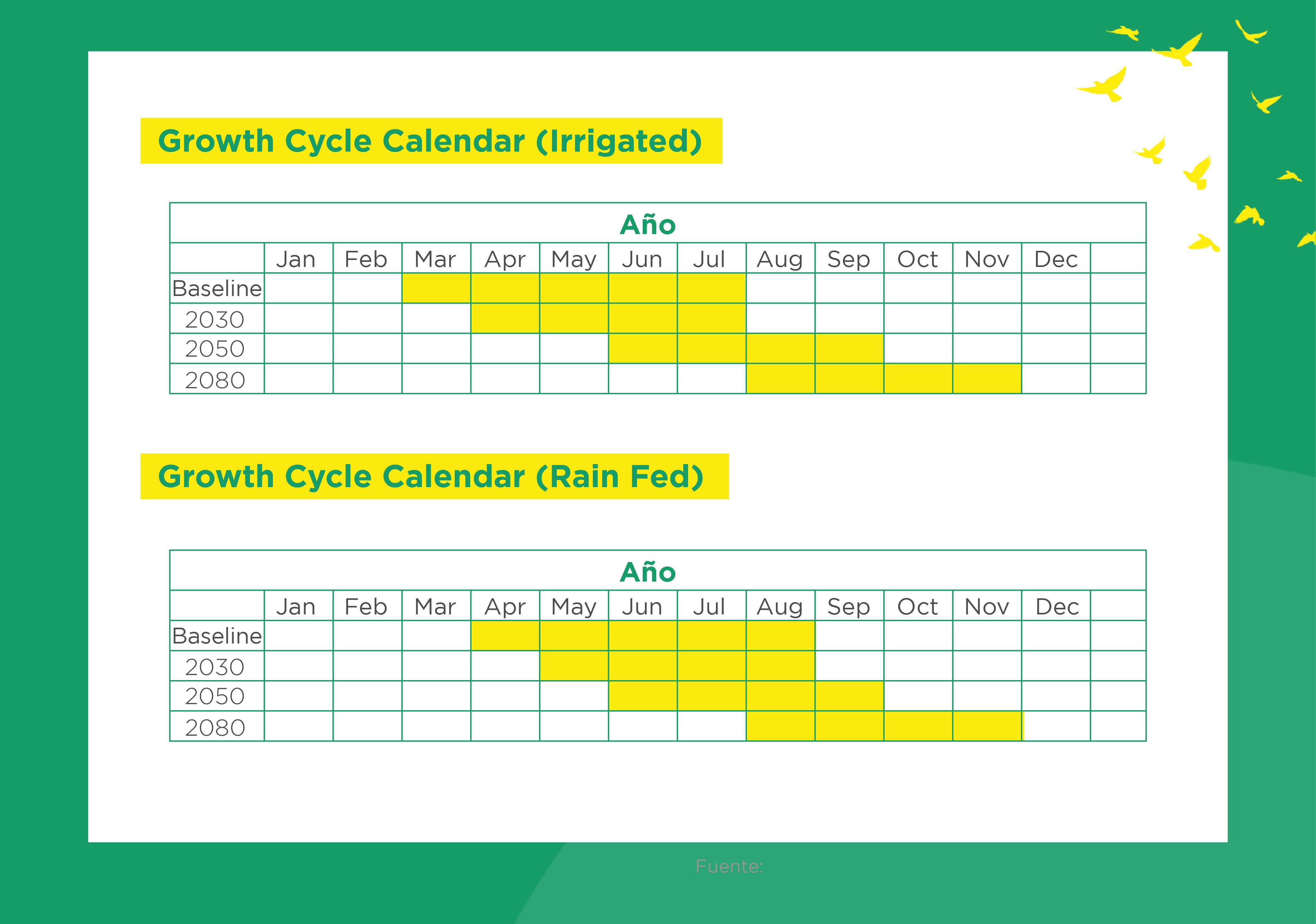
The crops module provides crop-specific data for different irrigation methods on both potential changes in productivity and changes in the growth cycle. These insights can inform company strategy and support risk management.
Figure 1: Illustrative change in growth cycle for different irrigation methods and considering changes from the baseline due to climate change
Climate change also escalates the prevalence of pests and diseases. That is why the AGRIDADAPT crop module shows the projected chemical application rates of the 20 most common chemicals as an indicative measure of pest pressure.
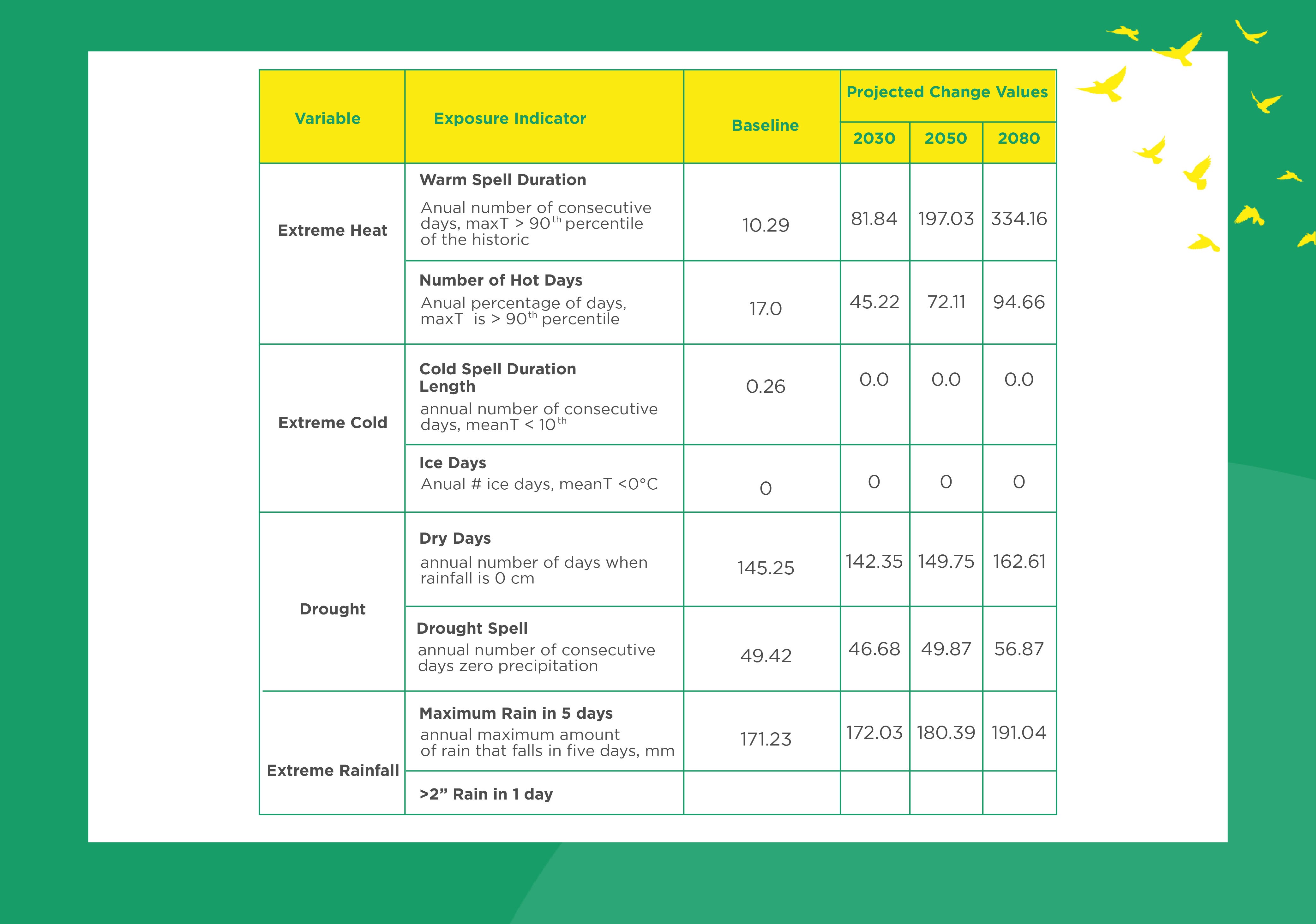
Additionally, segments of the AGRIADAPT tool, such as the natural hazard exposure module (depicted in Figure 2) and the loss and damage estimations due to facility damage and business interruptions, are sector-agnostic.
They can be used, for instance, to understand the exposure of a manufacturing operation to hydrometeorological hazards, both based on historic data and climate change scenarios.
Figure 2: Example of climate change exposure data output
IDB Invest is committed to empowering clients on their resilience journey. Evidence-based and data-informed decision-making is a critical step in navigating climate change and, ultimately, implementing adaptation measures on the ground.
By offering insights, technical assistance, innovative financial solutions, and leveraging the power of cutting-edge data IDB Invest looks forward to playing its part in strengthening the resilience of businesses in Latin America and the Caribbean.
Authors

Camila Rodríguez Taylor
Camila is a Senior Climate Advisor for IDB Invest, working at the Advisory Services Division at IDB Invest. She is responsible for assessing the Paris Alignment of transactions and estimating climate finance. She designs, develops and executes IDB Invest advisory services to help clients adopt climate resilience and decarbonization measures. Before joining the IDB Group, Camila worked in the climate change units of the Ministry of Agroindustry and the Ministry of Environment and Sustainable Development of Argentina. She has more than 15 years of experience in sustainable finance, climate risk and resilience, and decarbonization pathways. Camila holds a master's degree in Environmental Management with a specialization in Climate Change from the School of Environmental Studies at Yale University (USA) and a degree in environmental engineering from the Pontificia Universidad Católica Argentina.

Paula Valencia
Paula Valencia is an environmental and social specialist at IDB Invest, based in Washington, D.C. and she leads the agribusiness group within the Environmental, Social and Corporate Governance Division. She is responsible for evaluating environmental and social impacts and risks of agribusiness operations, proposing mitigation measures consistent with international best practices, supervising the performance and sustainability of projects, offering technical assistance to customers and generating knowledge products. She has extensive experience in the public and private sectors of Latin America and the Caribbean, having worked with the IDB Group for more than 19 years, primarily in agribusiness, financial intermediation, and manufacturing projects. Paula is an Industrial Engineer from the Pontificia Universidad Javeriana (Colombia), she has a master's degree in environmental science and policy from Johns Hopkins University (United States) and other studies in agriculture from Cornell University (United States).

Nora Lambrecht
Nora Lambrecht is a Senior Environmental and Social Officer for Climate Change at IDB Invest. She helps mainstream climate change institutionally and supports clients in managing climate-related risks and impacts. She previously worked in strategy and public affairs, particularly in developing sustainable practices to mitigate climate change and embedding circular economy strategies at Heidelberg Materials. Before working in the materials sector, she gained experience in management consulting, corporate strategy, and at the Council of the European Union. Nora has a graduate degree in economics from Cambridge University and an interdisciplinary background, having also studied energy and climate policy and international relations at SOAS London, UC Berkeley, and University College Maastricht. Nora is alumna of the Global Shapers Community, a World Economic Forum initiative.
LIKE WHAT YOU JUST READ?
Subscribe to our mailing list to stay informed on the latest IDB Invest news, blog posts, upcoming events, and to learn more about specific areas of interest.
Subscribe{{ raw_arguments.field_category_target_id }}
Related Posts

Korea's Cutting-Edge Innovations to Transform Agribusiness in Latin America and the Caribbean
Discover how IDB Invest connects regional agribusinesses with leading innovators in Korea to accelerate smart agriculture, agritech, and sustainable growth.
Digital Transformation Redefines Agricultural Competitiveness in Latin America and the Caribbean
Every time an agricultural company determines when to irrigate, selects what inputs to apply, or decides how to market or transport its production, the use of data and technological solutions becomes a key competitive advantage.

Combating Multidimensional Poverty from the Private Sector Requires Much More Than Jobs
For Danper, a leading Peruvian company in the global agri-food sector, understanding the living conditions of its workers and their families is fundamental to strengthening actions to improve their quality of life.