
How men and women sharing the workload can promote regional growth
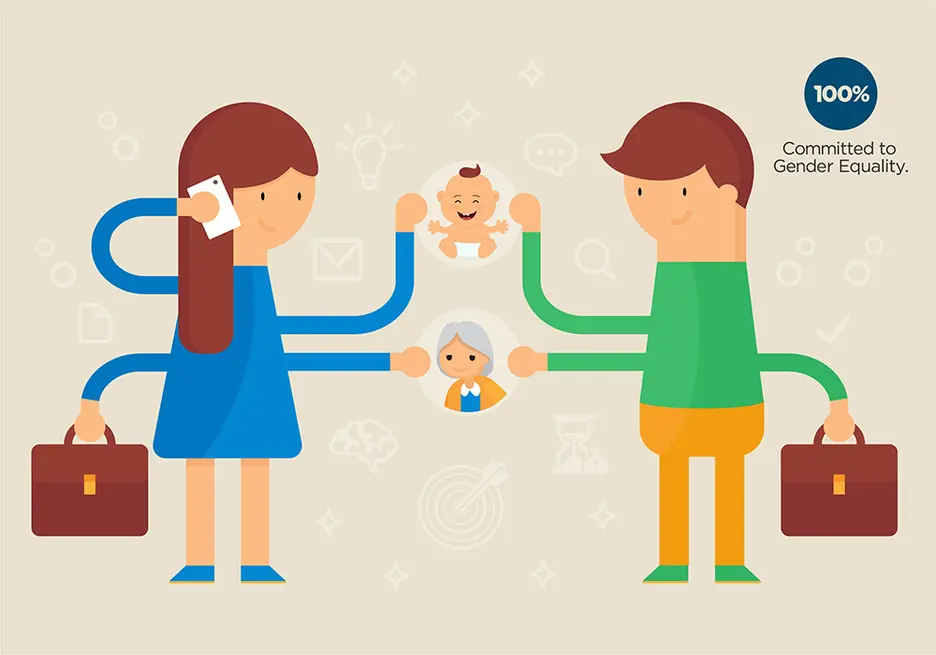
Women do more unpaid work than men, with significant consequences for the economy. From India to Denmark, the pattern is the same. While women invest an average of 4.5 hours per day in unpaid work, men invest barely 1.5 hours. It is estimated that the unpaid work that women do worldwide is equal to $12 trillion a year, or 11% of global GDP for the year 2025.
In the case of small businesses in Ecuador, which we analyzed in a study I published recently, we found that the most important factor explaining the differences between the profitability of companies managed by men and women is precisely the time dedicated to unpaid work: household tasks and caring for children and the elderly.
This does not mean that women work less in their professions than men. In the sample I studied, men and women invest the same number of hours per day and the same number of days per week in their businesses. But women dedicate a larger number of hours to unpaid work in the home and, to a greater extent than men, also tend to perform many tasks at the same time ― multitasking―combining business activities with household work.
There is extensive literature in psychology showing the negative effects of multitasking on performance. The greater the cognitive demand and the effort required to perform a task, the greater these effects. For this reason, we automatically stop talking to our passenger (task 1) when trying to pass a truck on a narrow road or merge onto a highway (task 2).
However, when in the study we compare companies with the same characteristics (age of the business, capital, number of employees, sector of economic activity, age and years of education of the manager, etc.), including the time managers devote to the business and to unpaid work, we see that companies managed by men and women are equally profitable.
This means that there is enormous economic growth potential if we resolve these disparities. Companies led by women in Latin America and the Caribbean could be an engine of growth for the region if men and women shared household tasks in a more balanced way, but it is difficult to imagine this change happening from one day to the next.
On International Women’s Day we want to emphasize the importance of gender equality in the productivity of the region’s companies. Each of us has the task of contributing to this change. At IDB Invest, along with the Inter-American Development Bank, we have been working for more than a year on our campaign 100% Committed to Gender Equality, in which we have explored how public and private sector projects become more productive when they invest in equality.
Similarly, at IDB Invest, we have created instruments, like the Women’s Empowerment Principles Gender Gap Analysis Tool (WEPs business gender tool); knowledge products, like our study “The Power of Gender Equality in the Workplace;” and we provide advisory services to help companies improve their gender equality standards. The time for sharing the burden is now and it is key to the growth of our region.
Subscribe to receive more content like this!
[mc4wp_form]

Women do more unpaid work than men, with significant consequences for the economy. From India to Denmark, the pattern is the same. While women invest an average of 4.5 hours per day in unpaid work, men invest barely 1.5 hours. It is estimated that the unpaid work that women do worldwide is equal to $12 trillion a year, or 11% of global GDP for the year 2025.
In the case of small businesses in Ecuador, which we analyzed in a study I published recently, we found that the most important factor explaining the differences between the profitability of companies managed by men and women is precisely the time dedicated to unpaid work: household tasks and caring for children and the elderly.
This does not mean that women work less in their professions than men. In the sample I studied, men and women invest the same number of hours per day and the same number of days per week in their businesses. But women dedicate a larger number of hours to unpaid work in the home and, to a greater extent than men, also tend to perform many tasks at the same time ― multitasking―combining business activities with household work.
There is extensive literature in psychology showing the negative effects of multitasking on performance. The greater the cognitive demand and the effort required to perform a task, the greater these effects. For this reason, we automatically stop talking to our passenger (task 1) when trying to pass a truck on a narrow road or merge onto a highway (task 2).
However, when in the study we compare companies with the same characteristics (age of the business, capital, number of employees, sector of economic activity, age and years of education of the manager, etc.), including the time managers devote to the business and to unpaid work, we see that companies managed by men and women are equally profitable.
This means that there is enormous economic growth potential if we resolve these disparities. Companies led by women in Latin America and the Caribbean could be an engine of growth for the region if men and women shared household tasks in a more balanced way, but it is difficult to imagine this change happening from one day to the next.
On International Women’s Day we want to emphasize the importance of gender equality in the productivity of the region’s companies. Each of us has the task of contributing to this change. At IDB Invest, along with the Inter-American Development Bank, we have been working for more than a year on our campaign 100% Committed to Gender Equality, in which we have explored how public and private sector projects become more productive when they invest in equality.
Similarly, at IDB Invest, we have created instruments, like the Women’s Empowerment Principles Gender Gap Analysis Tool (WEPs business gender tool); knowledge products, like our study “The Power of Gender Equality in the Workplace;” and we provide advisory services to help companies improve their gender equality standards. The time for sharing the burden is now and it is key to the growth of our region.
Authors

Irani Arraiz
Irani Arráiz es economista en la División de Efectividad en el Desarrollo de BID Invest. Sus áreas de experticia incluyen evaluación de políticas y finanzas y desarrollo del sector privado. Ha publicado varios artículos en revistas académicas internacionales relacionados con la efectividad de programas destinados a aumentar la competitividad del sector privado en América Latina. Antes de BID Invest, Irani trabajó en el Fondo Multilateral de Inversiones y en la Oficina de Evaluación y Supervisión del BID. Irani tiene un Ph.D. en Economía de la Universidad de Maryland en College Park, la designación de CFA, y un MBA del Instituto de Estudios Superiores de Administración en Venezuela. Irani se graduó con honores como ingeniero electrónico en la Universidad Simón Bolívar en Caracas.
LIKE WHAT YOU JUST READ?
Subscribe to our mailing list to stay informed on the latest IDB Invest news, blog posts, upcoming events, and to learn more about specific areas of interest.
SubscribeFinancial Institutions
Related Posts

Sustainable Financing for Construction in Mexico: Banco Inmobiliario Mexicano’s Framework
A sustainable financing framework to strengthen Mexico’s construction sector and help reduce the country’s housing deficit.

Governance and Succession: Securing the Future of Mexico’s Nonbank Financial Institutions
IDB Invest study: key findings and a roadmap to strengthen governance and CEO and senior management succession planning in nonbank financial institutions (NBFIs).

Facing the Storm: How IDB Invest Supports Caribbean Private Sector Resilience
IDB Invest is partnering with the Green Climate Fund to help Caribbean businesses better withstand future climate shocks through blended finance and technical assistance.