
World Cup Legacy: What It Leaves for the Creative Economy in Latin America and the Caribbean
The tournament strengthens the creative industries ecosystem, building the momentum for investment in the businesses that power digital content, media, and intellectual property across the region.


Every four years, the World Cup stops the planet. Stadiums fill. Streets empty. And for a few weeks, football becomes the world's shared language. But when the final whistle blows and the last fan heads home, what actually stays?
In Latin America and the Caribbean (LAC), we tend to measure the legacy of sporting mega-events in terms of infrastructure and tourism. Yet the World Cup also energizes a broader ecosystem of businesses built around content, media, intellectual property, and consumer experiences. Together, they form a creative economy that is increasingly viewed as an investable asset class with significant growth potential.
Sports are part of the cultural and creative industries that drive demand for branding, licensing, merchandising, music, film, fashion, digital content, and large-scale audience engagement. Creative industries already generate $124 billion annually – 2.2% of regional GDP and 1.9 million jobs. For IDB Invest, the opportunity lies in helping more of these businesses access the capital needed to grow, export, and expand across markets.
Sportainment: The Industry Behind the Industry
There's a term gaining traction in boardrooms from São Paulo to Mexico City: sportainment. It describes the convergence of sports with entertainment, media, technology, and culture; an ecosystem where the match is just beginning.
Audiences, creators, brands, broadcasters, and platforms all participate in a value chain that starts long before the players step onto the field. Globally, the sports market – media rights, sponsorships, match-day revenues, and licensing – is projected to reach $600 billion by 2030, with broader estimates including sports tourism, technology, and associated services reaching approximately $1.8 trillion annually.
Latin America and the Caribbean Has the Assets but Lacks the Architecture
The region's sports talent is globally recognized. Its cultural output – music, visual arts, storytelling – is world-class. Its fan base is passionate and digitally engaged. These strengths position LAC to capture a greater share of the value generated by sports-related content, media, and intellectual property (IP).
Yet LAC accounts for only around 1% of global creative exports. The region continues to face familiar challenges, including fragmented policy frameworks, limited access to financing for intangible assets, weak data infrastructure, and a creative workforce in which 24% of workers are informal.
IDB Group has spent more than a decade building the playbook to address those challenges. More than 126 operations supporting cultural and creative industries components across 24 countries – totaling over $2.5 billion – have demonstrated what works: digital skills development, export promotion platforms, creative cluster finance, and public-private partnerships that connect talent to markets.
Where Private Investment Comes In
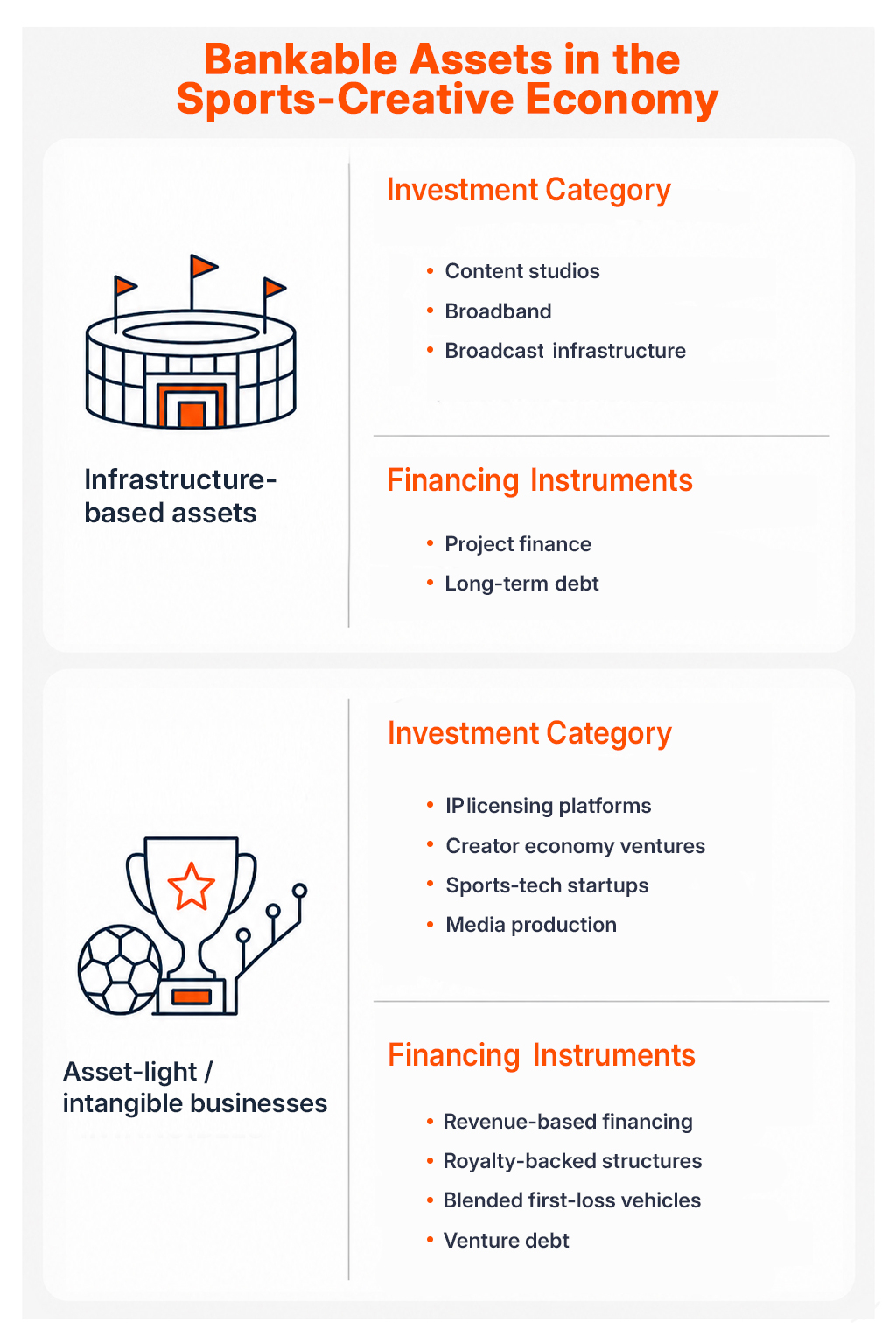
IDB Invest sees the sports-creative economy as a compelling investment thesis across a diverse portfolio of bankable assets.
Sports infrastructure, digital content platforms, sports technology companies, audiovisual production hubs, and creative licensing businesses all represent investment opportunities. Multilateral development banks are increasingly converging around this view, and IDB Invest is positioned to lead that agenda in LAC.
Consider the kinds of deals that connect sports to the broader creative economy: an animation studio producing sports content for streaming platforms; a sports-tech firm developing performance analytics tools; a music company building an official soundtrack ecosystem for a league; a fintech platform enabling creative freelancers in sports media to access working capital. These are already happening across the region, often without the structured investment vehicles to scale them.
After the World Cup: What Comes Next?
Mega-events like the World Cup create a rare window. They compress attention and investment. Infrastructure gets built, brands activate at scale, and creative sectors experience a surge in demand and visibility. The risk is that the window closes and the legacy fades.
And for LAC, that opportunity has never been more concrete. Mexico co-hosted the FIFA World Cup in 2026. Argentina, Uruguay, and Paraguay will open the 2030 edition. For the first time in history, the region hosts back-to-back World Cups – a compressed, once-in-a-generation window to build something that outlasts the tournament. Countries that have used major sporting events strategically have emerged with stronger creative ecosystems, not just renovated stadiums. The United Kingdom after the 2012 Olympics is one example. LAC now has that same chance, twice over.
When the World Cup trophy is lifted and billions are watching, the real measure of success for LAC lies in how many creative businesses are financed, how many digital jobs are created, and how many homegrown IP assets are built and exported.
That is the legacy of a thriving sports-creative ecosystem, one that continues to generate value through content, jobs, exports, and cultural identity long after the final whistle blows.
Authors

Guillermo Mulville
Guillermo leads the Telecommunications, Media and Technology (TMT) Team at IDB Invest, which he joined in 2016. He is responsible for developing business strategies and plans, and for managing clients and structuring the transactions of the TMT sector in Latin America and the Caribbean. Before joining the IDB Group, he worked at the International Finance Corporation (IFC) for more than nine years, as Head of the TMT sector for Latin America and the Caribbean. He previously worked at ABN AMRO Bank for 12 years. He was Enron International’s Global Finance Manager for two years. He served as board member of Pan-African and Pan- American companies engaged in broadband and cell tower distribution and infrastructure, with portfolios in various countries in Latin America and the Caribbean. Guillermo earned a master’s degree in finance from Universidad del CEMA and a professional degree in business administration from Universidad de San Andrés (both in Argentina).

Eliana Prada
Eliana is a specialist in the creative economy in the IDB's Competitiveness, Technology and Innovation Division. Since 2018, she has been responsible for designing and implementing creative economy components through an intersectoral approach. She has more than 15 years of experience strengthening creative, entrepreneurial, and innovation ecosystems in Latin America and the Caribbean. Eliana has coauthored several publications on the creative and cultural industries as drivers of employment generation, social inclusion, and urban development. Her educational background includes postgraduate studies at Harvard Business School in public policy and digital transformation, as well as a master's degree in public relations and communications from Georgetown University in the United States.
LIKE WHAT YOU JUST READ?
Subscribe to our mailing list to stay informed on the latest IDB Invest news, blog posts, upcoming events, and to learn more about specific areas of interest.
SubscribeDevelopment Impact
Related Posts

Sustainability Week 2026: Choose Your Free Sessions on business innovation and entrepreneurship
Business and knowledge come together at Sustainability Week 2026. Discover our virtual sessions on business innovation and entrepreneurship. Register today.
Corporate Governance: Practical Sessions, from Family Business to AI Oversight
Strong governance is the bridge between business strategy and tangible results. At Sustainability Week 2026 in Barbados, join free training sessions on family governance, AI oversight, and SOE continuity, available online on May 25.
Not Impact Measurement. Impact
MDBs are pioneering a new profession for results in a data-rich world. This blog was originally posted by the World Bank on April 21, 2026, by the Heads of Outcome Measurement of Multilateral and Bilateral Development Agencies, including IDB Invest.