
How to Create Jobs in the Caribbean: From Payment Delays to Payroll Growth
Discover a pathway that speeds up payments, unlocks cash flow, and empowers Caribbean entrepreneurs to take more orders and hire.


During one of my rotations in the Caribbean, I worked with a furniture maker who won a hotel contract in another country in the region. She delivered to the port on time. The invoice went out. Then nothing. The wire transfer was initiated in week two, the currency conversion in week three, and the compliance checks in week four.
By the time the payment cleared, she had already turned down two new orders because she could not take on any more unpaid work. Those orders would have let her hire an apprentice. Instead, the apprentice stayed unemployed. This story repeats thousands of times every month across the Caribbean.
What if we could create a different reality? Imagine settlement in minutes instead of weeks. The furniture maker takes both contracts, hires the apprentice, and the apprentice starts earning. The region gains two jobs, not zero. We can achieve that reality by engineering prosperity through faster payments, stronger cash flow, and policies that turn effort into earnings.
Rethinking Jobs in the Caribbean
The old industrial model assumed large employers and lifetime employment. Most Caribbean economies are relatively small, and firms are much smaller than those in larger markets. Expecting factories with thousands of people is generally unrealistic in this context.
People still want stable payroll jobs. The fastest way to create those jobs? Make it radically easier for someone with the skills or ambition to earn their first formal paycheck. A landscaper who wins a resort contract today could employ five people within three years. A coder who sells an app this month could hire two developers by next year.
Jobs are the outcome. The input is more people earning faster. That means faster payments, stronger cash flow, and policies that reduce friction between talent and first revenue. Clear the runway, create the jobs.
Expanding the Notion of "Jobs"
Economic agency means having the practical ability to turn effort into earnings through market participation. Governments can track this progress using key indicators derived from existing data in their systems.
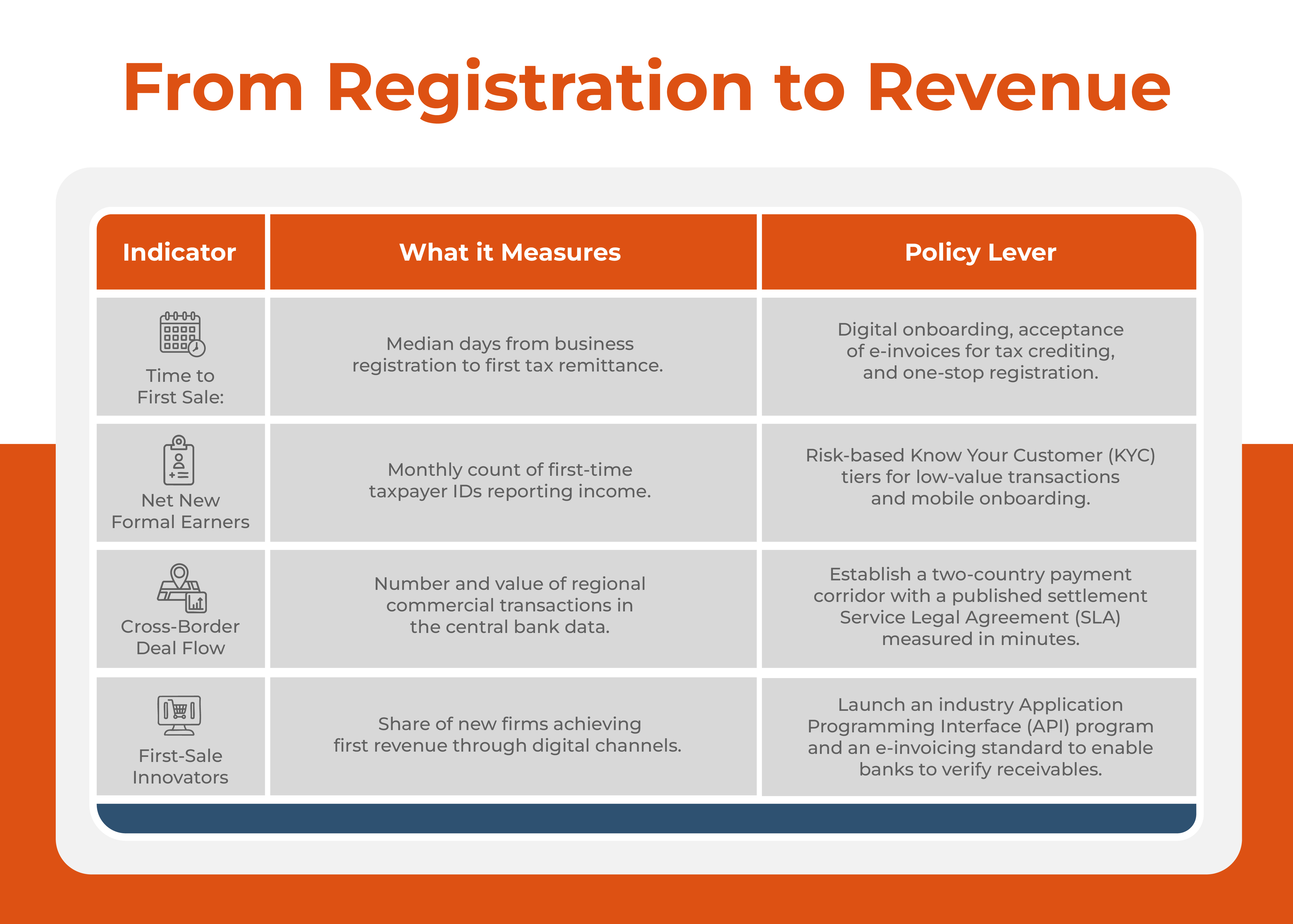
These indicators already exist in tax systems, banking data, and customs records. Publishing them monthly would focus policy on what matters: people's earnings.
Building on Payment Modernization Efforts
The region has strong foundations in payment modernization. The Bahamas upgraded its real-time gross settlement system and published its Fast Payments Implementation Roadmap.
The Eastern Caribbean Central Bank (ECCB) operates the Eastern Caribbean Automated Clearing House (ECACH) and has active modernization programs for retail payments.
Jamaica operates JamClear Real-Time Gross Settlement (RTGS) and is migrating to ISO 20022. The building blocks exist. They need to be wired into a cross-border commercial highway that unlocks working capital.
The IDB Group has also introduced IDB Pay, a new initiative to expand access to digital payment systems across Latin America and the Caribbean. Its goal is to accelerate the adoption of real-time, affordable digital payments and help countries develop interoperable Fast Retail Payment Systems (FRPS), which are essential to ensuring that different payment platforms can work together smoothly.
In this effort, IDB Invest actively supports the development and implementation of modern payment solutions across Latin America and the Caribbean. Through investments, technical assistance, and partnerships with financial institutions and fintechs.
The Immediate Build Order for Fast Payments in the Caribbean
Contract-to-Cash Highway: A great pilot could begin with two countries to build infrastructure that combines e‑invoicing, instant settlement, and receivables financing through portfolio guarantees. In such a setup, a purchase order could turn into collateral on Monday and enable access to working capital on Tuesday. The goal: to cut median contract‑to‑cash times and unlock millions in working capital for thousands of SMEs.
Go through the State: Skip privatization battles. Structure targeted partnerships where private operators upgrade specific segments while states retain ownership. Set public KPIs (tariff glide paths, uptime targets, clearance times) and report quarterly. The arrangements at Grantley Adams International Airport demonstrate that this model works.
Finance at Scale: Replace one-off projects with three-year pipelines of bankable deals. Publish a public deal scoreboard and monthly working-capital volumes. Development finance institutions stand ready to support these pipelines.
Tie Money to Capability: Financing should include basic governance upgrades, lightweight technology adoption, export-readying activities, and a first-sale milestone that unlocks better terms. With this approach, we have a better chance of changing firms' DNA to foster a more vibrant economy and create new opportunities.
Before the skeptics start. . .
"People want stable jobs, not gigs": Right. Faster settlement improves cash flow. Better cash flow enables more orders. More orders mean permanent hires. Every employer started with their first sale.
"This is pie in the sky – too advanced for our markets": The Bahamas has instant settlement infrastructure. The ECCB has technical rails. Start with a sandbox: two countries, low-value caps, existing rails, a small operations team, and clear SLAs.
"This is backdoor privatization": States keep ownership. Private partners upgrade specific functions under transparent performance contracts with published prices. Many such arrangements maintain public ownership while improving service. We have several creative options to address this concern.
"Integration takes decades": Start bilateral. Set transaction caps. Publish settlement targets. Scale the proof of concept. This incremental approach succeeds where grand schemes failed.
Action‑forward
The first step could involve two countries: connecting payment systems with a commercial wrapper, setting a rapid‑settlement threshold for invoices, and opening a guaranteed window to allow banks to discount corridor invoices at affordable rates while publishing monthly uptakes. Weekly tracking could focus on transactions processed, settlement times, working capital unlocked, and new hires by participating firms.
The real measure of success would not be in these statistics anyway, but in the conversations that change. When a young graduate stops asking about visa applications and starts asking about business registration. When a parent stops worrying about remittances and starts celebrating their child's first local hire. That’s when we know the architecture is working.
Authors

Musheer Kamau
Musheer is senior advisor for strategy and blended finance at IDB Invest, where he leads strategic initiatives to mobilize private capital and to revitalize dormant programs into active deployment vehicles. Previously, as principal specialist in the Caribbean Country Department, he spent nearly 20 years designing frameworks for infrastructure finance, faster payment systems, and working capital solutions for small and medium-sized enterprises (SMEs).
LIKE WHAT YOU JUST READ?
Subscribe to our mailing list to stay informed on the latest IDB Invest news, blog posts, upcoming events, and to learn more about specific areas of interest.
SubscribeDevelopment Impact
Related Posts

Supporting Argentine SMEs: Financing for Working Capital and Investment
IDB Invest is helping strengthen Argentina's private sector through long-term financing and reverse factoring solutions that improve small and medium-sized enterprises' access to liquidity.

Three Takeaways From our 2026 Impact Report
Learn how IDB Invest's portfolio is performing on development impact.

WE Finance Code Colombia: Data and Partnerships to Expand Financing for Women-Led Businesses
Financial sector stakeholders across Colombia are joining forces to expand women entrepreneurs’ access to credit through data, collaboration, and financial solutions tailored to their needs.