
Does Credit Access Create Jobs? New Evidence from 30 Countries in Latin America and the Caribbean
A new IDB Invest study measures how $1 million in credit translates into new jobs for MSMEs across the region.

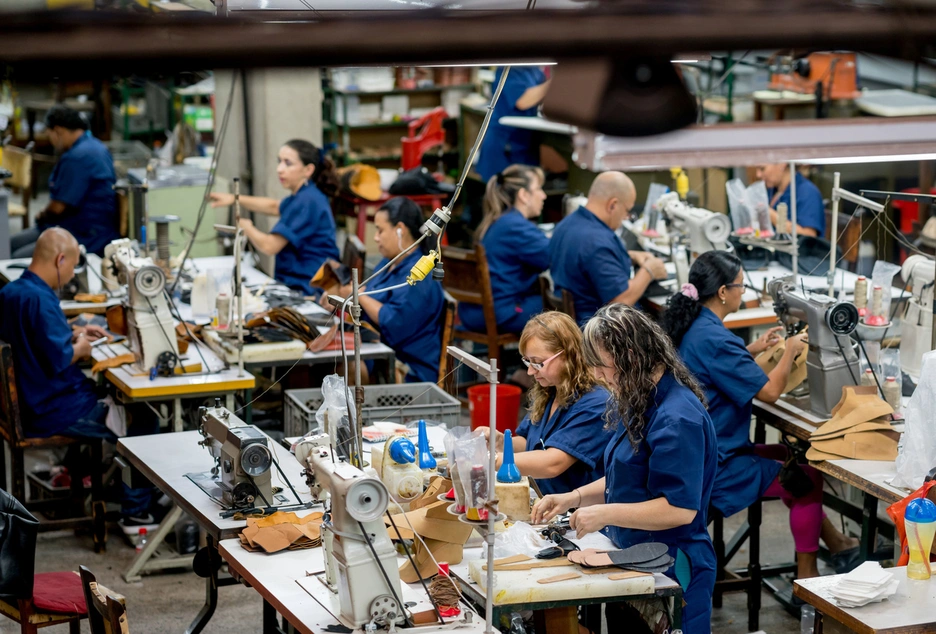
Latin American and Caribbean (LAC) economies typically have a dual structure, where many small firms with low productivity, limited growth, and high informality coexist alongside a small number of larger, formal, highly productive, and fast-growing firms. How can this gap be bridged?
A new IDB Invest study suggests that access to credit plays a larger role, revealing that every additional $1 million in credit is associated with four new permanent jobs among micro, small, and medium-sized enterprises (MSMEs) in the region.
Development Challenges of MSMEs in LAC
MSMEs represent 99% of all firms and employ two-thirds of the labor force. Despite their pivotal economic role, most MSMEs are trapped in a vicious cycle of low productivity, limited growth, and minimal creation of formal, productive jobs.
To better understand these challenges, IDB Invest has carried out a series of studies on firm productivity, growth, and employment. Here’s a quick recap:
Low Productivity
An IDB Invest study explores the prevailing productivity differences in the region, with three key findings:
- There are significant differences between the most and least productive firms in the same sector.
- Productivity differences persist over time.
Most aggregate productivity growth comes from improvements within existing firms, rather than from firm entry or exit.
Limited Growth
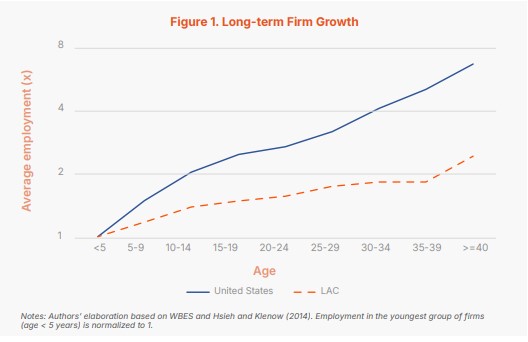
Another IDB Invest study replicates the analysis by Hsieh and Klenow (2014) on long-term firm growth, finding that:
- In LAC, firms tend to remain small even after decades of operation. While in the U.S., the average 40-year-old firm employs more than seven times as many workers as a newly established firm. In LAC, MSMEs show significantly slower growth, only doubling in size over the same 40-year period.
- This growth differential persists across firms of all ages. It is most pronounced in the mid-to-late stages of a firm’s lifecycle, signaling barriers to scaling rather than entry alone.
The flatter age–size profile of LAC firms suggests fewer scale-ups and/or many small firms surviving without growing.
High Levels of Informality
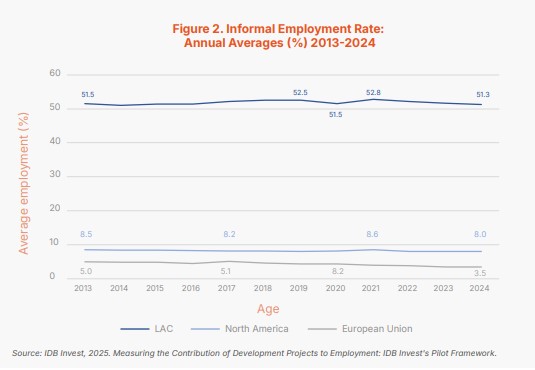
To explore employment trends in the region, an IDB Invest study analyzes key labor market indicators, showing that:
- The pandemic further weakened labor market participation, which, as of 2024, remained below pre-pandemic levels, and increased unemployment.
- Despite significant cross-country variation in labor market conditions across the region, all LAC countries exhibit persistently high levels of labor informality.
Barriers to MSME Growth
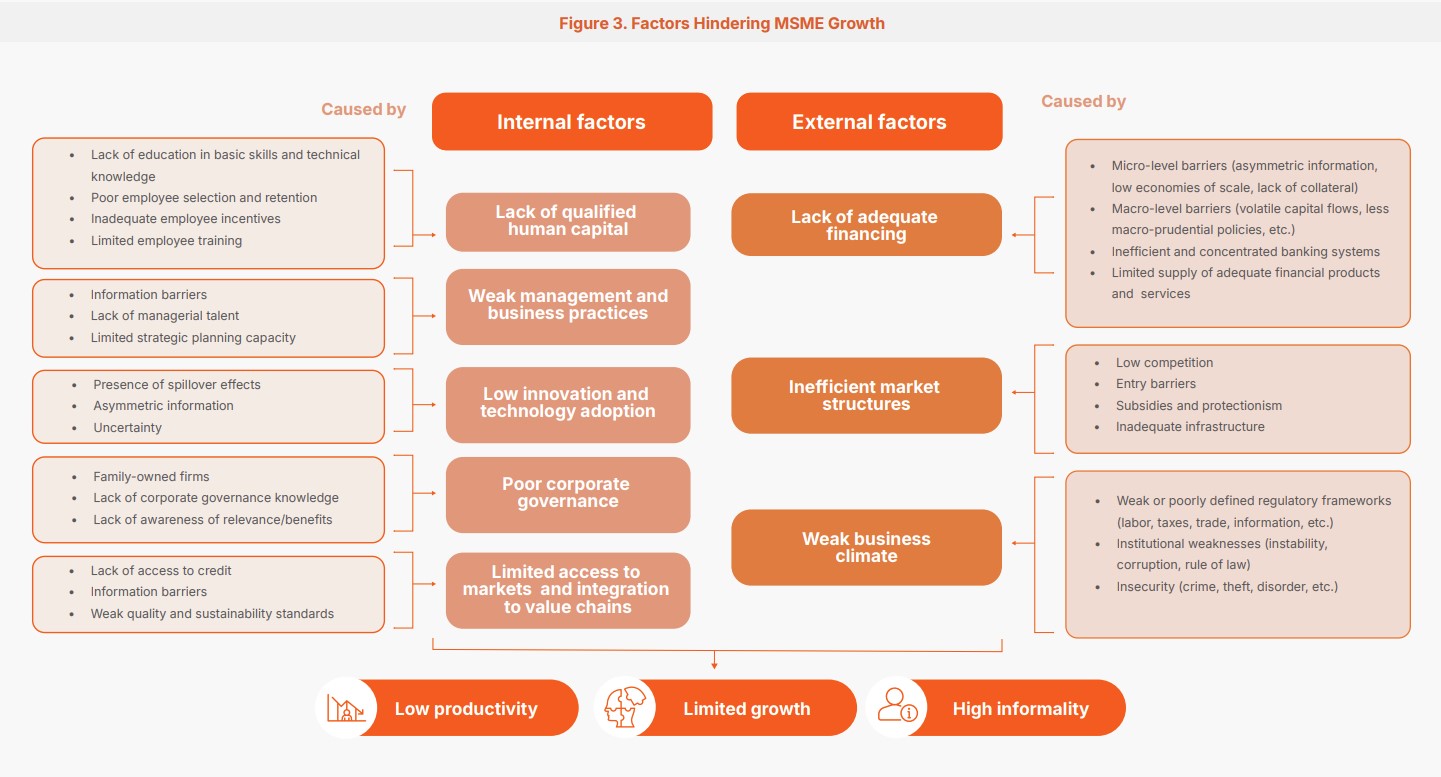
MSMEs face a web of mutually reinforcing internal and external factors that hinder them from reaching their full potential. Firm-level constraints and weak capabilities are amplified by market failures, information asymmetries, and institutional shortcomings, resulting in low productivity, limited growth, and persistent informality.
Can Access to Credit Help Break This Cycle?
One of the main barriers to growth is limited access to finance. At an estimated $1 trillion, the region’s MSME finance gap is the second largest in the world.
Among LAC firms, 75% consider access to finance a constraint on their operations, with 12% identifying it as their most significant obstacle.
Adequate financing is critical for alleviating liquidity constraints, enabling capital investment, facilitating technology adoption, and supporting innovation.
Improved access to finance not only promotes firm growth but also expands opportunities for generating higher-quality and more productive employment across the economy.
More Credit for MSMEs, More Employment?
Establishing causal links between access to finance and economic performance is challenging given the many factors at play, and evidence from LAC is still limited.
To contribute to the evidence, IDB Invest conducted a new study to estimate the relationship between access to credit and employment, using firm-level data from 21,696 firms across 30 countries in LAC.
The results indicate a positive association between access to credit and employment outcomes. On average, for MSMEs in LAC, an additional $1 million in credit is associated with the creation of 4 permanent jobs per year. These results are equivalent to an annual employment increase of about 8%.
The impact is not uniform. Employment effects are strongest for smaller and faster-growing firms, especially when credit is recent, used to finance fixed assets rather than working capital, and provided in more competitive banking sectors.
Recognizing these distinctions is essential not only for increasing employment but also for promoting higher-quality, more productive jobs that strengthen firm competitiveness and support long-term development outcomes.
Authors

Celina Camilletti
Celina is a development effectiveness consultant in the Development Effectiveness Division at IDB Invest. She contributes to the development of knowledge products related to IDB Invest operations, as well as to the collection and analysis of data on micro, small, and medium-sized enterprises, employment, and access to credit. Before joining IDB Invest, Celina worked as a research assistant on projects related to international trade, tourism, and environmental economics, and gained experience as technical staff at public-sector institutions. Celina holds a bachelor’s degree in economics from the National University of La Plata, Argentina, and is currently completing a master’s degree in economics at the same university.

Lucas Figal Garone
Lucas Figal Garone is Lead Economist of Development Impact for Latin America and the Caribbean at IDB Invest, Inter-American Development Bank (IDB).
He has more than 15 years of experience leading the design, monitoring, and evaluation of public and private sector development projects with the aim of maximizing their impact. He also leads economic analyses, studies, impact assessments, and testing of innovative solutions for the generation and dissemination of knowledge linked to the operational experience of IDB Invest, its clients, and the public-private sector in the region.
Previously, he worked in the Competitiveness, Technology, and Innovation Division, and the Strategic Planning and Development Effectiveness Division at the Inter-American Development Bank (IDB) in Washington, D.C.
Lucas is also Visiting Professor in the Economics Department at the Universidad de San Andrés (UdeSA) and coordinator of the SIDPA productive development initiative.
His areas of expertise and interest include development economics, productive development, impact evaluation, and applied economics. His recent research includes publications in World Development, Regional Science and Urban Economics, Research Policy, The Journal of Development Studies, Small Business Economics, Research in Economics, Journal of Development Effectiveness, Emerging Markets Finance and Trade, IDB WP Series, IDB Invest Development through the Private Sector Series, and chapters in several books.
He holds a PhD in Economics from UdeSA, where he also obtained his Master's degree in Economics, after completing his Bachelor's degree in Economics at the University of Buenos Aires (UBA).

María Laura Lanzalot
María Laura Lanzalot is the Development Effectiveness Officer of IDB Invest in Argentina. María Laura supports the identification, design, monitoring and evaluation of projects and investments in order to maximize their impact on economic, social and environmental development, with a focus on projects with financial institutions. Additionally, she contributes in the implementation of economic analysis, impact evaluations and testing of innovative solutions. Previously, she worked in the Department of Development Effectiveness in Washington DC. Her areas of interest are economic development, financial inclusion and applied economics. She has a master's degree in economics from the Universidad de San Andrés (UdeSA) and a bachelor's degree in economics from the University of Buenos Aires (UBA).

Victoria Luca
Victoria Luca is a Development Effectiveness consultant in the Development Effectiveness Division of IDB Invest, where she supports the evaluation of projects in the manufacturing and agribusiness sectors, as well as the development of knowledge products. Previously, she worked as a research assistant on various projects related to international trade, economic geography, and environmental economics, as well as a policy advisor in the public sector. She holds a Master’s degree in economics from the Universidad de San Andrés in Argentina.
LIKE WHAT YOU JUST READ?
Subscribe to our mailing list to stay informed on the latest IDB Invest news, blog posts, upcoming events, and to learn more about specific areas of interest.
SubscribeGender
Related Posts
Digital Innovation Expands Financing for Women-Led SMEs in Latin America and the Caribbean
Loans and disbursements approved in less than 24 hours, enabled by artificial intelligence, and early invoice payments powered by fintech solutions are transforming access to credit for MSMEs, especially those led by women.

Fixing the Broken Rung: How Data Can Help Advance Women’s Careers in Latin America and the Caribbean
In Latin America and the Caribbean (LAC), the greatest disruption in women’s career progression occurs during the transition into managerial roles. A collaboration between IDB Invest and LinkedIn, within the framework of the Development Data Partnership, uses large-scale labor-market data to identify where women’s participation declines and what barriers exist across sectors and career stages.

Addressing gender-based violence from the private sector: the experience of Laboratorios Bagó
Francisco Méndez, CEO of the pharmaceutical company, shares his company's efforts and achievements in fostering an inclusive and safe work environment.