
The Caribbean: A Private Sector’s Challenge to Increasing Productivity and Growth – Part I
New technologies and big data are increasing the demand for skills, including digital skills and high-level cognitive skills. Caribbean private sector can influence the types of skills it needs from its workforce and play an active role in increasing productivity and competitiveness in the region - and globally.


Evidence suggests that low skills in the workforce make it difficult for firms to innovate and that significant investments in skills development are needed to reduce the productivity gap (AfDB, ADB, EBRD, and IDB, 2018). In the Caribbean, firms have consistently identified “an inadequately educated workforce” as their most serious obstacle to improving performance, even when unemployment rate in Caribbean stands at 8% (which means that 1.5 million women and men in the region do not receive any income from employment).
Upon statistical analysis of more than 100 countries and 150 variables related to all sectors of the economy, the education sector presented the largest negative development gaps in Caribbean countries. This means that, compared to other economies of similar income per capita, Caribbean nations are the most lagging countries in terms of education, and, in the skill match with the private sector (Acevedo, Borensztein and Lennon, 2019).
In fact, innovation levels in the Caribbean region are relatively low. On average, roughly 19% of Caribbean firms reported having been engaged in some form of innovation in the past three years. Studies have found that innovation at the firm level is positively associated with workforce qualifications and expenditure on training. Recent studies in the Caribbean suggest that when firms have difficulty finding new skilled employees, they are less likely to engage in any type of innovation, and this is also true for decisions about future technological and non-technological innovations. Future technological innovation is lowered by 18%, on average, when firms are unable to find professionals with the appropriate core skills.
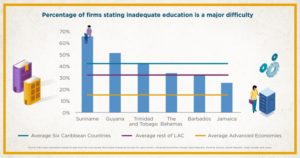
What can be done to improve the workforce in the Caribbean?
This was a topic of conversation during the IDB Group’s Exponential for Resilience, VIII Annual Consultation of Caribbean Governors in February 2019. In thinking about the local conditions of the Caribbean as a region, the conversation centered on the challenges and the benefits of embracing the Fourth Industrial Revolution, when emerging technologies (i.e. blockchain, artificial intelligence, internet of things, data mining, coding, and smart grids) and ability to decode large amounts of data are transforming traditional sectors and industries.
The private sector will be essential in driving innovation and use of technology, enabled by the right set of skills. Active involvement of the private sector in skills development enhances productivity both at the worker and country levels, attracts investment, and allows firms to expand locally and regionally. This support in skills development is key to enhancing countries’ productivity. One of the main elements of successful skills development systems is the active role that employers play in them, specifically in determining current skills needs, anticipating future skills needs, defining occupational standards, and shaping curricula. In Barbados, it has been reported that the annual demand for training resources is US$1.5 million, and more than half of this demand is unattended (IDB Economic Analysis, 2015).
One important priority is to build the right talent and skills, and for this the participation of both the public and private sectors is paramount, and it is a win-win situation. The public sector wins by having a more productive labor force and a more competitive and thriving economy. The private sector wins by having employees up to speed with latest technologies and standards, and with the right human capital to innovate and expand. In the end, individuals win by gaining better employment and being more assertive in their jobs.■
Authors

Adriana M. Valencia J.
Adriana M. Valencia is the Energy, Water and Sanitation, and Climate Change Officer in the Strategic Planning and Knowledge Division of IDB Invest, the private sector institution of the Inter-American Development Bank Group (IDB). Adriana has more than 15 years of international development experience in energy and environmental issues. Prior to joining IDB Invest, Adriana served as an energy specialist in the Energy Division of the IDB. Adriana joined the IDB in 2010 and has participated as a team leader/co-team leader in several innovative initiatives and projects. Adriana has contributed to devising strategies with countries and guidance documents for different sectors to achieve development goals in 26 countries in Latin America and the Caribbean. Prior to joining the IDB, Adriana worked on sustainable energy, environment, and climate change issues at the World Bank and other entities at the country, state, and city levels. Adriana has published and spoken at several conferences. Her academic background includes a Ph.D. and a Master of Science in Energy and Resources from the University of California at Berkeley.
LIKE WHAT YOU JUST READ?
Subscribe to our mailing list to stay informed on the latest IDB Invest news, blog posts, upcoming events, and to learn more about specific areas of interest.
SubscribeFinancial Institutions
Related Posts

Sustainable Financing for Construction in Mexico: Banco Inmobiliario Mexicano’s Framework
A sustainable financing framework to strengthen Mexico’s construction sector and help reduce the country’s housing deficit.

Governance and Succession: Securing the Future of Mexico’s Nonbank Financial Institutions
IDB Invest study: key findings and a roadmap to strengthen governance and CEO and senior management succession planning in nonbank financial institutions (NBFIs).

Facing the Storm: How IDB Invest Supports Caribbean Private Sector Resilience
IDB Invest is partnering with the Green Climate Fund to help Caribbean businesses better withstand future climate shocks through blended finance and technical assistance.