
An Innovative Digital Training Strategy for Women Microentrepreneurs in Guatemala
CMI Alimentos' Allies presents an excellent example of how IDB Invest can support our clients in forming more inclusive value chains, turning the challenges brought about by COVID-19 into opportunities.


Soon after the pandemic was declared, it was clear that it would bring winners and losers among the different sectors of the region's economies. The food industry, generally speaking, came out in good shape, but some distribution channels benefited more than others.
In the case of CMI Alimentos' micro franchises that sell chicken products in Guatemala, called La Casa de Pollo Rey, sales grew 8% year-on-year in the second quarter of 2020. This growth is even more relevant when one takes into account the increase in unemployment and the drop in income generated by the COVID-19 crisis.
A combination of factors contributed to this result, including being small neighborhood stores that benefited from the mandated mobility restrictions and being recognized for their strict hygiene standards, reinforced by the COVID-19 prevention measures that were quickly adopted with CMI’s help.
Seventy percent of these 850 Guatemalan micro franchises are managed by women. In a survey conducted the last week of November with 600 of these micro franchises, 43% of them stated that the COVID-19 crisis created opportunities for improvement in their businesses, especially in terms of an overall increase in sales (70%) and of home delivery sales in particular (16%). But, as shown by the drop in sales occurring as of July, these microentrepreneurs still face limitations when it comes to taking advantage of these opportunities.
IDB Invest has been working with CMI Alimentos for over two years to support these microentrepreneurs or so-called “Allies”, who constitute an important distribution channel for the company’s Livestock Industry sector, which is even more relevant than the supermarket channel.
As part of this collaborative work, this month we have launched a fully online Ally training project. It specifically aims to improve women entrepreneurs’ business management skills, soft skills and empowerment. The training strategy and materials will be developed with the support of the FUNDES consultancy firm, which will explore whether gender-based knowledge gaps exist and then adjust the materials accordingly.
An in-depth diagnosis
In order to identify these microentrepreneurs’ needs and challenges for growth, in 2018, IDB Invest and CMI Alimentos surveyed 200 Allies (75% women) and 100 female clients. The diagnostic work was completed with a focus group of 40 women led by IDB Invest in 2019. This work allowed us to find out just who these microentrepreneurs really are; on average, they are 37 years old, most have owned a business previously (63%), they have a bank account (70%), and have at least one employee (67%).
Fifty-seven percent of those surveyed stated that they had never received training on running a business. They were interested in topics such as marketing, accounting, customer service, and business plan development, all of which are among the most difficult to adopt for small businesses in developing countries.
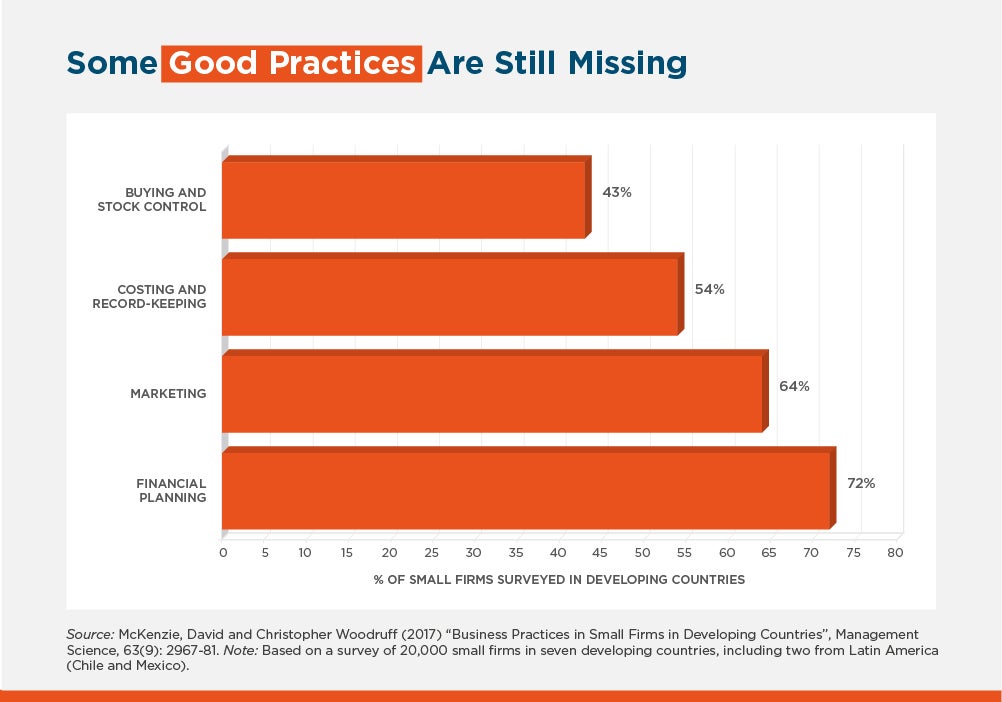
Over 90% of Allies have a smartphone and 60% said they preferred using WhatsApp to receive information to help their business. These elements, in addition to the restrictions imposed by the COVID-19 crisis, convinced us that this was an opportunity to develop a fully online training model, which will include a digital platform with general modules as well as personalized sessions with specialists in various subjects.
The importance of a rigorous assessment
A recent report highlights the importance of cost-effectively scaling interventions for micro and small entrepreneur training, as well as the massive potential of digital technologies and online training, especially in the current scenario marked by COVID-19.
It also notes, however, that there is little evidence regarding their effectiveness. IDB Invest will carry out an impact evaluation—which will include a group of trained microentrepreneurs and a control group—that will allow for measuring the effectiveness of the training strategy for Allies using digital means.
This is very relevant for CMI Alimentos, since the results will allow it to decide whether to scale the intervention, not only in Guatemala but also in other Central American countries where it operates through similar micro-franchise models. CMI Aimentos’ Allies presents a prime example of how IDB Invest can support our clients in forming more inclusive value chains, turning the challenges brought by COVID-19 into opportunities.
Authors

Martina Improta
Martina Improta is a Consultant in the Development Effectiveness Division at IDB Invest where she supports the structuring, monitoring and evaluation of transactions in the agribusiness sector. She also contributes to the organization’s knowledge agenda through the design and implementation of studies and impact evaluations of innovative projects. She previously worked at the International Fund for Agricultural Development (IFAD) in Rome and she holds a Master’s degree from the Johns Hopkins University (SAIS).

Mónica Navarrete
Mónica is an Investment Officer at IDB Invest, responsible for leading transactions in the Agribusiness sector in Central America and the Caribbean. Mónica has more than 16 years of experience in banking and finance in Latin America and the Caribbean, twelve of them in the IDB Group, leading and structuring complex transactions with clients in Latin America and the Caribbean, especially in sectors such as Agribusiness, Energy, Manufacturing and Financial Institutions. Before joining the IDB Group, Mónica served as Financial Planning Manager at Digicel Group El Salvador and held the position of Risk Officer at Citigroup N.A. Mónica studied Industrial and Systems Engineering at Tec de Monterrey (ITESM, in Mexico) and has master's degrees in Business Administration (MBA) from Thunderbird (USA), and in Finance from the business school at Tec de Monterey (EGADE, in Mexico).

Romina Ordoñez
Romina is a Senior Specialist in Rural Development at the IDB, in charge of the development and implementation of the program of the Division of Rural Development, Natural Resources and Disaster Risk Management (RND) in Chile. She previously worked as an economist at IDB Invest focused on the agribusiness and tourism sectors where she measured the development impact of private sector operations and designed and implemented impact evaluations and thematic studies. She has more than 10 years of experience in the design, supervision, and evaluation of development projects. She has a PhD in Agricultural Economics, a Master in Public Policy, a bachelor's degree in Economics and a technical degree in Journalism.
LIKE WHAT YOU JUST READ?
Subscribe to our mailing list to stay informed on the latest IDB Invest news, blog posts, upcoming events, and to learn more about specific areas of interest.
Subscribe{{ raw_arguments.field_category_target_id }}
Related Posts
Korea's Cutting-Edge Innovations to Transform Agribusiness in Latin America and the Caribbean
Discover how IDB Invest connects regional agribusinesses with leading innovators in Korea to accelerate smart agriculture, agritech, and sustainable growth.
Digital Transformation Redefines Agricultural Competitiveness in Latin America and the Caribbean
Every time an agricultural company determines when to irrigate, selects what inputs to apply, or decides how to market or transport its production, the use of data and technological solutions becomes a key competitive advantage.

Combating Multidimensional Poverty from the Private Sector Requires Much More Than Jobs
For Danper, a leading Peruvian company in the global agri-food sector, understanding the living conditions of its workers and their families is fundamental to strengthening actions to improve their quality of life.