
Can We Cut Down Food Loss in Agribusiness?
Food insecurity continues to rise. Agribusinesses in the region believe that stemming their food loss is a relevant issue and see opportunities to recover food that is currently thrown away.

First with the pandemic and then as a consequence of Russia's war in Ukraine, food insecurity has worsened across the world, including in Latin America and the Caribbean (LAC), where it grew from 32% in 2019 to more than 40% in 2021.
One way to boost food security is to increase the availability of food. This is where reducing food loss and waste comes into play, given the widespread economic, social, and environmental impacts of this global problem. Around 14% of the food produced worldwide is lost; in the region, the amount is 11%. This only includes food lost from harvest to wholesale distribution (not including food waste from businesses and households). Here we are focusing on food loss for agribusinesses.
But is food loss a concern for agribusinesses in the region? Does it offer an opportunity for IDB Invest to support its clients in the sector? With these questions in mind, in late 2020 we conducted a survey of 100 companies from 18 countries in 8 sectors, across all actors in the productive chain, from production to processing to wholesale distribution.
This new study seeks to characterize the problem of food loss in the region’s agribusiness sector and identify possible solutions to reduce it, based on an analysis of the challenges, needs, and opportunities expressed by the companies that were contacted.
What did we find?
- This is a relevant topic for companies in the sector. Food companies are generally aware of the economic impact and, to a lesser extent, the social impact of food loss. Most companies think food loss is relevant for their business: 67% have a specific food loss reduction policy, are taking actions to address the problem, or have identified solutions that they have been unable to implement due to lack of funding. Only 13% of companies define food loss as irrelevant to their business; most of these are small companies that do not measure the losses generated in their production process.
- The problem has multiple causes. The main causes mentioned by the companies include weather conditions, pests, storage infrastructure, machinery deficiencies, transport inefficiencies, and buyers' quality standards (the latter is especially relevant for agro-exporting companies).
- The larger the company, the better its measurement systems. Most companies adopt measurement practices and are able to describe them. However, the systematic measurement of food loss and the frequency of reduction practices seem to correlate with a company's size: the larger the company, the greater the professionalization and technification of its operations, and therefore, the lower its losses and the more frequent its measurement. The testimonies collected highlight the challenges posed by the absence of systematized measurement practices and tools, especially in the initial links of the agrifood chain: while 7 out of 10 companies measure losses in industrial activity, only 5 out of 10 do so in primary production.
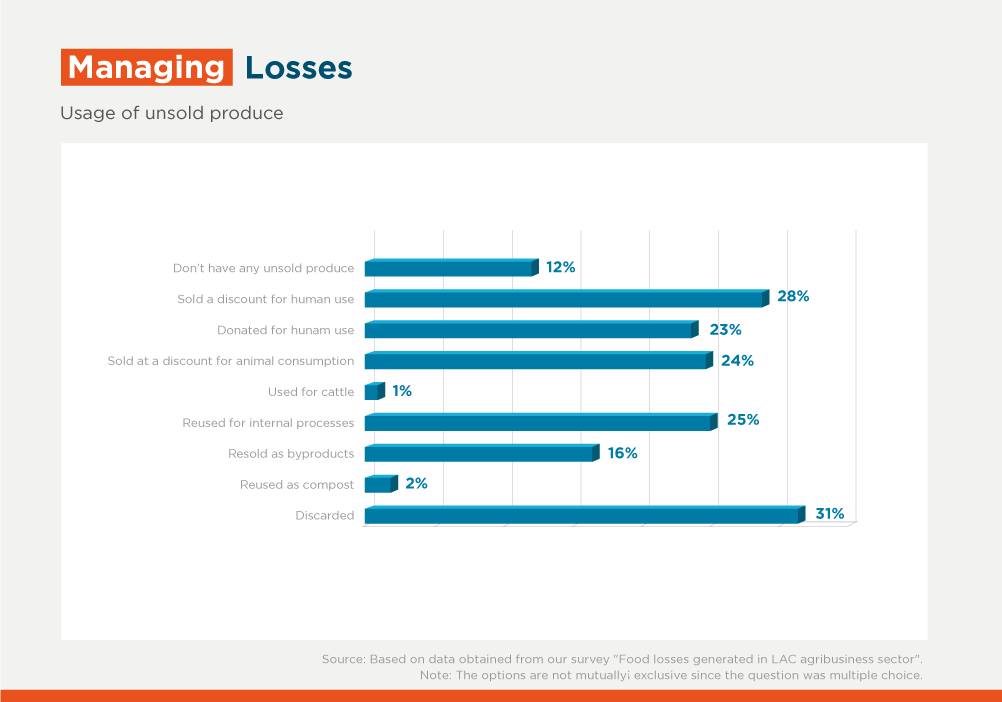
- There is an opportunity to rescue food that is currently being discarded. Almost a third of companies (31%) recognize that they discard food that doesn’t meet the quality standards demanded by their customers. In most cases, however, this is complemented with other actions such as discounted sales for human consumption (28%), reuse in their own processes (25%), or sale for third party processes (16%).
- Some companies are seeking and implementing solutions. More than half of companies stated that they have evaluated investing in food loss reduction projects or have ideas for reducing losses. Companies also emphasize that they lack integrated management tools to better manage losses. The solutions mentioned by the companies (some already implemented, others in the process of implementation) include: vertical integration, developing new varieties or processes to extend shelf life, improving packaging, taking advantage of by-products, and adopting technological improvements, especially for planting, harvesting, and storage.
There is ample opportunity to support companies in the agribusiness sector to reduce food loss in their production processes. For our part, and as a complement to IDB Group efforts through the #SinDesperdicio platform, we are supporting the private sector through financing instruments and technical assistance adapted to the needs of companies, as well as knowledge generation. For example, the design of financial instruments linked to key sustainability performance indicators that include food loss reduction, or the development of methodologies that convert food loss reduction into avoided greenhouse gas (GHG) emissions to contribute to corporate decarbonization strategies.
Ultimately, our objective and that of our clients in the agribusiness sector is to reduce food insecurity, and by decreasing food loss in the production process, more food is available for people to eat.
For more details, see the full study, Pérdidas de alimentos en el sector de agronegocios: La mirada de las empresas en América Latina y el Caribe, which is part of IDB Invest's Development through the Private Sector series, and the DEBrief summary. Only available in Spanish.
Authors

Romina Ordoñez
Romina is a Senior Specialist in Rural Development at the IDB, in charge of the development and implementation of the program of the Division of Rural Development, Natural Resources and Disaster Risk Management (RND) in Chile. She previously worked as an economist at IDB Invest focused on the agribusiness and tourism sectors where she measured the development impact of private sector operations and designed and implemented impact evaluations and thematic studies. She has more than 10 years of experience in the design, supervision, and evaluation of development projects. She has a PhD in Agricultural Economics, a Master in Public Policy, a bachelor's degree in Economics and a technical degree in Journalism.

Guillermo Foscarini
Guillermo is currently the Managing Director and Chief of the Corporates Division for IDB Invest where he leads the origination and structuring of investments in the agribusiness, manufacturing, tourism and digital economy sectors totaling +$1.5B per year.
He joined the IDB Group in 2019 after spending almost 17 years at the International Finance Corporation, private-sector arm of the World Bank Group, where he held several senior investment and development banking positions as Principal Investment Officer in the Manufacturing, Agribusiness and Services & Credit Risk Departments.
Guillermo has worked on +150 corporate and project finance transactions, as well as equity and quasi-equity investments in Africa, Asia and Latin America & Caribbean totaling +$4.5B.
Guillermo holds a MSc in Risk Management from New York University (NY, USA), a MBA from Universidad del CEMA (Argentina), and a CPA degree from the Universidad Católica de Cordoba (Argentina).
LIKE WHAT YOU JUST READ?
Subscribe to our mailing list to stay informed on the latest IDB Invest news, blog posts, upcoming events, and to learn more about specific areas of interest.
SubscribeFinancial Institutions
Related Posts
How Santander Brasil and Eco Invest Mobilize Private Capital at Scale
IDB Invest provides financing to Banco Santander Brasil to support sustainable agriculture, land restoration efforts, and resilient infrastructure.
S&P’s AAA Rating Validates IDB Invest’s Strength and Strategic Direction
The AAA rating expands the institution's access to a broader investor base, supporting its ability to finance and mobilize private impact investment in Latin America and the Caribbean.
Beyond the Cash Gap: How Reverse Factoring Is Unlocking Growth for MSMEs
An IDB Invest study in Mexico estimates that adopting reverse factoring is associated with a 27% increase in companies' sales.