
Sustainable BusinessRecent posts
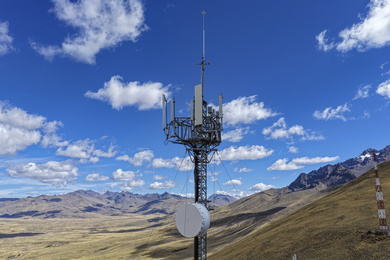
The Towers We Don't See and the Economy We Can't Live Without
IDB Invest finances telecommunications tower infrastructure across Latin America and the Caribbean, helping expand connectivity and support 5G network growth.
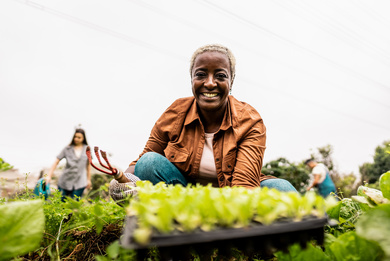
How Santander Brasil and Eco Invest Mobilize Private Capital at Scale
IDB Invest provides financing to Banco Santander Brasil to support sustainable agriculture, land restoration efforts, and resilient infrastructure.

The AI Factory: Latin America's Next Big Industrial Revolution
Latin America’s window to build AI infrastructure at scale is opening, supported by its diverse energy matrix and growing digital demand.


How Fintech Can Help Nanks Tackle Deforestation
Big data and geospatial technology are making it easier for banks to decrease risk when financing projects with potential environmental impacts. How? Our guest author, Luiz Amaral, Global Manager of WRI’s Global Forest Watch Commodities has the answer.

Empower women and investors will follow
Gender equality is no longer a choice for companies. It is not only about fairness, but about business success. For investors, this has become so clear that one of the world’s largest asset managers has just placed a statue of a defiant girl in front of Wall Street’s iconic bull in New York City to remind businesses that the time to fight for gender equality is now. Why? Because investors have realized that companies that foster diversity yield higher returns. More diversity improves decision-making, reputation, productivity, and employee retention and satisfaction, whTry ich in turn leads to higher returns. Companies with more diverse workforces are also better equipped to innovate in product development, tapping into new business opportunities, such as the women’s market. Investors are looking for results on gender equality But how can companies take concrete actions in line with what investors expect? The answer is not easy, as it requires looking at your company through a completely different lens. Statements and mere commitments to gender equality are not enough. In today’s data-driven world, investors are looking for information to evaluate companies’ performance and their environmental and social footprint. In the past few years, several gender equality indexes have emerged to help investors make informed decisions. Examples include the Barclays Women in Leadership Total Return Index, Pax Ellevate Global Women’s Leadership Index and the Bloomberg’s Financial Services Gender-Equality Index, among others. These benchmarks are tracking gender outcomes, including equal compensation and the number of women in leadership positions, employee policies, ability to create products and services for women, and community engagement. Some of these indexes have investment products to capture the benefits of gender diversity. Since 2014, both Barclays’ Women in Leadership Exchange Trade Notes and Pax Ellevate’s Global Women’s Index Fund enable investors to allocate capital in companies with strong female leadership. As investors’ appetite grow, similar initiatives are under way. Last year SSGA and California State Teachers Retirement System, the second-largest public pension fund in the US, launched the SPDR SSGA Gender Diversity Index ETF (SHE) to invest in companies with high levels of diversity on their boards. With over $280 million in assets, Berkshire Hathaway Inc and Oracle Corp. are among its top investors. A free tool to evaluate gender equality For those willing to roll up their sleeves and move beyond good intentions, the first step is knowing where you are and what you are doing. With this goal in mind, IDB Invest (formerly known as Inter-American Investment Corporation) and the Multilateral Investment Fund, along with UN Global Compact, UN Women and other public and private partners, have created a tool to help companies assess their gender equality performance. The tool follows the UN Women’s Empowerment Principles (WEPs) to unleash the potential of women in the workplace, marketplace and the community. The assessment is free and confidential and can be done by any company from any sector in any country. It looks at corporate policies in place and evaluates the extent to which firms provide equal opportunities, adequate work life balance, support to gender equality in the supply chain and respect to women’s rights in local communities. The tool has far-reaching potential for companies. Designed with the feedback of nearly 200 companies worldwide, the tool has proven to be eye opening for the firms that participated in the pilot phase. Some found that the assessment made them rethink their approach to gender equality in procurement and marketing, while others said it compelled senior management to improve processes. Others highlighted that the tool provided a road map to better integrate gender initiatives into the broader company’s strategy. So, if you are ready to face the bull and reap the benefits, complete the assessment and take action. Investors are waiting. This article was originally published on The Huffington Post Subscribe to receive more content like this! [mc4wp_form]

Three ways banks can attract more women customers
Narrowing the global gender gap could add $12 trillion in annual global gross domestic product by 2025. In Latin America and the Caribbean, access to finance for women-led companies is a key driver of this gap. Two out of five small and medium-sized businesses in the region are owned or managed by women, yet 70% of them still have unserved or underserved credit needs. Despite this discrepancy, there is an overwhelming sense of optimism: more than two thirds of active, early-stage women entrepreneurs are opening businesses because they see clear opportunities, not out of necessity.
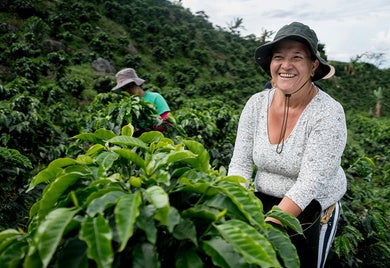
Can the private sector feed the world?
To feed the world by 2050, global food production must increase 60 percent on as little as 12 percent more arable land. This will require avoiding environmentally-sensitive areas while planning for the unexpected events of climate change. Increased floods, droughts, storms, heat and evolving insect resistance are changing how the world farms. Food security and agriculture are part of an ongoing dialogue at this year’s World Economic Forum Annual Meeting in Davos, where experts are identifying ways to replicate what works and tackle what doesn’t.

Green infrastructure: protect your oceanfront with a coral reef
Hurricane Matthew just swept across the Caribbean, leaving behind destruction and crumbled infrastructure. In Haiti, impassable roads and destroyed bridges between the capital Port-au-Prince and the areas most impacted by the hurricane pose the biggest challenge in reaching the affected population. The overall damage of the hurricane is estimated in the billions of dollars.
Local investors jumpstart capital markets and green energy matrix
Last night’s Latin Finance Deal of the Year Awards dinner in New York City highlighted some non-traditional deals. The Best Renewable Energy Financing Award went to Colonia Arias – a Uruguayan wind farm project with a unique structure to both tap local capital markets and mitigate the effects of climate change.
