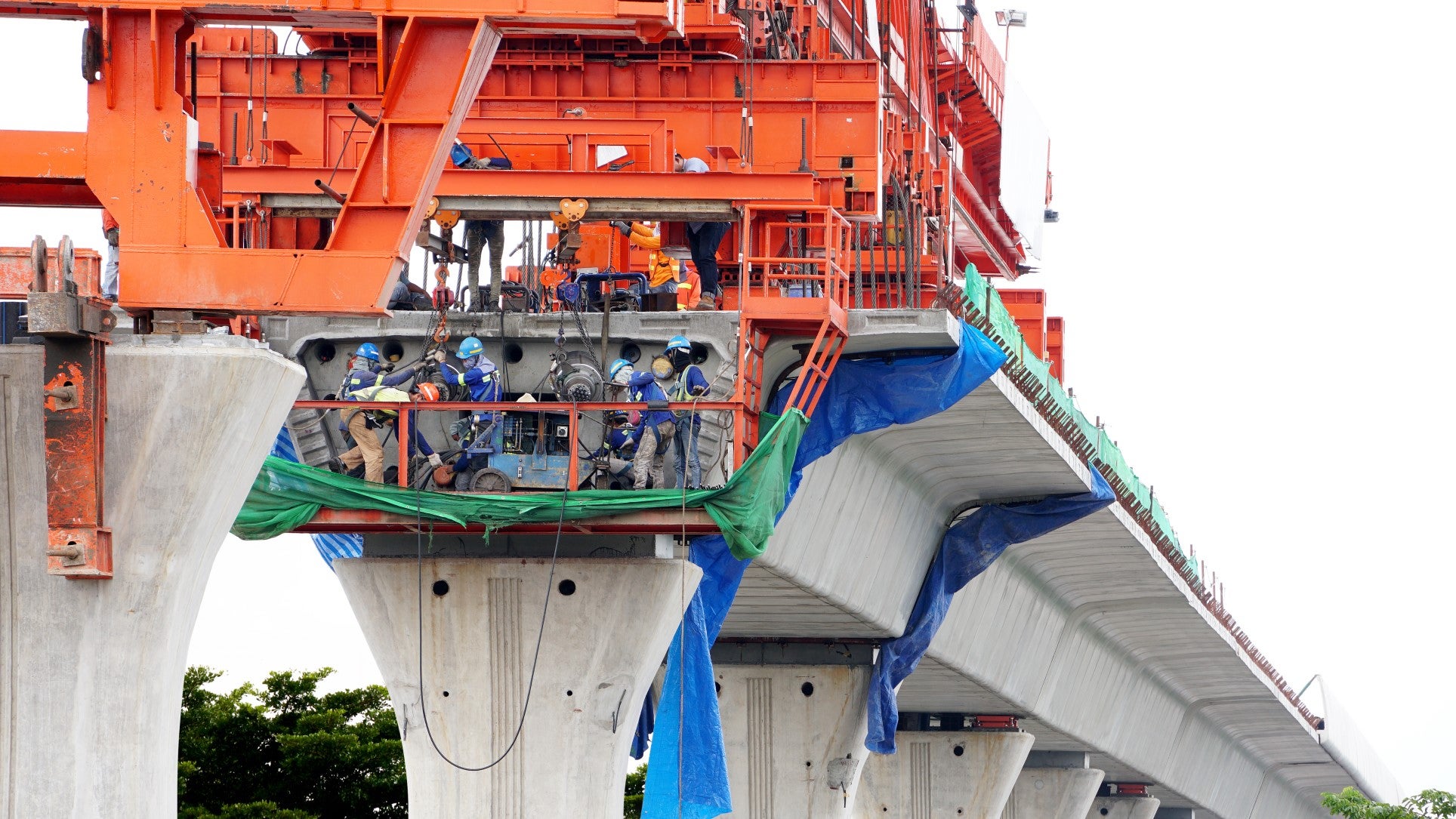
How to Implement Infrastructure Projects in the COVID-19 Era
IDB Invest's new guide for infrastructure projects has proven its usefulness in Colombia and can help decision-making during the pandemic. The guide helps to assess and prevent risks at a time when the region needs such projects more than ever.

Let's put ourselves in Edison Candela's shoes.
Edison needed a plan to protect workers and communities from COVID-19 along a 150-kilometer stretch of winding roads under construction across six municipalities in two rugged Colombian departments. And he needed it fast.
It doesn't seem like an easy challenge. But Edison simplified things by using, among other resources, "Guidance for Infrastructure Projects on COVID-19”, a decision-making tool for the pandemic.
Edison was one of several IDB Invest clients who presented their cases at a recent online forum held to introduce the guide, which focuses on company risk assessments, identifying operating risks, and determining preventive and remedial measures.
You may also like:
- Lessons from a Success Story: Private Port Operators in Latin America and the Caribbean
- How Can Latin America Attract Foreign Investment in Times of COVID-19
- How exposed is Latin America to the trade effects of COVID-19?
All of this was very helpful to Edison, head of Quality, Environment and Risk Prevention for the Ruta del Cacao concessionaire in Colombia. His company directs construction and operations in the departments of Santander and Antioquia, a mountainous area full of crops, a key source of income for these communities.
“The important thing was to establish well-structured protocols to boost the confidence of our workers, the municipal authorities, and the neighboring communities,” Candela explained to the 300 participants of the forum, which included people responsible for other IDB Invest-backed projects and representatives of trade groups and the public sector of Latin America and the Caribbean (LAC).
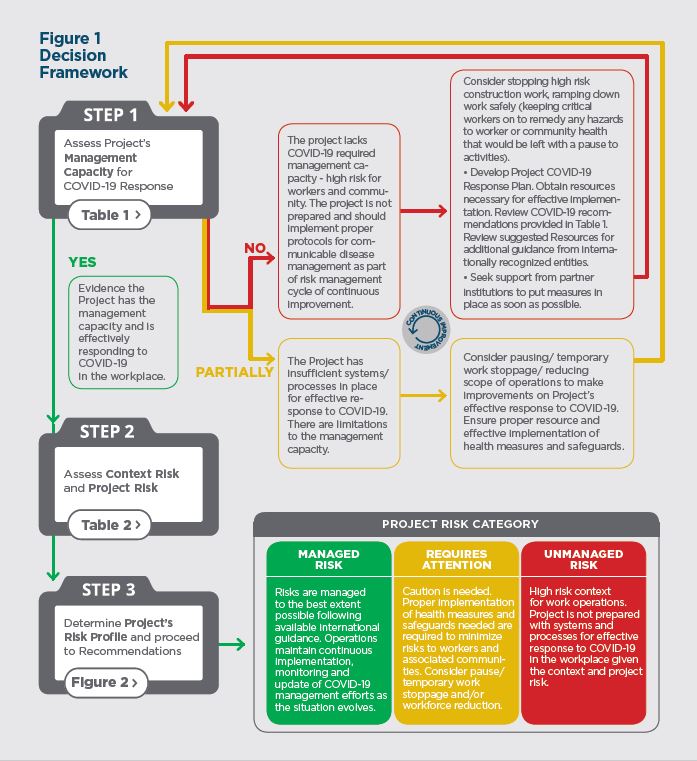
The guide is based on international good practices, including the IFC Performance Standards and the OSHA and World Health Organization guidelines. A key aspect of the guide is risk categorization: risks are classified as managed, requiring attention, and unmanaged. The latter can lead to stopping activities, reducing the scale of the project, isolating workers, and increasing the frequency of inspections.
IDB Invest, the IDB Group's private sector support institution, is financing 72 infrastructure projects in LAC worth upwards of $5.6 billion, including ports, hydroelectric plants, renewable energy, and transportation. According to IDB estimates, the region’s potential for economic growth is seriously hindered by the lack of quality infrastructure.
Such projects usually require large numbers of workers in both the construction and operation stages, which results in frequent interaction with the communities. Moreover, they often provide essential services, which gives them an incentive to keep operations going.
In the same forum, Felipe Ezquerra – Head of Infrastructure and Energy at IDB Invest – explained that infrastructure must now play an even greater role in the region than before the crisis. It is a driver for economic recovery in a region that requires considerable investment in this segment.
“We cannot forget that this pandemic has put the importance of social approaches on the table,” stressed Luiz Gabriel Azevedo, Head of Environmental, Social, and Corporate Governance at IDB Invest. “Protecting the health of both workers and communities is a common objective and a requirement for the continuity of projects,” he explained.
In April 2020, IDB Invest increased its financing capacity to $7 billion to respond to the challenges of COVID-19 in LAC, and it has developed a series of technical advisory programs and manuals for clients in the region.■
LEARN HOW IDB INVEST CAN OFFER YOU SOLUTIONS HERE.
SUBSCRIBE AND RECEIVE RELATED CONTENT |
| [mc4wp_form] |
Authors

Romina Aramburu
Romina Aramburu es Oficial Líder Ambiental y Social de BID Invest basada en Washington, DC. Romina cuenta con más de 17 años de experiencia en la gestión de riesgo ambiental, social, de salud y seguridad promoviendo la sostenibilidad en proyectos de impacto en América Latina y el Caribe, principalmente en proyectos de infraestructura y energía. En BID Invest, lidera los temas de calidad y conocimiento para la división de medio ambiente, social y gobierno corporativo. Antes de incorporarse a BID Invest en 2016, fue consultora principal en sostenibilidad con la consultoría internacional ERM basada en Washington, DC y directora técnica para los servicios de Finanzas Sostenibles. Trabajó en la industria de petróleo y gas con Repsol-YPF y Petroperú. Es Ingeniera Ambiental de la Universidad Nacional Agraria La Molina en el Perú, con estudios de posgrado en Gestión Ambiental, de Salud y Seguridad de la misma institución.
LIKE WHAT YOU JUST READ?
Subscribe to our mailing list to stay informed on the latest IDB Invest news, blog posts, upcoming events, and to learn more about specific areas of interest.
SubscribeGender
Related Posts
Digital Innovation Expands Financing for Women-Led SMEs in Latin America and the Caribbean
Loans and disbursements approved in less than 24 hours, enabled by artificial intelligence, and early invoice payments powered by fintech solutions are transforming access to credit for MSMEs, especially those led by women.

Fixing the Broken Rung: How Data Can Help Advance Women’s Careers in Latin America and the Caribbean
In Latin America and the Caribbean (LAC), the greatest disruption in women’s career progression occurs during the transition into managerial roles. A collaboration between IDB Invest and LinkedIn, within the framework of the Development Data Partnership, uses large-scale labor-market data to identify where women’s participation declines and what barriers exist across sectors and career stages.

Addressing gender-based violence from the private sector: the experience of Laboratorios Bagó
Francisco Méndez, CEO of the pharmaceutical company, shares his company's efforts and achievements in fostering an inclusive and safe work environment.