
The Towers We Don't See and the Economy We Can't Live Without
IDB Invest finances telecommunications tower infrastructure across Latin America and the Caribbean, helping expand connectivity and support 5G network growth.

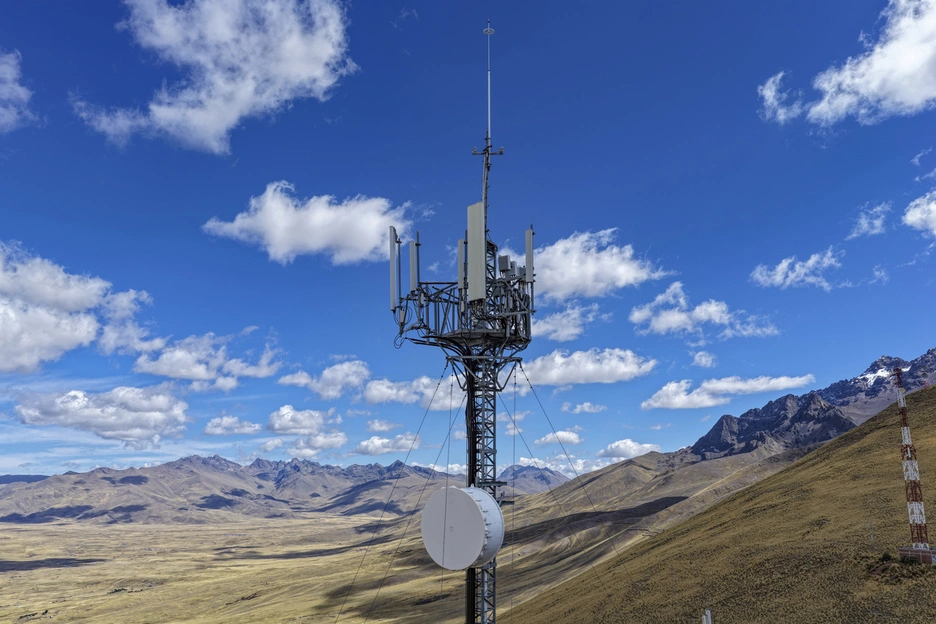
Drive almost any highway these days and you'll pass them without a second glance: steel lattice structures, sometimes disguised as palm trees, quietly doing more for regional GDP than most things that catch the eye. Cell towers are the unglamorous backbone of the digital economy, and across Latin America and the Caribbean, that backbone still has real gaps to fill.
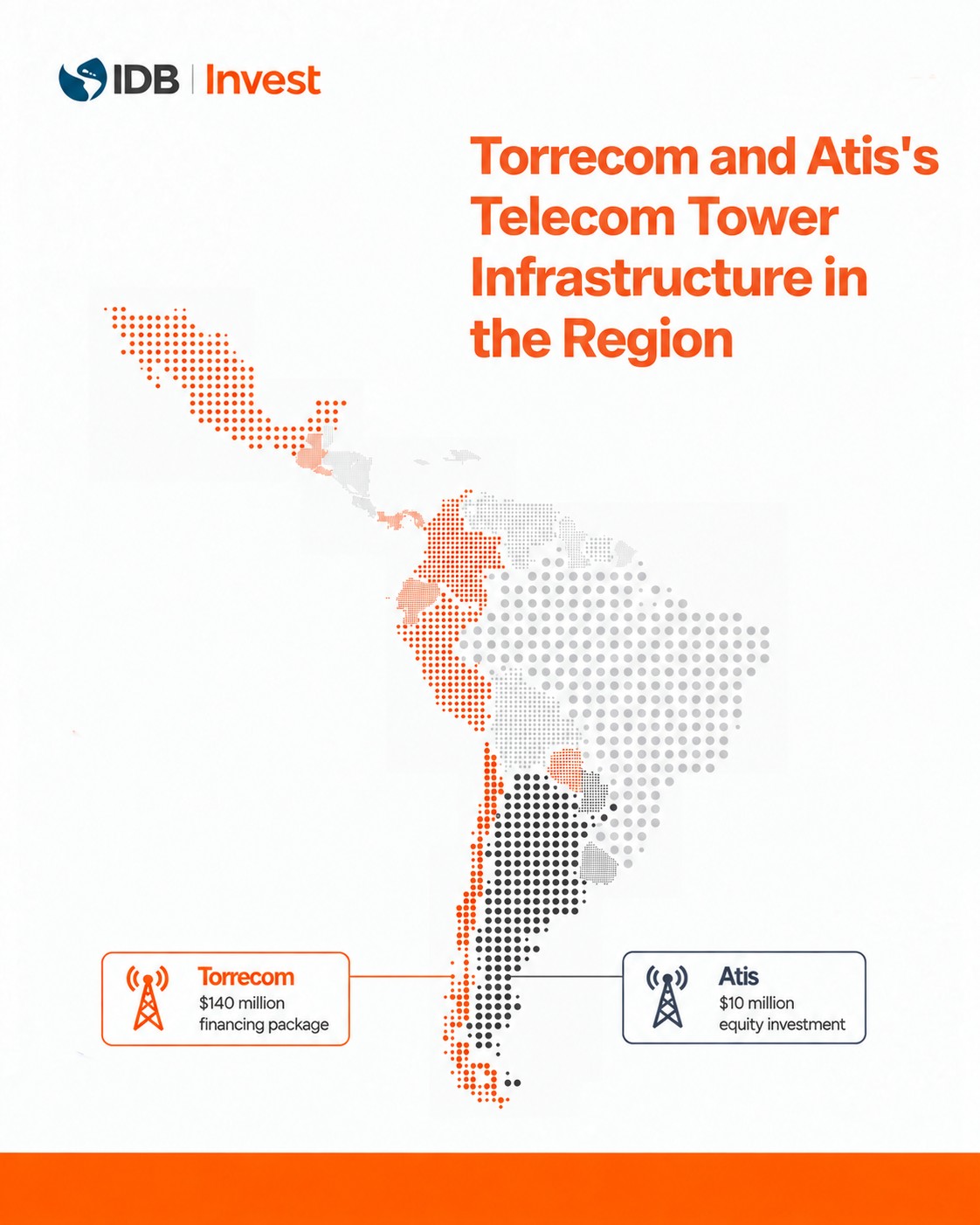
Addressing those gaps is the goal behind IDB Invest's new regional credit facility with Florida-headquartered Torrecom, one of Latin America's leading independent tower companies. The $140 million senior secured loan, structured across multiple borrowing subsidiaries, will fund growth capital expenditures through 2028 and refinance part of Torrecom's existing debt in markets from Mexico to Chile. The company's footprint has now grown past 1,500 towers across 11 countries.
Further south, we recently closed a $10 million equity investment in Atis, backing its tower expansion across the Southern Cone. It was a smaller check by design, but one that signaled confidence in an independent tower company model still taking shape where operators have historically held onto passive infrastructure longer than their regional peers. That's what a real Development Finance Institution (DFI) relationship looks like: not a single transaction, but a portfolio of bets, in debt and in equity, that keeps showing up as the sector grows.
Today's towers increasingly host fiber backhaul, backup power, and small edge-computing cabinets that process data closer to where it is generated, turning what used to be a passive piece of steel into an active node in a much bigger digital fabric.
More Towers for the AI Boom
Everyone is talking about data centers, graphics processing units (GPUs) clusters, and massive AI campuses. All that compute is useless if it can't reach a person or a machine that needs it. Towers are becoming the last mile for artificial intelligence (AI) as much as for a phone call the physical layer that carries inference results to a farmer's tablet, a logistics sensor, or a factory floor controller.
Independent tower companies are steadily gaining ground on mobile operators across the region, now controlling more than half the tower base as carriers sell off passive infrastructure to fund spectrum, a shift toward shared tower networks, where multiple operators can use the same tower.
At the same time, other technologies are nibbling at the edges: low-earth-orbit satellite constellations are reaching areas a tower would never pay back economically. Private 5G networks are being deployed in places such as mines, ports, and industrial facilities, while smaller cells are absorbing growing data traffic in dense urban areas. None of these technologies replace towers. They complement them. Towers are evolving, adding tenants, energy solutions, and edge capacity.
These market characteristics are well aligned with the DFIs' long-term financing mandate. Tower build-outs in rural and peri-urban Latin America and the Caribbean carry long payback periods, currency mismatches between dollar debt and local-currency lease revenue, and construction and permitting. These challenges often keep purely commercial lenders cautious outside the region's investment-grade capitals. That's precisely the gap patient, long-term DFIs' capital is built to fill: financing that de-risks the early years, crowds in commercial co-lenders, and holds the line on environmental and social standards that keep local communities on board. Every additional tower connected is a household with new access to banking, education, and healthcare.
A Growing Market for Tower Infrastructure
Demand for tower infrastructure is expected to continue growing. Brazil still has a fraction of the United States' tower density relative to population, which shows how much densification lies ahead as 5G subscriptions approach half the region's mobile base by the end of the decade. Colombia, Paraguay, and Mexico are all writing rural build-out obligations into spectrum auctions, converting licensing fees directly into coverage where the market alone wouldn't reach.
The Andean region tells its own version of this story: mountain corridors and rural populations dispersed far outside Bogotá, Lima, and Quito make towers more capital-intensive to build than almost anywhere else in the hemisphere. Sale-leaseback deals are freeing operator balance sheets for spectrum instead of steel. Alternative power solutions are helping expand coverage in off-grid areas, enabling connectivity further than the grid currently goes.
Tower infrastructure rarely attracts public attention. Nobody posts a cell tower on Instagram. But scroll through photos, check your bank balance, or run an AI query, and somewhere behind it all, there's a tower. The digital economy may ultimately run on software, data, and increasingly artificial intelligence. But without the physical infrastructure that connects people to those services, none of those innovations can achieve their full impact. Increasingly, the capital behind that infrastructure comes from institutions willing to invest in digital connectivity.
Authors

Guillermo Mulville
Guillermo leads the Telecommunications, Media and Technology (TMT) Team at IDB Invest, which he joined in 2016. He is responsible for developing business strategies and plans, and for managing clients and structuring the transactions of the TMT sector in Latin America and the Caribbean. Before joining the IDB Group, he worked at the International Finance Corporation (IFC) for more than nine years, as Head of the TMT sector for Latin America and the Caribbean. He previously worked at ABN AMRO Bank for 12 years. He was Enron International’s Global Finance Manager for two years. He served as board member of Pan-African and Pan- American companies engaged in broadband and cell tower distribution and infrastructure, with portfolios in various countries in Latin America and the Caribbean. Guillermo earned a master’s degree in finance from Universidad del CEMA and a professional degree in business administration from Universidad de San Andrés (both in Argentina).

Andrés Serrano
Andrés is an investment officer on the Digital Economy team at IDB Invest. He originates and structures financing solutions for telecommunications companies, digital infrastructure providers, data centers, and technology firms across the Andean Region. He has more than 15 years of experience in structured finance and infrastructure, spanning commercial banking, development finance institutions, and multilateral organizations. Andrés holds a bachelor's degree in finance and international relations from Universidad Externado de Colombia and a master's degree in finance from NEOMA Business School, France.
LIKE WHAT YOU JUST READ?
Subscribe to our mailing list to stay informed on the latest IDB Invest news, blog posts, upcoming events, and to learn more about specific areas of interest.
SubscribeDevelopment Impact
Related Posts

The Untapped Opportunity in SME Banking
IDB Invest is helping financial institutions across Latin America and the Caribbean strengthen their SME banking capabilities for long-term growth.

Supporting Argentine SMEs: Financing for Working Capital and Investment
IDB Invest is helping strengthen Argentina's private sector through long-term financing and reverse factoring solutions that improve small and medium-sized enterprises' access to liquidity.

Three Takeaways From our 2026 Impact Report
Learn how IDB Invest's portfolio is performing on development impact.