
The Rules Have Changed: Sustainability Is Now the Price of Entry for Investment in Latin America and the Caribbean
Discover how, at Sustainability Week, May 26–28, private-sector leaders turn resilience into investable, scalable growth.

In today’s environment, sustainability is no longer only about long-term aspiration. It is increasingly about competitiveness, resilience, and the ability to build businesses and markets that can endure. For Latin America and the Caribbean, that shift is reshaping how leaders across the region think about investment and growth. This is what makes Sustainability Week 2026 in Barbados, May 26-28, so timely.
IDB Invest Sustainability Week 2026 brings together private-sector leaders, investors, development finance institutions, financial institutions, and innovators to exchange solutions, build partnerships, and identify business opportunities that can drive impact, competitiveness, and sustainable growth across the region. If you work at the intersection of investment and sustainability, this is your event.
Register now and join the conversation
Volatility is Raising the Bar for Sustainable Growth in Latin America and the Caribbean
The region faces no shortage of opportunities. It has entrepreneurial energy, growing demand for infrastructure and services, deep natural capital, and enormous potential for innovation. But it is also operating in a world shaped by greater volatility: extreme weather events, disaster risk, energy and supply chain pressures, tighter capital conditions, rapid technological change, and increasing demands for stakeholder engagement and transparency.
That is why the conversation around sustainability continues evolving. It is no longer enough to ask whether growth is possible. The more important question is whether growth is resilient, investable, and built to last.
Translating Ambition into Scalable Outcomes
Sustainability, competitiveness, and resilience will be visible across all events at Sustainability Week. It will be in the conversations on resilience and disaster preparedness, embedded in the discussions about more durable infrastructure and supply chains. It will frame the conversation about how the region's financial systems enable real resilience, be it through local currency solutions, sustainable capital markets, catalytic and blended finance, and stronger data, governance, and transparency. Across sessions, the focus is the same: translating ambition into practical outcomes that are scalable where possible.
Taken together, those conversations point to a larger truth. Sustainability is a defining feature of investable growth. It is not just about what we want to achieve. It is about how we get there. And that “how” matters enormously.
Markets do not scale on ambition alone. They scale when risks are better understood and managed, when financial instruments fit real business needs, when stakeholders understand what to expect, and when transparency strengthens investor confidence. They also scale when local institutions and entrepreneurs have the tools to participate meaningfully – and when public and private actors work together to create the conditions for investment.
This is particularly important in Latin America and the Caribbean, where many of the region’s development and sustainability priorities are also investment challenges, requiring a combination of financial and non-financial solutions. Building resilient infrastructure, supporting Micro, Small, and Medium-sized Enterprises (MSMEs), strengthening food security, expanding access to finance, mobilizing capital, and accelerating adaptation require bankable pipelines, credible multi-stakeholder partnerships, and financial structures that can help move capital at scale.
The costs of uncertainty can be very high. A business that can withstand disruption, adapt to new conditions, and continue delivering value is more competitive. A financial system that can better manage risk and channel capital toward long-term opportunities is more effective. A market that can absorb shocks while continuing to attract investors is more investable. The benefits of business stability extend companies' strategic horizons. Resilience, in other words, is not separate from development. It is increasingly central to it.
Other Content on Sustainability 2026
Turning Sustainability Commitments into Bankable Investments
From Ambition to Execution: Building Future-Ready Markets
At Sustainability Week 2026, discussions around bonds, local currency, sustainability reporting, governance, Artificial Intelligence (AI), supply chains, and impact management are all part of the same broader story: how to build markets that are more future-ready. The goal is not simply to generate ideas. It is to connect ideas to implementation – and implementation to scale.
That requires a broader understanding of what sustainable finance really means as well as access to solutions, tools, and knowledge with a keen focus on localized actions and innovation that drive development impact. It is not only about earmarking capital for worthy purposes. It is about structuring capital in ways that can unlock investment, strengthen resilience, and create durable value over time. It is about making sure financing solutions are rooted in local realities.
It is also about strengthening stakeholder engagement that boosts investor confidence, reducing perceived risks, and encouraging investment in projects with long-term sustainability goals. Markets that adhere to sustainability and impact principles are more likely to attract and secure long-term financing. And it is about recognizing that the quality of the financial architecture often determines whether promising concepts remain niche or become transformative.
The region needs spaces where investors, corporates, financial institutions, policymakers, and development actors can engage together to develop practical solutions. It needs forums that bridge sectors, disciplines, and geographies. And it needs a sharper focus on what it takes to turn momentum into execution. By collaborating with stakeholders at the country, regional, and global levels, Sustainability Week fosters an ecosystem in which best practices become the norm, strengthening supply chains, improving governance structures, and raising sustainability standards across industries and sectors.
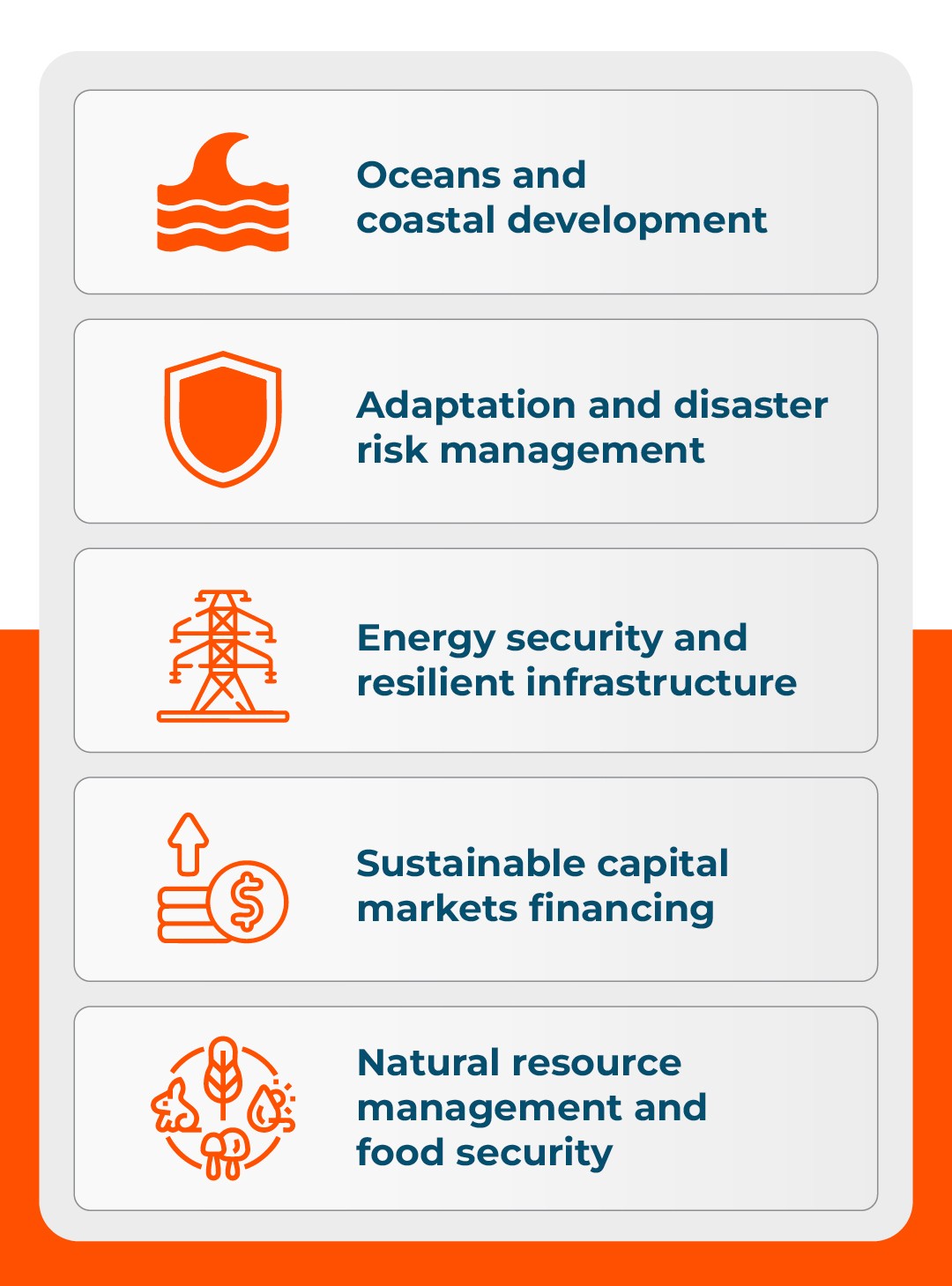
The event is built around five core themes that reflect the region's most pressing investment and sustainability priorities:
For those working across investment and development, that combination is where the real promise lies. In that context, Sustainability Week is more than a convening: it is a platform for advancing the multi-stakeholder partnerships and solutions that can help shape the region’s next phase of growth – a springboard for collaboration and engagement.
The future will favor businesses and markets that are better prepared, more adaptive, and more capable of creating value amid uncertainty. It will favor institutions that can engage stakeholders meaningfully and translate broad commitments into practical solutions. And it will favor partnerships that can bring together the right capital, tools, and incentives to deliver results.
Join private sector leaders, investors, and innovators in Barbados, May 26–28. Register for Sustainability Week 2026.
Authors

Stacy Swann
Stacy Swann is managing director of IDB Invest's Blended Finance Division. Her background as an investor includes impact, angel, and venture investing, as well as project and corporate finance. From 2015 - 2023, she was CEO of Climate Finance Advisors, a financial advisory and consulting firm focused on supporting investors of various types, including banks, institutional investors, and impact fund managers. She has held senior and executive positions with the International Finance Corporation (IFC), the US Department of the Treasury, Enron Corporation, and other organizations. In her personal capacity, she is a co-founder of Resilient Earth Capital. She serves on multiple boards, including the Montgomery County Green Bank and the Green Guarantee Company, and sits on the Climate Panel of the Maryland State Pension Fund. Ms. Swann holds an MBA in finance and development economics from American University, a master's degree from Harvard University, and a bachelor's degree from City University of New York - Hunter College.

Leonardo Mazzei
Leonardo leads stakeholders’ engagement and non-financial risk management in high-risk high-reward projects at IDB Invest. He coordinates institutional and operational-facing engagement activities and partnerships to accelerate the private sector's adoption of sustainability solutions and best practices. Leonardo is a sustainability expert with over 20 years of experience leading regional and global impact investing initiatives involving multilateral development agencies, government, private sector, and non-profit organizations to advance sustainable development. He has extensive experience dealing with political and business leaders during economic reform, public-private partnerships, and project finance in over 40 countries. Before this role, Leonardo was Head of Communications at IDB Invest supporting private sector investments in Latin America and the Caribbean. Before the IDB, he worked as Senior Communications Officer for the World Bank, leading stakeholder engagement interventions in Africa, Central, and East Asia, Eastern Europe, and Latin America, focusing on infrastructure, energy, governance, and private-public partnerships. He has authored four books on the role of communication to enhance sustainability performance.
LIKE WHAT YOU JUST READ?
Subscribe to our mailing list to stay informed on the latest IDB Invest news, blog posts, upcoming events, and to learn more about specific areas of interest.
SubscribeInvestment Funds
Related Posts

IDB Invest Cultivates Caribbean Fund Managers to Mobilize Private Capital
By training local fund managers and anchoring blended‑finance vehicles, IDB Invest mobilizes private capital for sustainable growth across the Caribbean.

Strengthening Impact Measurement and Management to Attract New Investors
To attract impact investors, fund managers increasingly recognize the need to measure and demonstrate the impact of their investments credibly. IDB Invest is working with fund managers in Latin America and the Caribbean to build their impact measurement and management capacity from the ground up.

Five Best Practices for Sustainable Bond Reporting
Enhancing transparency and accuracy, boosts investor confidence, and drives capital towards sustainable development.