
Private Investment, a Solution to Water & Sanitation Challenges in Latin America & the Caribbean
COVID-19 has presented an additional challenge to the expansion of water and sanitation access in the region, with a reduction in related investments; public-private partnerships and other resources such as access to local currency financing are expected to help expand private investment in the sector.

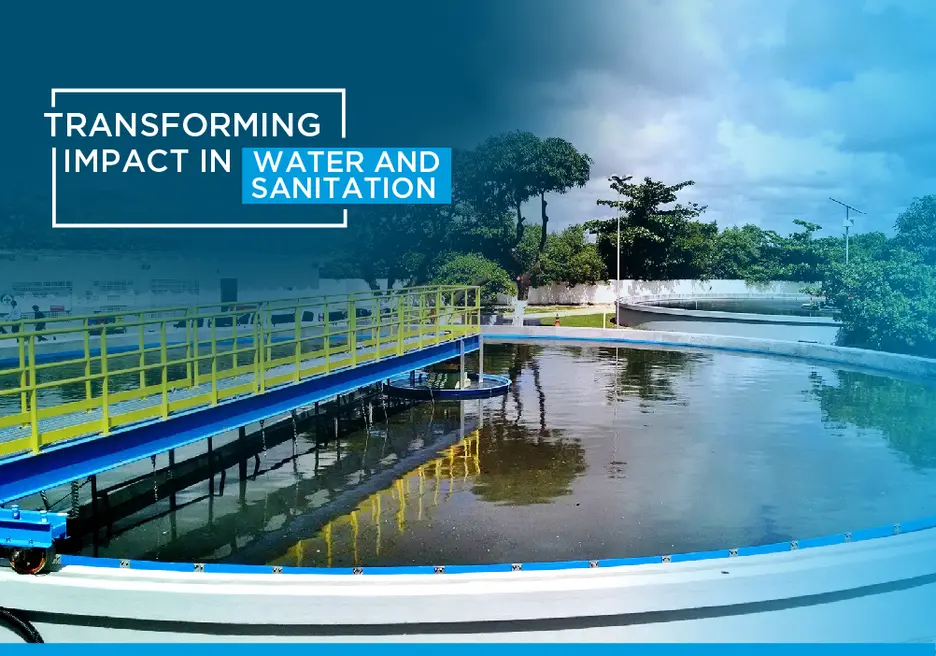
Our region faces access challenges when it comes to water and sanitation (W&S), and a significant need for investment in infrastructure. In this context, it's to be expected that the solution comes through public-private partnerships (PPP) with a relevant role in boosting the sector.
According to IDB data, with the current level of investment, Latin America and the Caribbean (LAC) will not be able to meet the UN Sustainable Development Goal number 6 – "Ensure availability and sustainable management of water and sanitation for all" – until 2100. COVID-19 has underlined the importance of tackling this problem.
According to a study conducted this year by IDB Invest's advisory services area, LAC's challenges are particularly important with regard to waste-water collection and treatment. The takeaway is that infrastructure shortcomings in the region help to accelerate the transmission of COVID-19 in vulnerable populations, given that the World Health Organization has indicated that one of the most effective solutions to stop the disease is access to clean water for hand washing, as well as efficient sanitation systems.
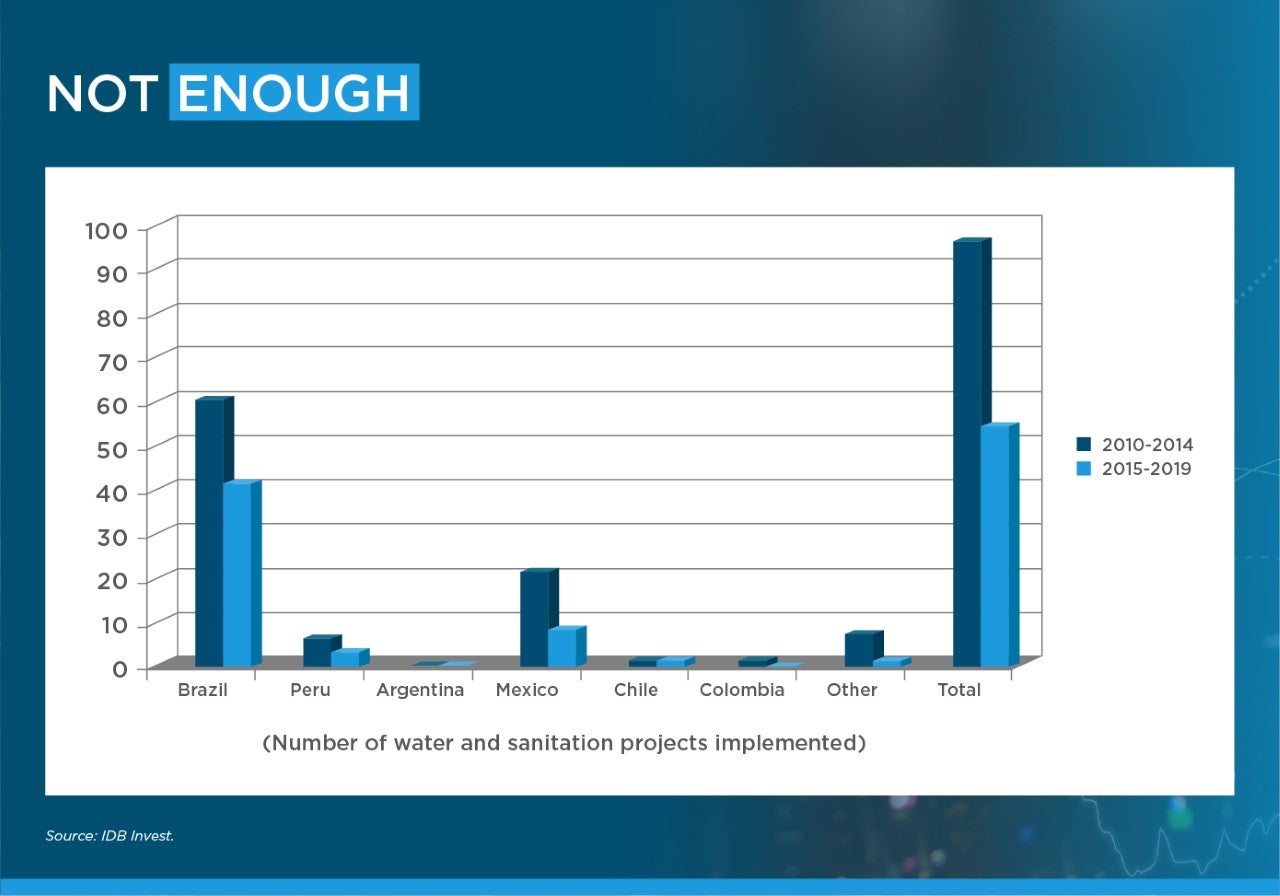
To reduce the gap and increase access to efficient W&S infrastructure, current investments should be doubled, requiring more private sector participation. However, the number of projects in the W&S sector that have a private component decreased by around 40% in LAC in the 2015-2019 period, compared to the previous five-year period, and fell by more than half if we exclude Brazil, the regional economy where more emphasis has been placed on these investments.
In this context, well-structured PPP, with a balanced risk allocation and with adequate bankable requirements, have been successful in attracting private capital and developing other sectors: especially transport infrastructures such as ports and highways, but also transmission and renewable energy. This represents a valuable precedent to follow at W&S.
To achieve more and better PPP in this sector, we need to increase collaboration with public institutions, and clarify the possible perception that these structures may result in “privatization”, which is not the case since asset ownership does not revert to the private sector. Given this situation, it's possible that a greater dissemination of the benefits of identifying, structuring and contracting W&S projects under PPP schemes and structures is necessary, as the Brazilian government, a pioneer in this field, already does. On the other hand, a solid technical and financial feasibility analysis is key in determining which specific projects should be structured under PPP.
In line with the above, operators and financiers active in the region have a great interest in this market, but many find it difficult to find opportunities. This indicates a need to structure more PPP projects in the region to generate a more important portfolio of projects and generate efficiencies, synergies, and more investment and private liquidity.
You may also like:
-
Sustainability, the vaccine for Latin America and the Caribbean economies
-
Food Waste is on the Menu as the Hospitality Sector Rebuilds
-
Latin America & the Caribbean Has a Truck Problem, But the Solution is on its Way
Financing that is well adapted to the characteristics of the sector/project is also key. In our experience, a great incentive to attract private capital lies in the flexibility of debt instruments, such as financing in local currency or longer grace and financing periods adapted to each sector and adjusted to the investment period. This is particularly important in W&S projects, which are structured on the basis of projections of increased users and wider use of services, and in many cases, precisely for that reason, have several investment cycles during the concession period.
Recent deals such as the IDB Group financing for R$442 million with a total term of 20 years to BRK Ambiental, the largest private sanitation company in Brazil, and whose majority shareholder is the Canadian Brookfield fund, are an example.
In this project, IDB Group financing is being used for the expansion, rehabilitation and improvement of infrastructure works for waste-water in 15 municipalities of the metropolitan region of Recife (corresponding to the second investment cycle of this concession) and will benefit a population with high economic vulnerability, increasing access to waste-water sanitation to 90% from 33% of the population currently.
These are projects that, by lowering infant illnesses, have clear benefits for everyone's lives, particularly women, who tend to take care of those sick children. That is why IDB Invest has set itself the goal of being the leading development bank in financing sustainable infrastructure in the W&S sector.
Authors

Denis Leduc
Denis is an Investment Consultant, Advisory Services and Blended Finance Team at IDB Invest, which he joined in 2019. He is responsible for providing active support to private corporations and public entities for the Development of Public-Private Partnership (PPP) projects. Before joining the IDB Group, Denis worked for more than three years as manager of the Infrastructure and PPP team at Deloitte in Colombia, where he participated in the financial structuring of several social infrastructure and transportation projects. He also worked as Mergers & Acquisitions (M&A) Officer at Fluxys, a Belgian industrial group focused on energy storage and transportation infrastructure. Denis has extensive experience in the structuring and assessment of infrastructure projects, particularly in Colombia and Peru, and in the rest of the Latin American region as well. Denis earned a master’s degree in economics from Solvay Brussels School of Economics and Management, and a master’s degree in financial management from Vlerick Business School (both in Belgium).

Rafael Matas
RAFAEL MATAS TRILLO is presently Head of the Andean Region and Energy Sector Lead, in the Infrastructure and Energy Division of IDB Invest, based at IDB Invest’s head-office. He has been working for the IDB Group since 2007, leading the development of transportation, renewable energy, transmission and water and sanitation transactions in Latin-America.
As Head of the Andean Region since 2020, Mr. Matas leads a team that has structured and financed paramount transactions such as Lima Airport, the Rumichaca-Pasto and Pamplona-Cucuta 4G toll-roads through social bonds, the first solar PV project finance transactions in Colombia, and the largest wind projects in Peru to date with Engie and Enel, among others.
He is presently also the Energy Sector Lead of IDB Invest, where he leverages on the experience and knowledge of the energy markets, obtained throughout the last 17 years helping countries to develop its PPA frameworks (such as Uruguay or the Dominican Republic), structuring numerous solar, wind and green transmission transactions (in Dominican Republic, Uruguay, Argentina, Chile, Brazil and Colombia), and designing innovative products such as the first Total Credit Guarantee from the IDB Group to wrap a debenture of infrastructure to finance a wind transaction in Brazil, or the IDB Invest Green Transmission Line Certificate.
A Spanish national, he has received awards for innovative project finance execution. Previous to the IDB Group, Mr. Matas worked for the Spanish bank Banco Bilbao Vizcaya Argentaria (BBVA) in its Hong Kong office for two years, managing the Spanish desk of the BBVA in China, and mainly devoting to corporate finance transactions.
He has a Law Degree and LLM by ESADE (Spain) and a Master in Foreign Service by Georgetown University.
LIKE WHAT YOU JUST READ?
Subscribe to our mailing list to stay informed on the latest IDB Invest news, blog posts, upcoming events, and to learn more about specific areas of interest.
SubscribeAgribusiness
Related Posts
Korea's Cutting-Edge Innovations to Transform Agribusiness in Latin America and the Caribbean
Discover how IDB Invest connects regional agribusinesses with leading innovators in Korea to accelerate smart agriculture, agritech, and sustainable growth.
Digital Transformation Redefines Agricultural Competitiveness in Latin America and the Caribbean
Every time an agricultural company determines when to irrigate, selects what inputs to apply, or decides how to market or transport its production, the use of data and technological solutions becomes a key competitive advantage.

Combating Multidimensional Poverty from the Private Sector Requires Much More Than Jobs
For Danper, a leading Peruvian company in the global agri-food sector, understanding the living conditions of its workers and their families is fundamental to strengthening actions to improve their quality of life.