
Génesis: A Model of Financial Health in Rural Guatemala
By 2017, fewer than 13% of Guatemalans had access to formal credit. Fundación Génesis developed a model that combines tailored lending, financial education, and digital tools to strengthen financial health in communities with limited access to financial services.

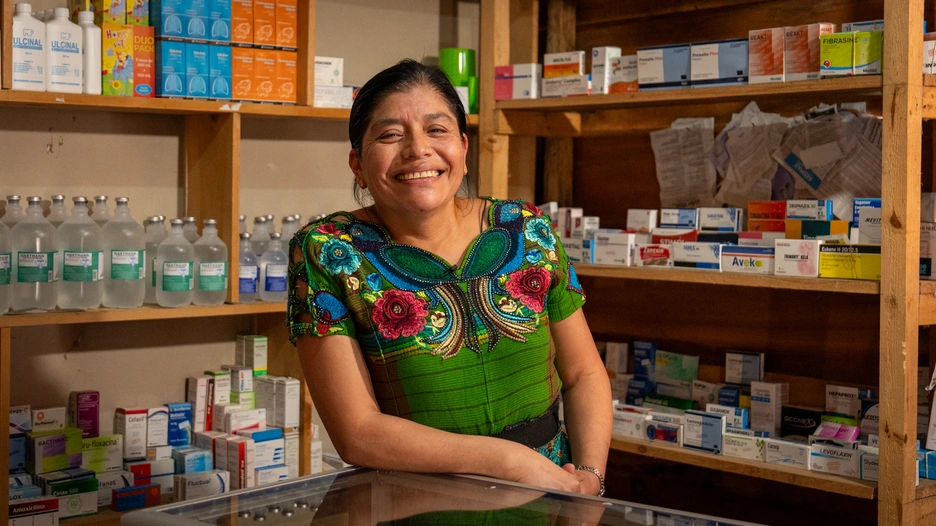
In colonia Las Flores, a hillside community in San Juan Sacatepéquez, Guatemala, Carmen Eugenia Osorio delivers babies, treats patients, and keeps her small pharmacy well-stocked. She is a nurse, a midwife, and an entrepreneur, all at once.
Running a pharmacy requires more than healthcare experience. It requires access to capital. For nearly a decade, Fundación Génesis Empresarial, a microfinance institution backed by IDB Invest, has provided Carmen with loans and financial training to run an essential service for her community.
“Having access to capital allows me to purchase medicines, ensure adequate supplies… and see people’s health improve,” Carmen said.
A Replicable Blueprint for Financial Health
By 2017, only 12.7% of Guatemala's population had access to formal credit. Banks had long underserved rural communities, informal workers, and small entrepreneurs because of systemic assumptions about risk.
Génesis built a model that combines tailored credit with financial education, digital solutions, and business advisory services, all aimed at building lasting financial health for its clients. Génesis calls this pathway Ruta de Desarrollo.
In 2019, IDB Invest committed $20 million to support Génesis in expanding its microfinance portfolio and provided technical assistance to help the institution diversify its funding sources, adopt risk assessment tools, and integrate new technologies into its operations.
"The innovative aspect of IDB Invest's support has been its willingness to share knowledge and experiences with openness and trust," said Edgardo Pérez, CEO of Fundación Génesis.
To reach more remote areas, IDB Lab, the innovation and venture arm of the IDB Group, supported Génesis in deploying digital solutions, including electronic wallets, smart ATMs, and digital microcredit. With these tools and its network of non-bank agents, the institution brought financial services closer to rural and underserved communities.
Small-scale farmers were among the first to benefit. “Génesis financed the purchase of fertilizers, the construction of additional greenhouses, and improvements to the farm,” said Gabriel Tepet Ajquejay, a flower grower in San Juan Sacatepéquez. Today, his farm produces more, his customer base has grown, and he has created jobs for his community.
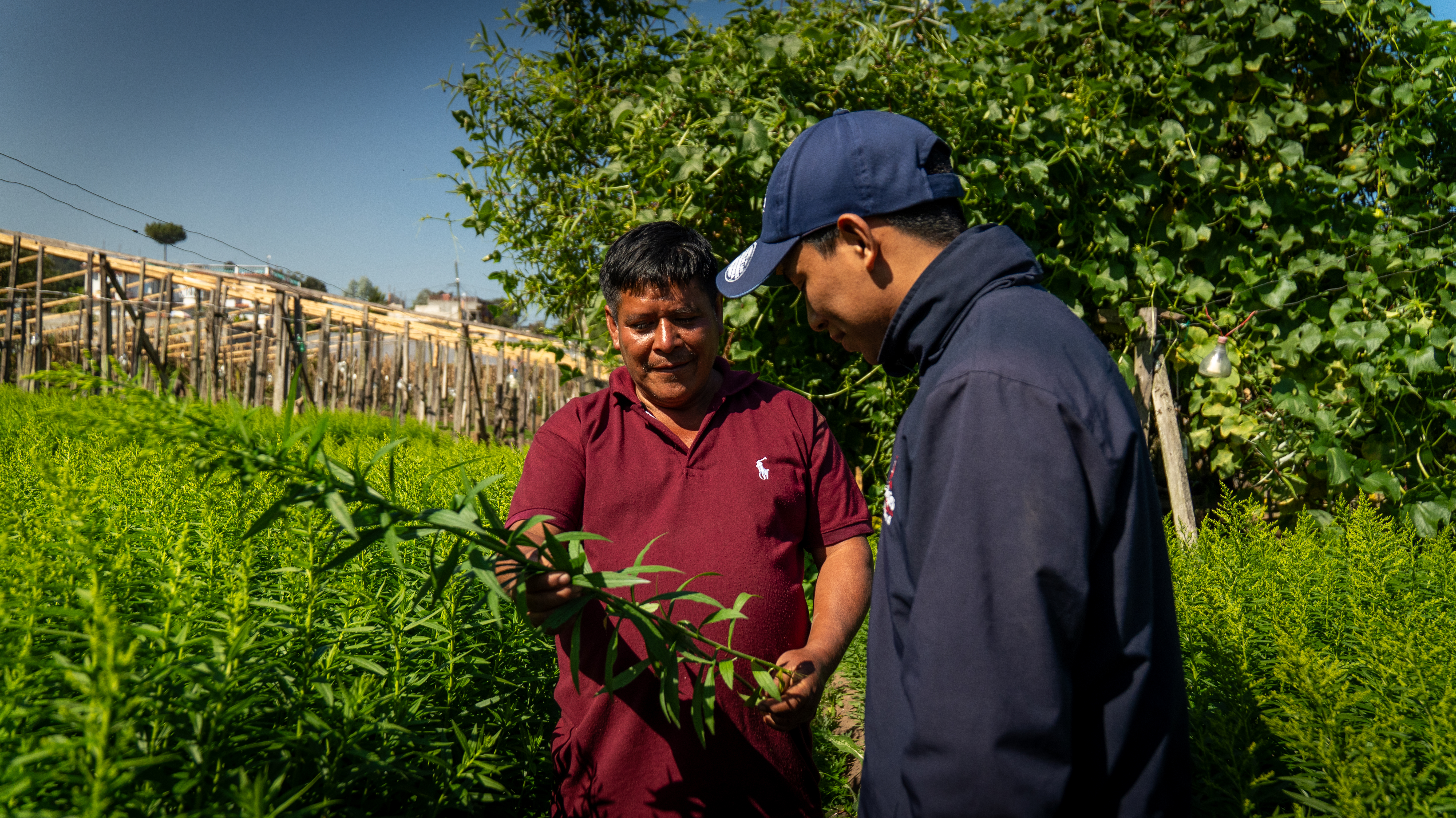
Gabriel Tepet Ajquejay, together with a Génesis field advisor.
IDB Invest also collaborated with Génesis to integrate risk assessment tools into its lending process. These tools provide farmers with guidance on how to adapt their crops to extreme weather events. Génesis also developed an agricultural app that helps farmers decide what to plant and when, based on land and weather data. Farmers also receive on-farm training to apply the tools’ recommendations.
Ruta de Desarrollo
These digital wallets, risk management tools, agricultural app, and on-farm training are part of what Génesis calls Ruta de Desarrollo: a sustained, client-centered pathway that combines financial and non-financial services to gradually move families toward stability in housing, education, nutrition, and health.
Across Guatemala, more than 500,000 Génesis clients are on that pathway – 80% of them in rural areas, 43% from vulnerable populations. The institution they rely on keeps loans more than 90 days past due below 1%, reflecting Génesis’ commitment to supporting clients’ financial health and preventing over-indebtedness.
For nearly a decade, Carmen Osorio has followed Génesis' development pathway, and her pharmacy shelves have never been empty since.
Authors

Samantha Todd
Samantha is Development Effectiveness Officer at IDB Invest. She is part of a team that works on the Development Effectiveness Framework for its alignment with the Sustainable Development Goals (SDG). Samantha has an MA in Social Policy from the London School of Economics and a BA in Data, Economics and Development Policy. Before joining IDB Invest, she worked researching reproductive health in Latin America and the Middle East.

Galia Rabchinsky
Galia Rabchinsky is a Development Effectiveness Officer in the Development Effectiveness Division at IDB Invest. She works mostly with Financial Institutions in Central America and Mexico, ensuring IDB Invest operations promote social and economic benefits for the region. Within her professional career, Galia has also worked as a Research Fellow for the IDB’s Office of Evaluation and Oversight, supporting the Bank’s corporate and country evaluations, aimed at assessing and improving the quality of its internal processes, policies and programs, and as a Financial Analyst for the US State Department, supporting various budgetary programs. She received her degree as an Economist from the Universidad Iberoamericana in 2012 (Mexico) and has a Master's degree in International Development Policy from Georgetown University (2017).
LIKE WHAT YOU JUST READ?
Subscribe to our mailing list to stay informed on the latest IDB Invest news, blog posts, upcoming events, and to learn more about specific areas of interest.
SubscribeWater and Sanitation
Related Posts
IDB Invest Structures the Largest Blue Bond in History: $1.35 Billion
The transaction supports the expansion of wastewater collection and treatment in the State of São Paulo and improves living conditions for 2.5 million people through an innovative financing solution.
Tailored Strategies to Provide Water and Sanitation to Brazil's 'Favelas'
When a new law allowed private capital to enter the sector, water and sanitation companies established programs that enabled them to work efficiently in vulnerable communities.

Leveraging the Private Sector to Unlock the Caribbean’s Most Precious Resource
The Caribbean’s reliance on oceans, often the biggest avenue of transportation and the main source of local employment, presents a clear economic opportunity, particularly for the private sector.