Leveraging the Private Sector to Unlock the Caribbean’s Most Precious Resource
The Caribbean’s reliance on oceans, often the biggest avenue of transportation and the main source of local employment, presents a clear economic opportunity, particularly for the private sector.


Perhaps the strongest link bringing together the 45 million people living in the Caribbean is the ocean.
This may sound obvious but, as we celebrate Oceans Day this year, it’s worth noting that practically everyone lives at a short distance from the shore.
It is tempting to view the oceans as a threat, given a changing climate and rising seas. In fact, the Caribbean’s reliance on oceans, often the biggest avenue of transportation and the main source of local employment, presents a clear economic opportunity, particularly for the private sector.
If the oceans were considered as an economy separate from the rest, they would be the seventh largest economy in the world, with an annual gross domestic product of more than $1.5 trillion, according to an estimate by the World Economic Forum.
This ocean economy is also growing. A report that IDB Invest is launching in Barbados for what it has been dubbed “Oceans Week” discusses options to support a healthy marine environment and the next generation of high-quality jobs and livelihoods. Our conclusion is that, with the right infrastructure and investments in place, the size of the blue economy in the region could double by 2030.
The report features investment opportunities that can support the transition away from destructive practices and create new enterprises. In a clear departure from other approaches, ours stresses the need to have positive social outcomes while achieving a financial return, which we believe is key given the region’s challenges.
This is easier said than done, but we’re doing it already.
In Barbados, IDB invest is providing advisory services to ensure the Environmental and Social Impact Assessment for the development of Renewstable Barbados, a 50 MW solar generation facility with green hydrogen and lithium-ion battery storage.
The new facility, which will extract its hydrogen from water, will provide stable and clean electricity supply for the Barbadian grid. The project is also supported by the IFC and Hydrogène de France (HDF).
Another example of great ingenuity is provided by companies that use seaweed to create organic fertilizer. In the Caribbean, Algas Organics relies on local species, some of the fastest growing seaweeds in the world, to become the first indigenous agriculture biotech company.
Such projects are showing the world how technology can be used to sustainably tap into ample resources. Sadly, the Caribbean requires financing to implement this type of projects, and this is not always forthcoming given the current instability in global financial markets.
That’s where the role of multilateral development banks (MDBs), is key. International investment funds have a growing appetite for sustainable assets and projects like those the Caribbean has to offer, but they’re often wary of investing in small economies where they don’t have much experience and local knowledge.
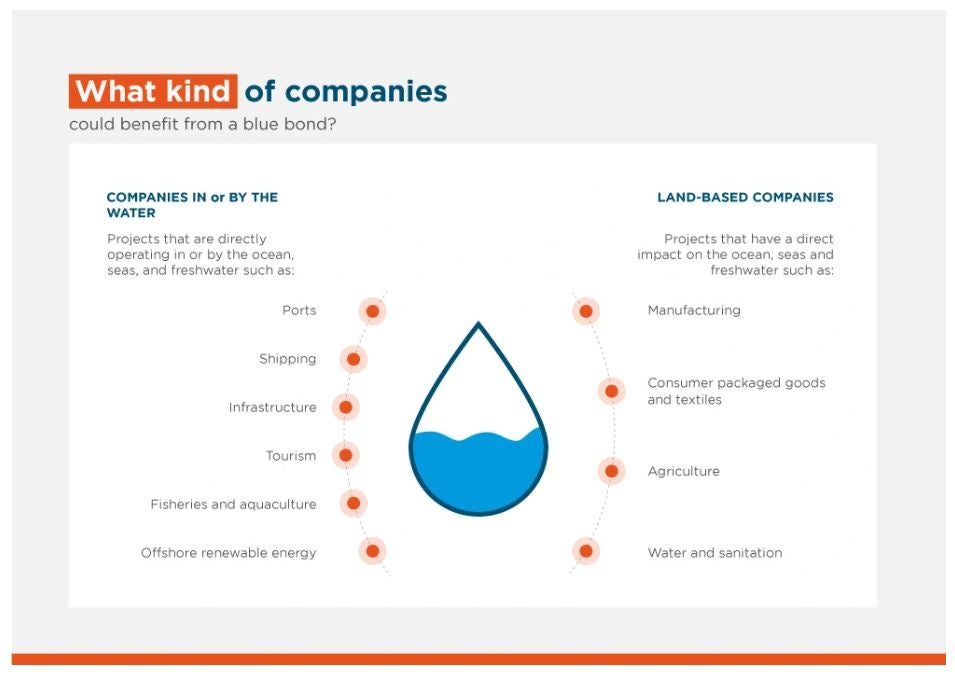
Sophisticated financial instruments like “blue bonds”, in which issuing companies specifically commit to investing proceeds in commercial solutions for ocean health, fresh water and/or to improve access to water and sanitation, are a way to match investors with capital-hungry entrepreneurs – using MDBs as the intermediary.
So far, only a handful of “blue bonds” have been issued in the world. At IDB Invest we have issued two blue bonds over the last two years to finance private sector projects in clean water, tourism, and shipping, among other water-related industries. More recently, we supported Ecuador’s Banco Bolivariano to issue the first blue bond in Latin America and the Caribbean that will include the recommendations from the so-called Taskforce on Nature-related Financial Disclosures (TNFD).
It’s important to keep in mind that “blue” proceeds can be allocated to sustainability projects that operate in proximity to the ocean, seas, and freshwater. These include ports, shipping, infrastructure, tourism, fisheries, aquaculture, manufacturing, and offshore renewable energy.
The potential for the private sector to invest is tremendous.
Overall, the blue economy is estimated to contribute $3-$6 trillion to the global economy and over $407 billion to the region’s GDP. Maintaining a clean and productive ocean, by getting as many industries and parties involved as possible, is a fundamental precondition for the achievement of the 17 UN Sustainable Development Goals. The ocean, which covers 70% of the planet, helps mitigate climate change by storing large amounts of heat and carbon dioxide and it is an essential source of food production, ensuring food security and employment for people around the world.
The expansion of the sustainable ocean economy will provide food for a growing population and foster low-carbon transportation, as well as a nearly unlimited source of renewable energy. This is an opportunity we can’t miss.
Authors

James P. Scriven
James P. Scriven is the CEO of IDB Invest, a multilateral development bank dedicated to driving sustainable growth in Latin America and the Caribbean through the private sector. A dual Argentine-British citizen, Mr. Scriven has over two decades of experience advancing the role of the private sector to increase development impact.
Before leading IDB Invest, he served as Vice President of Corporate Risk and Sustainability at the International Finance Corporation (IFC), where he held multiple leadership roles. Prior to that, he was Chief Financial Officer of Banco Hipotecario in Argentina.
Mr. Scriven holds a Master’s degree in Finance from Universidad del Centro de Estudios Macroeconómicos in Argentina, and a Business Administration degree from the Pontifical Catholic University of Argentina.
LIKE WHAT YOU JUST READ?
Subscribe to our mailing list to stay informed on the latest IDB Invest news, blog posts, upcoming events, and to learn more about specific areas of interest.
SubscribeAgribusiness
Related Posts
Korea's Cutting-Edge Innovations to Transform Agribusiness in Latin America and the Caribbean
Discover how IDB Invest connects regional agribusinesses with leading innovators in Korea to accelerate smart agriculture, agritech, and sustainable growth.
Digital Transformation Redefines Agricultural Competitiveness in Latin America and the Caribbean
Every time an agricultural company determines when to irrigate, selects what inputs to apply, or decides how to market or transport its production, the use of data and technological solutions becomes a key competitive advantage.

Combating Multidimensional Poverty from the Private Sector Requires Much More Than Jobs
For Danper, a leading Peruvian company in the global agri-food sector, understanding the living conditions of its workers and their families is fundamental to strengthening actions to improve their quality of life.