
Lessons from a Success Story: Private Port Operators in Latin America and the Caribbean


At a time of economic gloom, the role of private sector in the management of commercial ports in Latin America and the Caribbean (LAC) is a success story that provides lessons to ensure the supply of food and essential goods in the region.
Maritime transport is essential to the world’s economy as over 80% of the world’s trade is carried by sea, and LAC accounts for 7% of total container cargo worldwide, which roughly represents the region's share of global GDP.
However, most developing countries have been challenged with poor port infrastructure and management, leading to low productivity and expensive operations. The solution, since the 1980s, has been the rise of Public-Private Partnerships (PPP) that leave port authorities as owners, but put the private sector in charge of operations.
You may also like:
- El Hub, a new podcast for exporting SMEs
- How Can Latin America Attract Foreign Investment in Times of COVID-19
- How exposed is Latin America to the trade effects of COVID-19?
Across the world, PPP have proved themselves useful to address cargo containerization trends, shortcomings in efficiency and outdated infrastructures. LAC has been no exception: PPP are now the norm for multi-purpose or container cargo port terminals. 92% of TEUs in the region are moved from/to PPP ports, which account for 83% of container terminals in the region.
According to IDB’s estimates, in the last decade there has been an average of three new PPP port projects developed per year, typically landlord agreements on existing infrastructure implemented through competitive tendering processes. Until 2019, most PPP were financially self-sustaining, providing a revenue stream for governments from fixed or revenue based payments, thus generating fiscal space to address other public needs.
Private port operation has improved LAC's competitiveness through remarkable increases in efficiency and productivity in cargo management. Particularly, since the turn of the century, ports in Latin America and the Caribbean have increased their operational efficiency by more than 20%. Data shows private sector participation and port competition is correlated with higher levels of operational and economic performance, and better maintained ports.
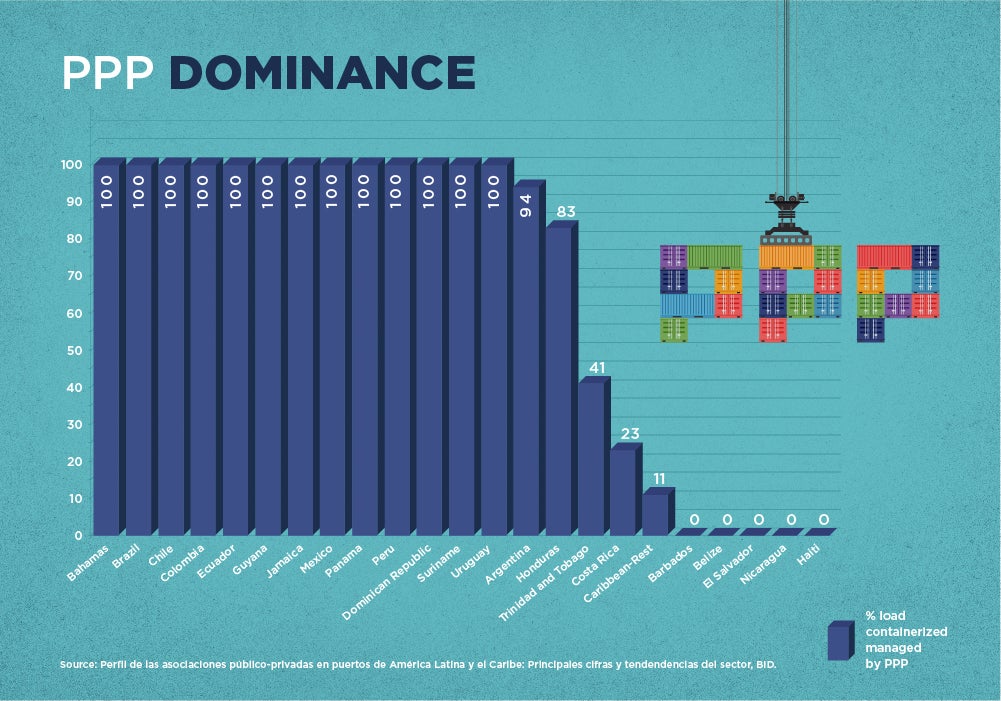
As COVID-19 has battered economies, the leading role of the private sector in incorporating technological advancements will be key for ensuring safety in the terminals, protecting food security, the supply of essential consumer goods and trade. The pandemic has only heightened the need of technology to allow remote operation and autonomous computer control, and the private sector is well positioned to further deploy these advancements. Examples range from paperless and remotely stationed operations to automated crane handling, autonomous or remote pilotage, automated shuttling of containers and blockchain-enabled digital shipping platforms.
A key, well-known takeaway is that public sector projects aiming for private sector involvement must be structured through an adequate regulatory and institutional framework. They must also align incentives to maximize social returns. Risks need to be thoroughly identified and efficiently allocated – particularly since COVID-19 makes risk identification and management key for infrastructure projects.
Lessons learned from previous PPP indicate that robust technical teams on the public side are critical for the correct identification, structuring, tendering and implementation of projects and for ensuring high standards of asset performance and service provision. In fact, there is a close relationship between regulatory quality, compliance, government effectiveness and infrastructure efficiency.
Multilateral institutions also have a relevant role: not only in providing and mobilizing financing resources to these projects, but also in supporting governments. Evidence shows that multilateral financing increases the number of lenders of a project as well as the average maturity of syndicated loans, making them more affordable. Some recent examples are Puerto Antioquia in Colombia, Puerto Posorja in Ecuador, and Kingston Container Terminal in Jamaica (check out our recent case study on this project here), all financed by IDB Invest.
The past sheds light on the future: in the midst of COVID-19 and beyond, the role of the private sector – supported by robust public counterparts – is and will be more relevant than ever, and multilaterals will continue to have a key role in providing assistance, financing and mobilizing resources to successfully materialize these investments while maximizing social returns.■
LEARN HOW IDB INVEST CAN OFFER YOU SOLUTIONS HERE.
SUBSCRIBE AND RECEIVE RELATED CONTENT |
| [mc4wp_form] |
Escrito por

Ancor Suárez-Alemán
Economist, PhD., BA., with over 15 years of working experience in the field of infrastructure economics and policy. Public-Private Partnership (PPP) Senior Specialist at the Vice-presidency for Countries at the Inter-American Development Bank Group. Currently leading the infrastructure PPP upstream public-sector support at the IDB, advising 26 Latin America and the Caribbean Governments on upstream (PPP regulatory and institutional framework, infrastructure planning and prioritization, coordination between Public Investment Management and PPP Units, Capacity building); downstream/operations (infrastructure project preparation and structuring, with a focus on port transactions); and infrastructure PPP knowledge development and dissemination activities. Manager of the LAC Regional Network on Analysis and Best Practices on PPPs. IDB Project Manager for the Infrascope development – analysis of the enabling environment for efficient and sustainable PPP in LAC social and economic infrastructure (energy, telecom, transport, social infrastructure, water and sanitation), an IDBG and The Economist Impact joint initiative. In the past, I worked at the Infrastructure and Energy Department at the IDB developing and coordinating key infrastructure knowledge and strategic products related to infrastructure investment, financing, governance, regulation, and performance, among other areas. Before that, I worked at The World Bank in the transport practice, where I developed transport knowledge outcomes such as the first port competitiveness report for the South Asia region. I have advised public and private sectors in Europe, South Asia, and Latin America and the Caribbean. Prior to my career in Washington D.C. (USA), I contributed to various European Cooperation in Science and Technology projects on business models for enhancing funding and enabling financing of infrastructure projects, as well as national and regional infrastructure investment projects. I completed my PhD focusing on Port Competitiveness and the European Maritime Transport Policy. I have authored and coordinated general and sector studies, and published over more than 100 works on infrastructure economics, policy, investment and financing, and PPP in various journals and other specialized publications.

Paula Castillo
Paula Castillo is a Senior Officer in the Strategy, Planning, and Synergies Division of IDB Invest, where she leads the strategic and analytical work in transport, social infrastructure, and public-private partnerships (PPPs). Paula is also involved in developing regional frameworks and corporate strategy initiatives aimed at maximizing IDB Invest’s impact. Prior to her current role, Paula served as a technical advisor to the Vice President for Sectors and Knowledge at the Inter-American Development Bank (IDB) and worked as a consultant in the IDB’s Transportation Division. Before joining the IDB Group, she contributed to Colombia’s National Planning Department in the Infrastructure Division and held academic positions at the Universidad de los Andes. Paula holds a degree in economics, a master’s in sustainability management from American University’s Kogod School of Business in the United States, and a master’s in economics from the Universidad de los Andes.
¿TE GUSTA LO QUE ACABAS DE LEER?
Suscríbase a nuestra newsletter para mantenerse informado sobre las últimas noticias de BID Invest, publicaciones de blog, próximos eventos y para obtener más información sobre áreas específicas de interés.
SuscribirseDevelopment Impact
Posts Relacionados

Banca para pymes: una oportunidad de crecimiento
BID Invest apoya a las instituciones financieras de América Latina y el Caribe en el fortalecimiento de sus capacidades de banca para pymes e impulsar el crecimiento a largo plazo.

Impulso a las pymes argentinas: financiamiento para capital de trabajo e inversión
BID Invest refuerza el apoyo al sector productivo de Argentina mediante financiamiento a largo plazo e instrumentos de factoraje inverso que permiten anticipar el cobro de facturas y mejorar la liquidez de las empresas.

Tres aprendizajes de nuestro Informe de Impacto 2026
Conoce los resultados de impacto en el desarrollo de la cartera de BID Invest.