
"A man is not a financial plan:" Banks globally target women clients

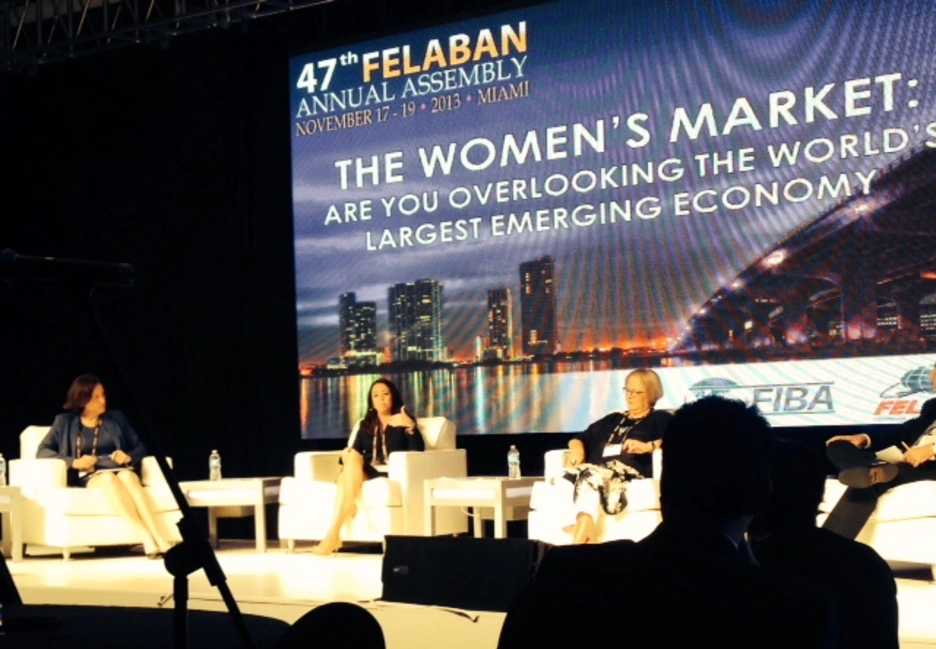
After Tomas Miller, IDB Group's access to finance chief, opened, the panel moderated by Global Banking Alliance for Women CEO, Inez Murray, uncovered concrete solutions good for society and bank bottom lines.
 The typical woman client in Latin America is marrying later, having fewer children, earning greater incomes, achieving higher levels of education than men and spending more years in the workforce, and the region's banking sector must adapt to their evolving needs. The high-level, global panel shared ways to support this "emerging economy" in Latin America and beyond:
1. Education for women clients. "Men and women are equal but not the same," commented Eduardo Ferreira, representing Itaú Unibanco. One difference is women's interest to receive training and have a more holistic bank relationship. To engage women clients, banks deploy educational programs. Online support, in-person workshops, mentoring initiatives and personalized consulting services are a few ways banks, often in partnership with NGOs, build women's capacity to successfully utilize financial products and services around the world. Westpac even charges for such workshops and sells out every time.
2. Education for bank staff: "It's all about consistency," added Marcela Navarro from Royal Bank of Scotland. Addressing women as a market segment is impossible without recognizing their value in the bank as well. Training toolkits are increasingly available for bank managers, credit officers and other employees to raise awareness about gender and diversity and promote women in bank leadership.
3. Research: "Women are really complex," half-joked Ferreira, but Itaú Unibanco takes research seriously. It is investing in feasibility studies and collaborating with partners to better understand this critical market. The banks on today's panel from Lebanon, the United Kingdom, Brazil and Australia are making investments to fully comprehend the needs and life cycles of women as retail clients, investors, business owners, job generators and wealth creators. The goal: identify in which products and services women are most interested and then devise a strategy to engage them. Like men, not all women are identical, so segmentation is key
4. Innovative credit scoring: Credit scoring that recognizes unique financial behavior will ensure a more inclusive approach to finance. One possibility is that credit assessments, especially for the small and medium enterprise segment, focus on future repayment (ability and willingness) rather than collateral and credit history. This could have implications for women just starting a business. Psychometric models such as Entrepreneurial Finance Lab's (EFL) can be tailored to the Latin American context. EFL currently operates in 20 countries and 24 languages.
5. Mainstreaming: Across the panel it was unanimous. This is not about CSR. In order for financial markets to add value financially and socially, the female market must be operationalized as part of a core business strategy. Limiting such initiatives only to a CSR or HR department "risks extinction." Banks will most successfully attract this 50% of the economy by mainstreaming gender considerations in product and service development.
So what can banks do to involve this emerging market? One idea - join the Global Banking Alliance for Women (GBA).
Building women’s wealth through access to capital, information, education and markets, GBA has 37 members to date, yet only three (Banco Nacional de Costa Rica, Banco Pichincha and Itaú Unibanco) are from Latin America and the Caribbean. Existing members have committed to launch comprehensive programs that deliver women entrepreneurs the tools they need to succeed. The business case is compelling, and organizations like the GBA are key in raising awareness and building banks’ capacities and knowledge to strengthen women’s financial plans in a sustainable way.
Escrito por

Elizabeth Nicoletti
Elizabeth Nicoletti maneja comunicaciones ejecutivas y participación de partes interesadas en BID Invest, donde cubre proyectos complejos de infraestructura con asuntos de riesgo contextual y reputacional además de liderar las comunicaciones para la Oficina del Gerente General. Antes trabajaba en la Vicepresidencia del Sector Privado y Operaciones sin Garantía Soberana como una redactora de discursos, y en la División de Mercados Financieros del Banco Interamericano de Desarrollo (BID). Antes de llegar al Grupo BID, Elizabeth trabajó en la Corporación Financiera Internacional (IFC, por sus siglas en inglés) en Washington, DC, la Fundación Chol-Chol en Temuco, Chile y el Centro Internacional de Investigación de la Mujer (ICRW, por sus siglas en inglés) en Washington, DC. Elizabeth cuenta con una maestría en economía internacional de Johns Hopkins University, School of Advanced International Studies (SAIS) y es licenciada de Georgetown University de Washington, DC.
¿TE GUSTA LO QUE ACABAS DE LEER?
Suscríbase a nuestra newsletter para mantenerse informado sobre las últimas noticias de BID Invest, publicaciones de blog, próximos eventos y para obtener más información sobre áreas específicas de interés.
SuscribirseDevelopment Impact
Posts Relacionados

Impulso a las pymes argentinas: financiamiento para capital de trabajo e inversión
BID Invest refuerza el apoyo al sector productivo de Argentina mediante financiamiento a largo plazo e instrumentos de factoraje inverso que permiten anticipar el cobro de facturas y mejorar la liquidez de las empresas.
Tres aprendizajes de nuestro Informe de Impacto 2026
Conoce los resultados de impacto en el desarrollo de la cartera de BID Invest.
WE Finance Code Colombia: datos y alianzas para ampliar el financiamiento a empresas lideradas por mujeres
Las entidades del ecosistema financiero de Colombia unen esfuerzos para ampliar el acceso al crédito de las mujeres empresarias mediante datos, colaboración y soluciones financieras adaptadas a sus necesidades.