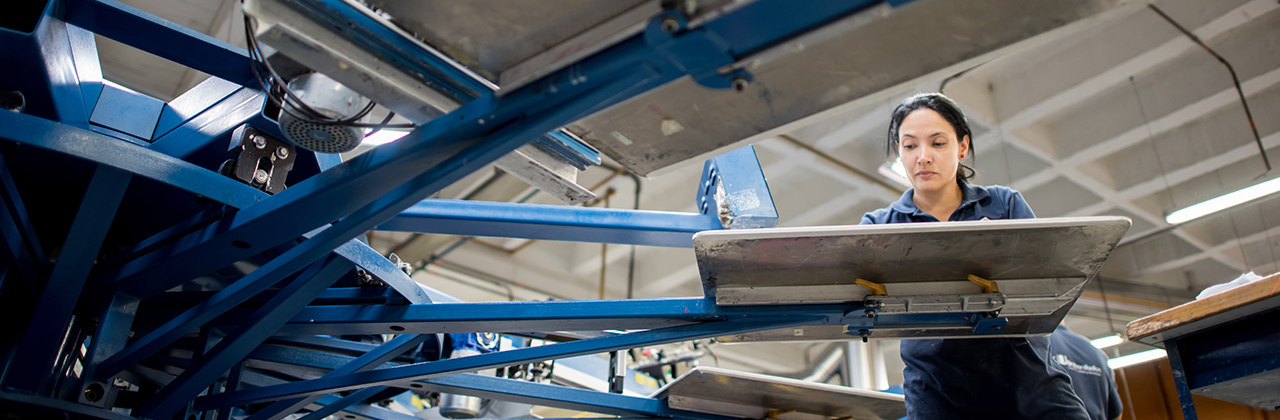
Scaling Manufacturing to Drive Jobs and Exports in Honduras
With long-term financing from IDB Invest, Grupo Elcatex in Honduras expands capacity, creates jobs, and connects to global markets.

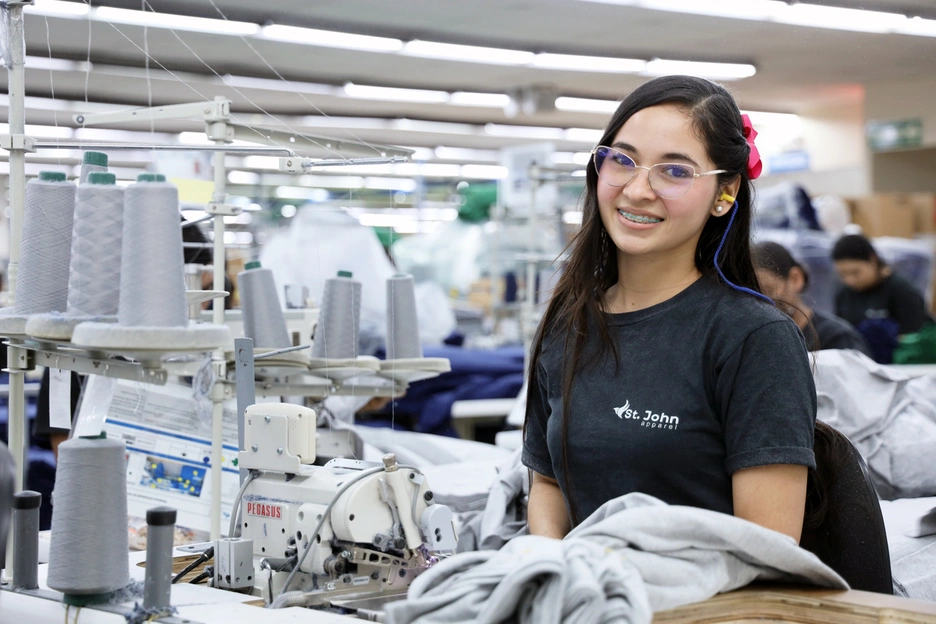
Over the past decade, Honduras has emerged as a small but increasingly competitive global exporter of apparel. While Latin America and the Caribbean (LAC) accounts for just over 4% of global apparel exports, Honduras has steadily gained ground, becoming the top regional supplier of cotton T-shirts and one of the leading exporters of activewear.
Representing about half of the country’s exports, textiles and apparel play a critical role in creating jobs, generating foreign exchange earnings, and advancing productive development.
Productive Scale-Up
Grupo Elcatex is one of Honduras’s largest textile and apparel producers and employers. By 2019, the company was operating near full capacity at a time when global demand patterns were shifting and nearshoring dynamics were creating new prospects for regional suppliers.
To capture that opportunity, Elcatex needed to expand and diversify its production by building a new, vertically integrated facility and adding synthetic fabric capabilities. Funding this major investment plan called for long-term financing that was not available in the local market.
In 2020, IDB Invest partnered with Grupo Elcatex to help turn this growth opportunity into reality. The long-term financing supported the construction and operation of the new San Juan Textiles facility, upgrades to existing plants, and working capital needs. The new plant would allow Elcatex to bring key production stages in-house, expand into synthetic fabrics, and increase overall manufacturing capacity by half.
More Jobs and Exports
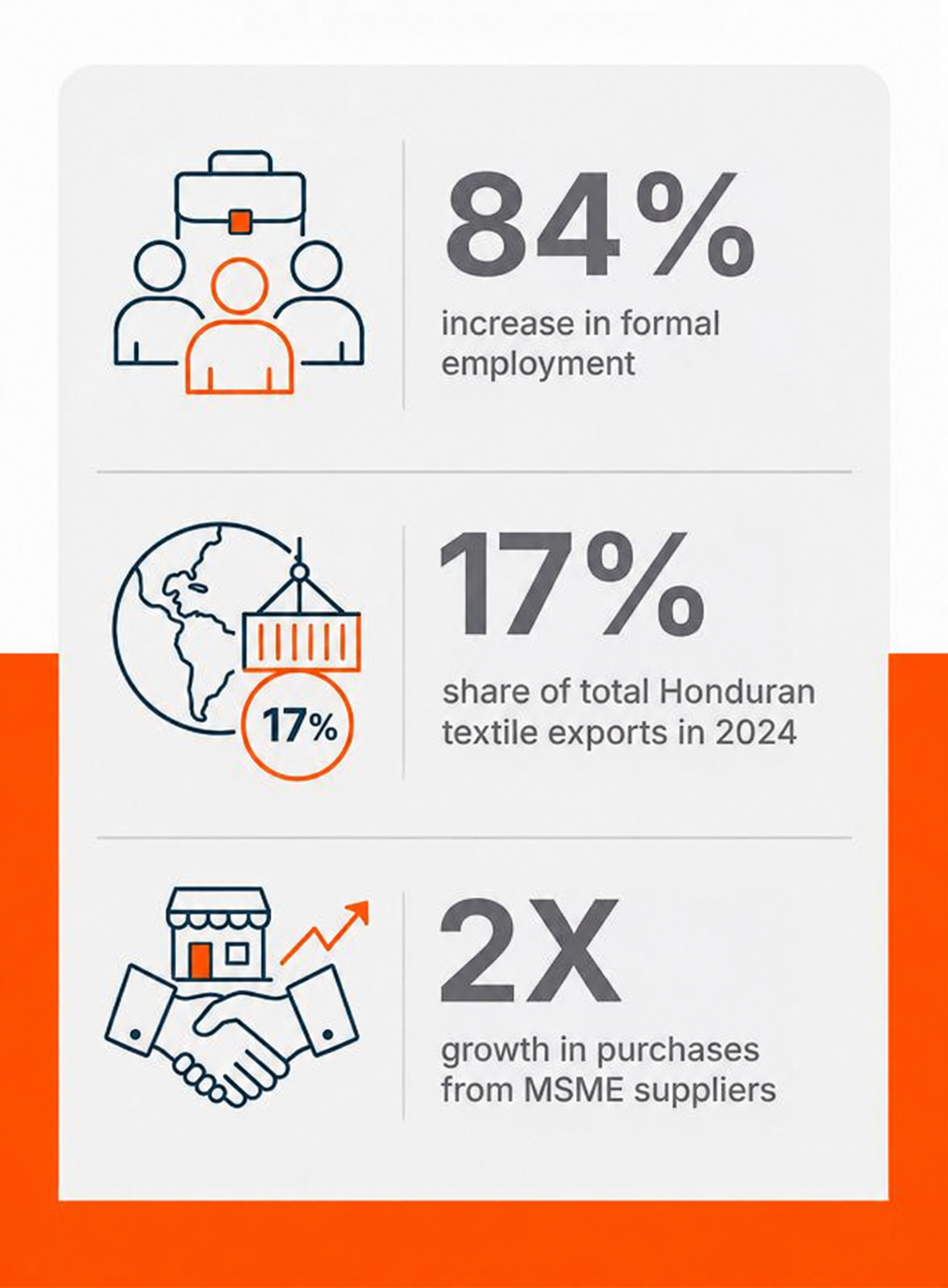
As production lines expanded, new processes were deployed, and the company scaled its operations to meet export demand, more workers were needed. Starting with around 7,300 employees in 2019, employment rose to an average of more than 12,000 formal permanent jobs from 2020-2024, exceeding the project’s original target by a third. By 2024, the company employed 13,425 people.
Exports followed a similar trajectory. Like many exporters, Elcatex faced a sharp downturn in 2020 as the pandemic disrupted global trade. As new production capacity came online, export volumes steadily recovered and revenues strengthened. By 2022, export performance was already outpacing initial targets, and the company continued to expand its footprint in international markets.
Over the life of the project, average annual export performance consistently exceeded expectations. In 2024, Elcatex’s export sales represented about 17% of the country’s total textile product exports that year, reinforcing Honduras’s position as a competitive supplier in the global textile industry.
Increased Sourcing from Local Suppliers
While the project aimed to strengthen local supply chains, the results were mixed. The number of local suppliers and micro, medium and small enterprises (MSMEs) in the supply chain fell short of targets, mostly due to the limited pool of local firms able to meet standards for export. However, purchases from local suppliers expanded significantly, reaching $110 million per year on average, and purchases specifically from MSME suppliers averaged $19 million, more than doubling expectations.
At the same time, both the number of and purchases from women-led MSMEs increased. For firms that could meet quality and scale requirements, Elcatex’s growth translated into larger contracts and more stable demand.
Challenges and Lessons
During implementation, the company faced a series of shocks, including the pandemic, supply chain disruptions, two hurricanes, and fluctuating buyer demand. Yet it maintained operations, avoided layoffs, and recovered key financial indicators within a year. Long-term financing provided by IDB Invest made it possible to invest through uncertainty rather than retreat from it.
Additionally, while Elcatex exceeded targets for exports, production, and formal, permanent job creation, expanding the number of domestic suppliers was more difficult than anticipated, reflecting structural constraints in the local supplier base and the scarcity of firms able to meet technical, scale, and compliance requirements. This signals the importance of investing in strengthening supplier capacity alongside anchor firms.
Taken together, this project shows how IDB Invest supports productive development through the private sector by enabling industrial expansion, translating capacity into exports and jobs, and helping firms remain resilient in volatile conditions. In Honduras, this helped build a stronger manufacturing base connected to global markets and rooted in the local economy.
Authors

Mariana Coello
Mariana is an Investment Officer at IDB Invest in Honduras, which she joined in 2017. She is responsible for developing new businesses and structuring sustainable projects in Honduras in sectors such as transportation, energy, water and sanitation, social infrastructure, agribusiness, telecommunications, media and technology, manufacturing, tourism and financial institutions. Before joining the IDB Group, she was Head of Corporate Business and SMEs in the credit area of Banco Ficensa, where she managed and structured projects in various sectors, acquiring more than fourteen years of experience in corporate banking. Mariana earned a master’s degree in business administration (MBA) from Florida International University (USA) and two master’s degrees in business management and Public Management from Universidad Tecnológica Centroamericana (UNITEC), and a professional degree in agribusiness administration engineering from Escuela Agrícola Panamericana (both in Honduras)

Joanne Riley
Joanne Riley is a Development Effectiveness Officer in the Development Effectiveness Division (DVF) of IDB Invest, where she works in the structuring, supervision, and evaluation of projects. Prior to joining the IDB Invest she worked in the Office of the Executive Director for the Caribbean at the Inter-American Development Bank (IDB) and the Government of Barbados. With over 25 years’ experience in monitoring and evaluation of projects, she has an MSc in Project Planning and Development from University of Bradford, United Kingdom.
LIKE WHAT YOU JUST READ?
Subscribe to our mailing list to stay informed on the latest IDB Invest news, blog posts, upcoming events, and to learn more about specific areas of interest.
SubscribeManufacturing
Related Posts
Scaling Manufacturing to Drive Jobs and Exports in Honduras
With long-term financing from IDB Invest, Grupo Elcatex in Honduras expands capacity, creates jobs, and connects to global markets.

Manufacturing 4.0: Digital Transformation as a Catalyst to Accelerate Development
Contributing 15.7% to the regional GDP, the manufacturing sector is a fundamental driver for the economies of Latin America and the Caribbean countries. New technologies are radically changing the way of production and becoming critical factors for the sector's competitiveness and resilience in the current market context.
Honduras, Where Low-Emission Manufacturing is Made Possible
Manufacturing is one of the main money-making, job-creating sectors in Central America. The current prices of renewable energy and the adoption of efficient practices are starting to cut the path towards carbon-low manufacturing, a competitive edge that could lead to export markets.