
Bridging the Digital Divide in Colombia
Through IDB Invest’s support for expanding rural mobile broadband – complemented by IDB-backed policy reforms and IDB Lab-financed innovative last-mile solutions – IDB Group is helping boost connectivity across Colombia.

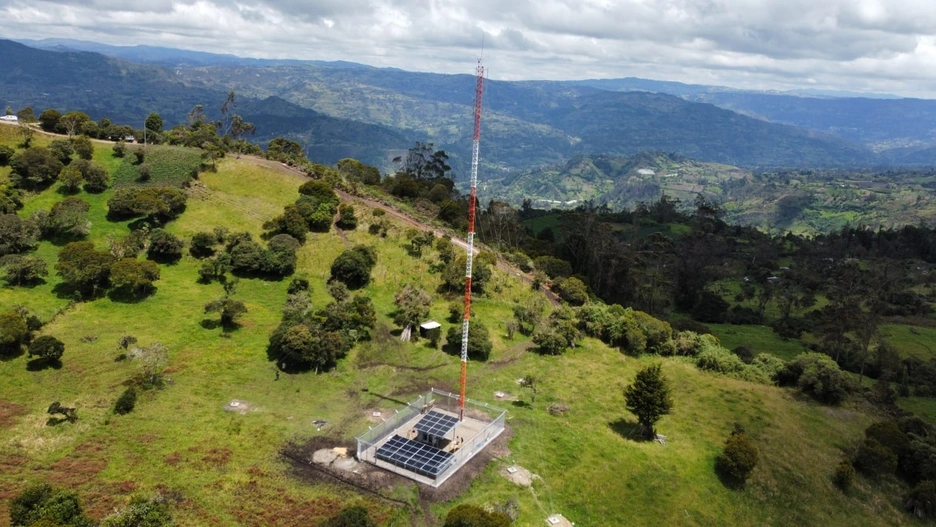
The digital divide in Colombia remains a significant challenge, particularly in rural and underserved areas, where access to reliable and high-speed internet is limited or current solutions fall short of meeting the needs of the most vulnerable populations.
An estimated $5.8 billion is needed in fixed and mobile broadband infrastructure investments to close the digital gap with OECD levels, 41% of which should go towards rural connectivity. This gap hinders economic growth, productivity, educational opportunities, and financial access.
The IDB Group has supported a combination of private sector broadband infrastructure expansion, regulatory reforms, and innovative digital service providers to expand connectivity across the country. These efforts are part of a broader strategy to enhance digital infrastructure and ensure that all citizens can benefit from the digital economy.
New or Improved Connectivity for Nearly One Million Vulnerable People
In 2021, IDB Invest partnered with Colombia Móvil S.A. (Tigo), a major player in the Colombian telecommunications industry, to support the expansion or upgrade of digital infrastructure in 1,255 high-poverty small rural towns and municipalities, home to over 1.3 million people. As of 2024, over 1,400 small rural towns were connected to the internet for the first time with the installation of 4G mobile broadband. Mobile service was also upgraded from 2G/3G to 4G in around 630 municipalities. Taken together, around 984,000 poor and vulnerable people now have access to high-speed data connectivity, putting digital health, education, and financial services within reach.
To promote usage of new mobile broadband connections in remote areas, the project also included technical assistance for two farmer associations in San Vicente de Caguán, a territory in the Amazon region. Producers enhanced their digital literacy and learned how to leverage digital tools for agricultural and conservation activities.
The expansion benefited from the regulatory framework established in 2019, which linked spectrum allocation to rural coverage obligations and helped incentivize network expansion into underserved areas. This encouraged private operators such as Colombia Móvil (Tigo) to expand networks beyond commercially attractive markets.
Sound Policies for Digital Transformation
Also helping to lay the foundation for greater private investment in digital infrastructure, from 2018-2020, an IDB-supported policy-based loan focused on improving connectivity and modernizing Colombia’s digital policy and regulatory framework. In a context of rapid technological change, it promoted information and communication technology (ICT) services, infrastructure development, and greater adoption of digital technologies by citizens, companies, and government.
These improvements were reflected in the country’s ranking on the governance dimension of the Network Readiness Index – from 97th globally in 2017 to 70th in 2024 – and a notable improvement in its ICT regulation maturity, which reached the highest Generation 4 status by 2020, according to the global ICT Regulatory Tracker.
Innovative Digital Services for Last-Mile Communities
Complementing private investment in rural connectivity, IDB Lab is advancing digital access for vulnerable communities in Bogotá, Cartagena, Barranquilla, and other large cities through innovative business models. Through a $2 million loan from the Social Entrepreneurship Program, IDB Lab is financing the expansion of Fibrazo, a social enterprise that delivers high-speed, fiber-optic internet to low-income urban households.
What makes Fibrazo unique is its community-centered model: it offers prepaid internet with no contracts, no installation fees, and no need for a bank account or formal address – removing the most common barriers to connectivity for families with informal incomes. Customers can pay in small increments, even weekly, and access a free trial before committing. As of 2024, over 33,000 households were connected, 63% of which had never had broadband before, and 92 schools were receiving free internet.
Challenges and Lessons
On the policy front, the IDB program demonstrates the importance of progressively combining regulatory framework reforms with technical capacity building across different sectors.
For the network expansion, bringing new and improved mobile broadband coverage to sparsely populated rural areas was inherently challenging because private telecom operators typically do not serve them. That is why the clear regulatory framework was critical. It provided certainty regarding coverage obligations and timelines, which helped the operator plan investments accordingly.
Fibrazo’s experience shows that well-designed free trials can be highly effective for scaling broadband adoption. By temporarily removing financial and commitment barriers, a two‑week free trial enabled low‑income households to experience broadband services directly, driving a 97% conversion rate, strong retention, and penetration well above traditional providers. Most new users (60%) cited education as the primary use, underscoring the social value of expanded connectivity.
Together, these complementary public and private efforts illustrate how sound regulation, private investment, and innovative business models can work in tandem to bridge the digital divide across Colombia.
Authors

Diego Margot
Diego es economista en la División de Efectividad en el Desarrollo de BID Invest. Su especialidad es el análisis económico y la regulación de los sectores de infraestructura y telecomunicaciones. Tiene experiencia en el análisis de impacto en el desarrollo y en el financiamiento de proyectos de infraestructura. Anteriormente, Diego trabajó en la gerencia del Departamento de Infraestructura y Medio Ambiente del BID y en la agencia de antitrust de Argentina. Tiene un doctorado en economía de la Universidad de Illinois (EE. UU.) y una maestría en economía de la Universidad Nacional de La Plata (Argentina).

Edgar L. Cabañas
Edgar is an experienced professional in the field of structuring corporate finance, credit guarantees, supply chain finance, equity investments and project finance. He leads investment project teams within the Digital Economy at the Inter-American Investment Corporation (IDB Invest). In 2014, he received the prestigious IDB Ortiz Mena award by the Inter-American Development Bank for improving efficiency and corporate solutions of the Bank through an innovative long-term local currency financing product and in 2019 & 2020 the LatinFinance Social Infrastructure Deal of the year and IJ Global Telecom of the year respectively for the equity investment in Internet Para Todos (Peru). With solid experience in leading a diverse pool of professionals, client relationship management, business development, structuring, and managing complex, multi-million dollar financial transactions in Latin America in industrial sectors such as cement, agribusiness, pulp and paper, textile, and telecom. Before the IDB Invest, he held a number of positions at the Inter-American Development Bank (IDB) including Advisor to the Executive Director for Uruguay, Bolivia, and Paraguay, Alternate Executive Director at the Multilateral Investment Fund, Private Sector Country Coordinator and Senior Investment Officer at the Inter-American Development Bank. Prior to joining the IDB Group, he worked as a Corporate Relationship Manager and Head of the Stress Asset Management Unit at Citigroup. He holds an MBA and MPA from the American University of Paraguay, and Kansas State University, including postgraduate studies in conflict resolution & Negotiation Mastery at Georgetown University and Harvard University respectively.

Luis Alejandro Fernández
Luis Alejandro is a senior investment officer in the Venture Capital Investments Unit at IDB Lab, with more than 12 years of experience in international development finance focused on the private sector. He originates, structures, and supervises a portfolio of development impact investments across Latin America and the Caribbean, including structured debt, venture debt, quasi-equity, and equity investments.
He has strong expertise in negotiation, advanced corporate finance, innovation, impact investing, and venture capital.
Luis Alejandro holds an MBA from INCAE Business School, where he graduated magna cum laude with concentrations in finance and sustainable development. He also holds an advanced specialization in corporate finance from NYU Stern.

Pau Puig Gabarró
Pau holds bachelor's and master's degrees in telecommunications engineering, as well as a postgraduate degree in business management and a master's degree in international business administration. Since 2016, he has worked at the Inter-American Development Bank as a senior telecommunications specialist, supporting governments in Latin America and the Caribbean in reforming public policies related to digital technologies and in planning and implementing investments in telecommunications infrastructure.
LIKE WHAT YOU JUST READ?
Subscribe to our mailing list to stay informed on the latest IDB Invest news, blog posts, upcoming events, and to learn more about specific areas of interest.
SubscribeDevelopment Impact
Related Posts

Supporting Argentine SMEs: Financing for Working Capital and Investment
IDB Invest is helping strengthen Argentina's private sector through long-term financing and reverse factoring solutions that improve small and medium-sized enterprises' access to liquidity.
Three Takeaways From our 2026 Impact Report
Learn how IDB Invest's portfolio is performing on development impact.
WE Finance Code Colombia: Data and Partnerships to Expand Financing for Women-Led Businesses
Financial sector stakeholders across Colombia are joining forces to expand women entrepreneurs’ access to credit through data, collaboration, and financial solutions tailored to their needs.