
Leveraging Knowledge to Scale Impact in Latin America and the Caribbean
In a world of information overload, how do we make sense of the data that surrounds us? How do we use it to create positive change in our region and beyond? At IDB Invest, we believe that the answer lies in knowledge. It helps us build a bridge that connects people and insights to actions that matter to advance the Sustainable Development Goals (SDGs). By leveraging knowledge, IDB Invest can scale impact across Latin America and the Caribbean (LAC).


As a multilateral development bank focused on the private sector, knowledge is vital to IDB Invest to continue financing sustainable projects and to support the private sector in the region. We create knowledge to assess potential opportunities, address development challenges, influence markets, embrace best practices for the private sector, help mobilize investments beyond our balance sheet and catalyze private innovation.
Our value proposition for knowledge management aims to augment the impact of our work by influencing both external and internal stakeholders. Keeping up with new trends and innovative solutions is vital; for example, understanding how the emergence of AI can benefit the process, our organization, and our stakeholders.
One of the main objectives of knowledge management is to sharpen external influence by generating knowledge that is tested, cutting-edge, timely, and relevant.
We are building a knowledge agenda that guides the production and dissemination of knowledge, incentivizes collaboration, and allocates resources to maximize impact. This can be done by identifying strategic topics, engaging with experts, analyzing, and disseminating findings.
We promote sharing knowledge by fostering collaboration and generating quality publications that contribute to the knowledge frontier in LAC, using our practical experiences to offer insights to stakeholders. We produce content that reflects our learnings, failures, successes, and recommendations across various sectors and themes. One example of how we do this is our Sustainability Week, a forum where we bring public and private sector leaders to discuss and learn about sustainability issues.
We produce knowledge that drives impact at scale for investors and stakeholders, builds capacity, and provides greater value for our clients. Beyond offering knowledge products and services, we create knowledge solutions that address their needs and challenges.
An example is the case of Konfio. Konfio is a fintech company that provides loans to MSMEs in Mexico, with a particular focus on women-owned businesses, using fair and transparent algorithms. A study by IDB Invest and Konfio found that Konfio's loans increased the sales growth of all MSMEs by 19.4%, and by 41.9% for women-owned ones. This demonstrates the potential of fintech in promoting financial inclusion and gender equality in Mexico.
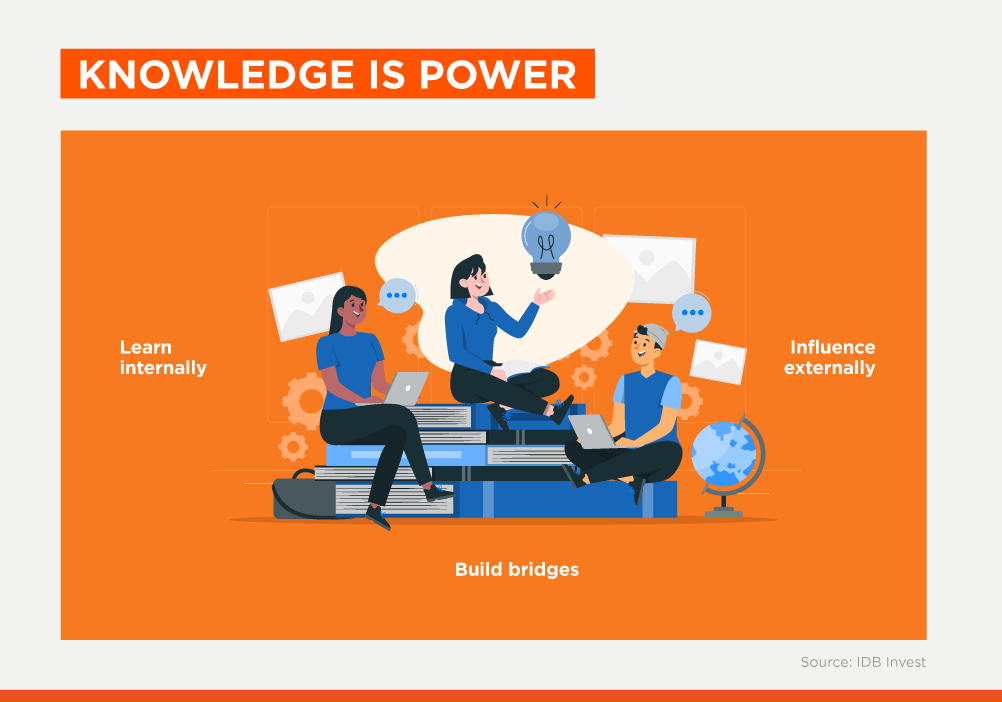
Another key objective of knowledge management is to enhance internal learning.
It’s been said before that knowledge is power. When employees spend less time searching for information needed to complete daily tasks, they become more efficient and have more time to engage in activities that add value to the organization.
At IDB Invest, we approach all our projects with this in mind. We are always striving to learn from our operations and the experiences gained by our employees through their work with clients and other stakeholders in the region. We believe that this open-minded and analytical approach bolsters our decision-making skills and helps to avoid repeating mistakes while replicating good practices.
Additionally, we aim to support cross-cutting priorities to become a gender- and climate-smart institution. We do this by packaging our knowledge in a reliable and actionable way with easy access. This boosts employee focus, productivity and operational efficiency.
Knowledge management also contributes to internal cultural transformation, increasing organizational capacities by developing new skills within the workforce, facilitating peer learning, and making relevant information available to all. This fosters a culture of collaboration, innovation and continuous improvement.
Building bridges to connect people and share insights
To support our knowledge value proposition, we actively seek synergies across the IDB Group, leveraging expertise, experience, and networks, to building bridges connecting people and insights. For example, this week we participated in IDB Group’s Knowledge Week, a hybrid event where global experts shared the latest trends on financial inclusion, gender equity, sustainable infrastructure, climate change and development impact. We also partner with other organizations across the region and beyond to keep up with trends and to promote innovation.
Processes and technology play an important role as well. Technology helps to automate toolsets and to systematize processes facilitating knowledge sharing. The integration of organizational systems improves efficiency and user experience. The incorporation of user experience in the design of processes ensures that systems are more intuitive and easier to use.
The value of knowledge cannot be overstated. It is an important catalyst for organizations to learn from experience facilitate professional growth and understand customer needs. After all, information without insights is little more than data.
At IDB Invest, we are committed to building a bridge that connects people and insights to actions that matter to achieving our development mission. We believe that, by leveraging knowledge, we can scale up the impact of our work for the benefit of our region.
Authors

Alejandra Haro
Alejandra is a Knowledge Management Consultant at IDB Invest. In this role, she leads institutional efforts to promote knowledge sharing on key topics including governance, content management, accessibility, and engagement. Prior to joining IDB Invest, Alejandra held positions related to Learning and Knowledge Management at IFC, Wayfair, General Electric, and Willis Towers Watson.

Gabriel Azevedo
Luiz Gabriel Todt de Azevedo (Gabriel Azevedo) is Head of the IDB Group Amazon Coordination Unit. During his 35+ year career in international development, the private sector, academia, and civil society, he has developed a unique perspective on strategic leadership, political economy, partnerships, and collective action. He has held various leadership positions, including seven years as Managing Director of the Environmental, Social and Corporate Governance (ESG) Division at IDB Invest. He has worked in development projects in more than forty-five countries, focusing on areas such as energy, water supply and sanitation, natural resource management, agribusiness, social innovation, and environmental management. He has worked in renowned institutions such as the World Bank, the World Wildlife Fund for Conservation (WWF), and Construtora Norberto Odebrecht.
Gabriel served as Board Member and Member of the Financing and Audit Committee of the Brazilian Biodiversity Fund (FUNBIO). He was Vice Presidente and President of Brazilian Water Resources Association (ABRHidro) and seats on its Consultative Board. He is also an observer to the Board of the International Hydropower Association (IHA). He has received numerous awards in recognition of his professional achievements. Additionally, he has published numerous articles, short papers, blogs, and book chapters in his field of expertise.
Gabriel is a civil engineer from the Federal University of Bahia in Brazil and holds a M.Sc. and a Ph.D. in Civil Engineering - Hydrology and Water Resources Management from Colorado State University.
LIKE WHAT YOU JUST READ?
Subscribe to our mailing list to stay informed on the latest IDB Invest news, blog posts, upcoming events, and to learn more about specific areas of interest.
SubscribeClimate change
Related Posts

2024, the Year the World Turned Its Eyes to the Amazon Region
The "lungs of the planet," was one of the major topics of the past twelve months. Despite significant challenges, the region has much to offer regarding global solutions that drive sustainable development. Here is a selection of blogs we published on the topic.

Addressing Climate Change Through Improved Business Continuity
The increasing impact of climate change on the Caribbean, emphasizes the need for effective business continuity management to mitigate disruptions.

Assessing Climate Risks Is Vital for Companies, the Economy and the Environment
Although each company’s adaptation strategies must be tailored to its unique circumstances, ignoring climate change is never wise. Conducting a professional assessment is the best approach to making informed decisions.