
Integrating Green Finance Into the Core Business of Financial Institutions
Green finance in the private sector was predominantly linked to corporate responsibility. It’s now the time to integrate climate action into the core business of financial institutions.


Green finance in the private financial sector used to pursue high-impact goals predominantly linked to corporate responsibility. The time is ripe to incorporate it into the core business strategy.
For two decades now, the financial sector has embraced social responsibility by treating green finance as additional, and to some extent secondary, to its operations. Now, a sense of urgency for action and change needs to be infused in order to mitigate the large-scale impacts of climate change on the economic system and to avoid rising inequality and poverty levels as sustainable development in LAC countries slows down.
To put it simply, the core business of a financial institution includes adequate risk management and strategic business management. With adequate risk management practices, institutions can leverage sufficient income on financial intermediation, while protecting third-party capital and their own equity from expected losses, which are forecasted and mitigated by identifying and managing the relevant risks of financing activities.
The need to take urgent climate action requires increasing green climate finance and highlighting a systemic, relevant and very likely risk that has a negative physical impact and results in an increase in expected losses due to higher, unmanaged risks. In order to reduce the exposure to this risk, it is necessary to shift from a business that finances high-exposure investment portfolios to low-exposure portfolios, with the resulting transition risk.
Focusing on climate risk management by adopting the right governance, risk management and measurement structures, as well as on the business strategy dimension will help financial institutions to better manage the process. This dimension needs to be implemented as soon as possible.
To this end, there are recommendations from the Task Force on Climate-related Financial Disclosures (TCFD), as well as the standard currently being developed by the International Sustainability Standards Board (ISSB) that will integrate TCFD recommendations and, more recently, the “Principles for the effective management and supervision of climate-related financial risks” issued in June 2022 by the Basel Committee on Banking Supervision, from which supervisors and regulators will soon be integrating these ideas. The Inter-American Development Bank has also put forward its own recommendations.
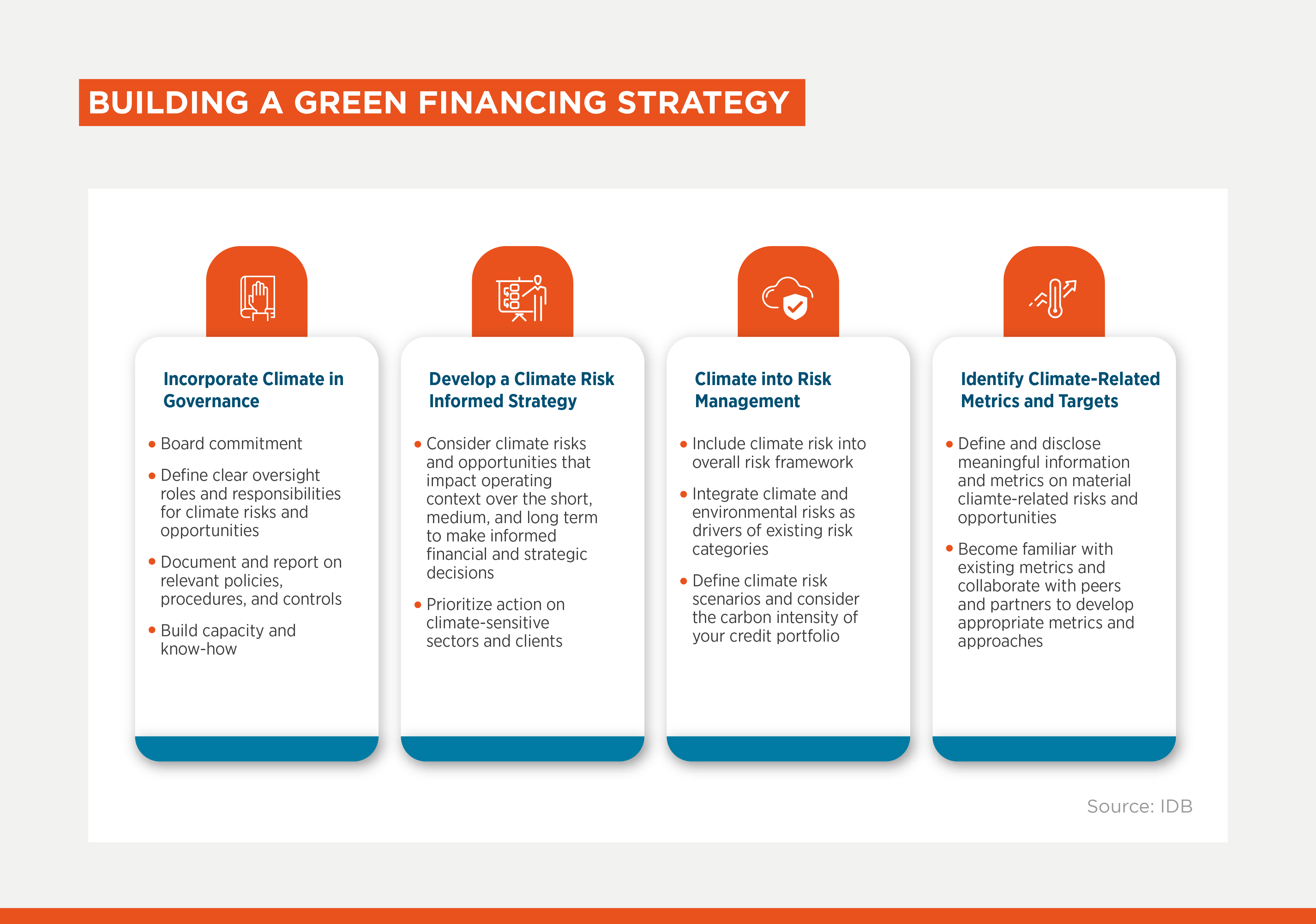
As a second relevant dimension, the necessary transition in the business strategy approach requires analyzing the design of business lines, financial products and non-financial services for priority segments, as well as establishing next-generation risk management systems to identify business segments with climate risk exposure.
You may review the conferences on Green Financial Innovation held in June 2022 at the Sustainability Week, organized by IDB Invest in Miami, Florida, showcasing specific actions that financial institutions are taking in Latin America and the Caribbean and the latest trends in this topic.
As an example of this second dimension, Fundación Génesis Empresarial, a leading microfinance institution in Central America, explained how they focused on managing climate risks in agricultural value chains, using innovative technologies. As a result, they have a new green business line that supports sustainable agriculture and poverty reduction for rural populations, allowing them to grow from 2,000 to 17,000 customers in three years.
You may download the full case study showcasing practical and concrete examples on how to accelerate climate action in the core business of financial institutions.
Authors

Luis Alejandro Mejía
Luis Alejandro is Lead Advisory Officer in IDB Invest, where he oversees the Sustainable Finance advisory practice for investment

Jan Petter Eskildsen
Jan Petter Eskildsen, Director, Financial Sector Central America, Mexico, and the Dominican Republic, BID InvestJan is the Director of Financial Servi
LIKE WHAT YOU JUST READ?
Subscribe to our mailing list to stay informed on the latest IDB Invest news, blog posts, upcoming events, and to learn more about specific areas of interest.
SubscribeDigital Economy
Related Posts

Financial Health: Driving Growth in Latin America and the Caribbean
According to the latest Global Findex database, the proportion of adults in Latin America and the Caribbean (LAC) with account ownership rose from 39% in 2011 to over 75% in 2025. This increase was driven by the rise of digital-first financial service providers, expanded government transfers, and innovations that enhance the value proposition, such as the growth of e-commerce and instant payment systems in countries like Brazil, Peru, and Costa Rica.

Microinsurance: The New Frontier for Financial Resilience in Latin America and the Caribbean
In Latin America and the Caribbean, fewer than 10% of people with potential access currently use microinsurance services. However, this gap in financial protection is beginning to narrow. The expansion of the insurtech ecosystem is transforming the insurance sector, deploying digital and innovative solutions that strengthen financial protection for the most vulnerable populations.

Five Drivers Reshaping Finance in Latin America and the Caribbean
The tech revolution is breaking down structural financial barriers across Latin America and the Caribbean. Informal workers, rural communities, and small businesses are gaining rapid access to digital savings accounts, microloans, and instant transactions, often at little or no cost. But what’s really driving this transformation?