
Sustainable BusinessRecent posts
Corporate Governance: Practical Sessions from Family Business to AI Oversight
Strong governance is what turns sustainability goals into results. At Sustainability Week 2026 in Barbados, join free training sessions on family governance, AI oversight, and SOE continuity, available online on May 25.

Not Impact Measurement. Impact.
MDBs are pioneering a new profession for results in a data-rich world. This blog was originally posted by the World Bank on April 21, 2026, by the Heads of Outcome Measurement of Multilateral and Bilateral Development Agencies, including IDB Invest.
The Rules Have Changed: Sustainability Is Now the Price of Entry for Investment in Latin America and the Caribbean
Discover how, at Sustainability Week, May 26–28, private-sector leaders turn resilience into investable, scalable growth.

Sharing is caring: Two solutions for more sustainable living
Have you ever considered how much you use your most valuable items? A personal automobile, for example, is only used five percent of the time – even less in urban areas. Fortunately, private and public sector actors are realizing how little we use individual items and proposing unique ways to be a bit more utilitarian, environmentally-conscious and community-oriented. The key is sharing.
-
Three Assumptions You Should Avoid When Working with the BoP
“I like working in something I love, where I receive compliments and I manage my own time,” said Carlos, a 43-year old man, father of two, who earns less than U$360 per month. He was one of the 10 men and women we gathered in Villa El Salvador in Lima, Peru, for a focus group on the consumption preferences of low-income people. His response to the question about the advantages of a formal, stable job made me realize people and organizations (me included) working with those at the base of the pyramid (BoP) tend to make subtle assumptions about this segment of the population – assumptions that impact the effectiveness of our projects to benefit this population.

What can Latin American countries learn from Korea in energy efficiency?
*By Narae Lee If you dig a hole through the center of the Earth, starting from Montevideo in Uruguay, you would get to Seoul, the capital of South Korea. Korea and Uruguay are the antipodes, meaning that they are diametrically opposite to each other. Korea is indeed one of the farthest countries from Latin America, seemingly not having many things in common with the region either. However, the Asian tiger has recently increased its visibility on the other end of the planet through Korean companies and celebrities in mass culture and sports, but most importantly by sharing its development experience.
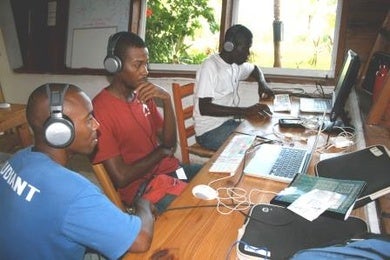
Wish there were more hours in the day? Distance learning can maximize time and earning potential
Doesn’t it always seem like there aren’t enough hours in the day? How can we possibly fit it all in? The same is true for young people in Latin America and the Caribbean - especially those in lower income or vulnerable communities. For the high school graduates, many aren’t able to go directly to university for financial, family or other reasons. For example, Estacio, a large private university in Brazil, estimates that approximately 40% of high school graduates in Brazil go directly to university. Many others start a job, or a family or both.

Can innovations in healthcare technology leapfrog to better solutions?
In our experience at the IDB, healthcare systems in many countries in Latin America and the Caribbean (LAC) suffer from severe resource constraints. Competing health priorities, budget restrictions, staff shortages and general technological deficiencies leave large segments of the population without basic treatment.

The Caribbean Private Sector: How to expand lending
“All cassava have the same skin, but all don’t taste the same way,” is a Caribbean proverb which serves as a reminder that while people may appear alike on the outside, each is quite unique on the inside. The saying, which first originated in Guyana, speaks about the individuality of people, yet it also resonates with me as a development professional when thinking about the diversity of the Caribbean economies. From what I have seen, each country in this region offers a distinct mix of cultural richness, entrepreneurialism, sector expertise, biodiversity, natural resources and much more.
