
Sustainable BusinessRecent posts
What Drives Business Growth in Colombia? Six Key Factors
Initial capital has long been understood as a driver of business growth, but in Colombia, how much capital is needed to grow?

Sustainable Financing for Construction in Mexico: Banco Inmobiliario Mexicano’s Framework
A sustainable financing framework to strengthen Mexico’s construction sector and help reduce the country’s housing deficit.

Building the Market While Building the Network: Tigo Paraguay’s 10 Year Local Currency Bond
IDB Invest acted as an anchor investor, strengthening confidence among local market participants in Paraguay to finance digital infrastructure.


Por qué digo que no a los paneles de solo hombres
Como alguien que trabaja en desarrollo internacional, a menudo participo en debates sobre igualdad de género. Lamentamos que haya muy poca participación de mujeres emprendedoras, clientes de bancos, líderes políticos y directoras ejecutivas.
Food for thought on World Food Day
The number of individuals who suffer from some kind of malnutrition today almost equals the number of adults who are overweight or obese - 2 billion people globally. Calorie deficiency, lack of micronutrients in the diet and other forms of malnutrition create obvious development challenges, especially for children.

Would a women’s club break the hegemony of the men’s club?
* By Maria Teresa Villanueva and Ana Isabel Rodríguez Iglesias You could play a game to find the seven differences in photographs of boards of chambers of commerce in Latin America and the Caribbean. At first glance, they all look very similar: white men between 50 and 60 years old, wearing suits and ties. A quick review of the composition of boards or councils of seven chambers of commerce in the region (in Argentina, Chile, Colombia, Jamaica, Mexico, Panama, and Peru) reveals that 91% of their members are men and only 9% are women.

Banks can make the world a better place — here’s how
* By Angela Miller When people are asked to name institutions they trust, banks rarely top the list. In fact, they don’t usually make it among the top five. According to the Edelman Trust Barometer, the financial sector is among the least trusted industries, a position it has held since the height of the global financial crisis in 2008.

A survival guide for business: The role of corporate governance and sustainability
By Rocío Budetta and Andrea Ortega Químicas Veterinarias is a small producer and distributor of veterinary products in Nicaragua. The Hoigjelle family founded the company in 1999, and since then it has met with success in this Central American country with a market of more than 120,000 micro, small, and medium-sized enterprises.
Greening corporate value chains lowers environmental impact and lifts competitiveness
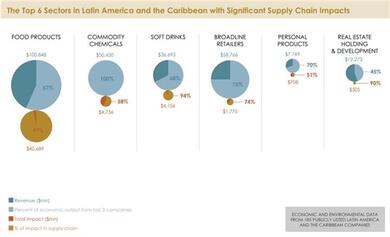
By David Bloomgarden and Michael Hofmann Adidas, one of the world’s top two sportswear manufacturers, recently ended its business relationship with 13 of its Asian suppliers as a result of their severe or repeated noncompliance with labor, health, and safety workplace standards at their factories. This is one example of large multinational corporations working harder to demonstrate to their ever-more-demanding stakeholders that they operate sustainably. As a result, companies’ sustainability strategies are increasingly directly relevant to their operations—and are resulting in positive financial returns. An analysis of S&P 500 companies confirmed that businesses that have built sustainability into their core strategies achieve financial profitability that is significantly higher than that of their laggard peers—by between 18% and 67%.
