
Posts by Energy

Climate finance and Climate Investment Funds
What do Bob Marley and climate change have in common? Never would I have thought there might be a connection between Bob Marley and climate change. "It's all about 'One Love,'" repeated the Honorable Minister Ian Hayles of Water, Land, Environment and Climate Change, when he opened the Climate Investment Fund (CIF) Partnership Forum in Montego Bay, Jamaica. Obviously the minister realizes it is slightly more complicated than just “one love.” But starting with a little love, and, equally importantly, simplicity made the issue of climate change a tad more entertaining and understandable for the 500 plus global participants at this week’s event.
Energy Efficiency: A game changer for business & the environment
Energy efficiency is a simple concept. Do more with less. Channeled through a wide array of industries and organizational departments in Latin America and the Caribbean and elsewhere, a serious approach to energy efficiency has many winners - consumers, private firms and governments.

Renewable Energy: Approaching the tipping point
Renewable Energy: Approaching the tipping point Imagine pushing a cumbersome and heavy ball up a steep incline with the goal of arriving at the top and having it roll down the other side by itself to a final destination. The initial time invested and physical strength exerted would seem worthwhile if you could just arrive at the summit – the tipping point. This is oftentimes the feeling in the renewable energy sector in Latin America and the Caribbean (LAC). Although there is increasing activity in renewable projects and frameworks, developers, investors, engineers and others in the relatively nascent industry in LAC seem to be trudging up a hill, sweating and hoping that the industry can soon move itself without assistance. http://vimeo.com/65930811
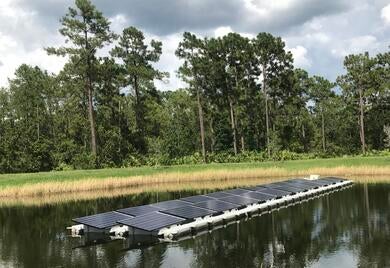
Can 'flotovoltaics' be a future partner for hydropower systems?
To address changing paradigms, a new technology has been proposed: hydropower plants that enable solar generation or hybrid hydro-solar systems.
Solar energy: The revolution spurring development in Honduras
When Invema plant, the main plastic recycler in Honduras starts operating, a success formula resonates. It is one of the commercial companies that took advantage of the photovoltaic energy boom in the country. Its case demonstrates how the private sector’s investment in solar energy can facilitate greater economic and sustainable development for the country. Six years ago, the executives of the firm decided to install solar panels in the company, so it could generate its own power. This initiative promised a 20% reduction in energy consumption as well as a significant reduction in greenhouse gases emissions of polluting gases. And so it was. Today, Invema obtains energy savings up to 30% in electricity and reinvests in the focus of its business, recycling, so much so that it is now manufacturing the bottles that Coca-Cola uses in Central America. “We are very proud, because thanks to the solar panels, IDB Invest’s doors/channels opened up and allowed us to make the investments we dreamed,” says George Gatlin, the manager of Invema, which is located in the northern city of San Pedro Sula. Invema is part of many companies and private consortia that have opted for photovoltaic energy since Honduras decided to reform its electricity subsector to revert its electricity matrix from thermal to renewable. The reforms began in 2012, when generation using fossil fuels accounted for 70% compared to 30% for renewables. This thermal hegemony was reflected in increasing oil billing, carbon dioxide emissions, high tariffs up to US$0.30 per kilowatt (KW) produced, and frequent rationing. Following the reforms, led by the government with the advisory services of the Inter-American Development Bank (IDB), there was an upsurge in renewable energy until the energy matrix was completely reversed compared to 2012. The latest report from the Central Bank of Honduras (BCH) in 2018 records a 75% electricity generation based on renewable sources, and an 11% share of photovoltaic energy. This percentage translated into 433 megawatts (MW) of installed capacity at the end of 2016, placing Honduras in the lead of solar generation in Central America and third in Latin America, after Chile and Mexico. “We are witnessing a revolution in the electricity sector, not just in Honduras, but worldwide, because energy storage is changing the concept, points out Carlos Jácome, IDB energy specialist who has participated in the reforms process in Honduras. “The Bank support comprises studies and soft financing. Later, the savings make it possible to improve the productivity of these companies because they can use what they no longer pay in energy to expand their businesses,” comments Jácome. Since 2012, the IDB and IDB Invest have provided technical assistance to Honduran commercial, industrial, and institutional sectors to investigate the technical and financial feasibility of photovoltaic projects. To date, 22 studies have been completed for projects ranging from 40 kilowatts (kW) to nearly 3 MW of installed capacity. Official reports indicate that interest in photovoltaic projects have increased due to a reduction in about 40% of the installation costs over the last five years. Behind this innovation there are three combined components that have resulted in a successful formula: i) the impetus of government that created favorable conditions for investment; ii) the decisions made by entrepreneurial companies; and iii) the IDB’s ability to evaluate and finance the projects. The initial investments in photovoltaic development in Honduras involved a shared risk for IDB Invest and its clients. Nonetheless, what made the difference is the technical capabilities of the Bank for evaluating and support for this type of investments. The Honduran experience encourages entrepreneurship and new markets while demonstrating that IDB Invest is the partner of choice for innovative markets. Experiences of this kind should be replicated in the region. The first photovoltaic investments began in 2015, when 388 MW were installed, followed by 45 MV more in 2016, according to reports from the National Electrical Energy Company (ENEE). According to the ENEE, the Honduran commercial and industrial solar energy market is quite different from what it was in 2012, starting with changes in electricity billing (between 11 and 18 cents per kW per hour), installation costs for panels, legal regulations, and the availability of photovoltaic manpower in the region. In addition to this, national capacities have developed with the installation and administration of photovoltaic projects. “Before, if a Canadian, Spaniard or a Costa Rican person did not show up to supervise the project it didn’t move forward. Now the Hondurans themselves have been strengthening all these positions. There is a friendly environment for investment,” notes Elsia Paz, President of the Honduran Renewable Energy Association (EHER), one of the entities that emerged in the context of these reforms. Download the full story here: “Solar Energy: The Revolution Spurring Development in Honduras” Subscribe to receive more content like this! [mc4wp_form]
What powers Chile's energy transformation?
Recently The New York Times highlighted Chile’s energy transformation. The profile told the story of Chile’s clean energy market revolution. However, missing from the story was one key component that facilitated Chile’s sustainable energy surge: donor funds. Donor funds supported by governments can lower cost and risk barriers, which limit financing for renewable energy projects. Donor funds invest in untested technologies and new markets, while also adhering to the highest social and environmental standards. Their purpose is to jumpstart climate-friendly investments in developing countries. In 2008, Chile had less than 20 megawatts (MW) of installed non-conventional renewable energy (NCRE), such as wind, solar and geothermal. The government’s Energy 2050 law set a target to increase Chile’s share of renewable energy to at least 60% by 2035. Despite developers’ enthusiasm for Chile’s stable political environment and resource endowment, which includes over 300 days of sunshine per year in the Atacama Desert, local banks had little or no experience with NCRE technologies. Donor funds: able to overcome cost and risk barriers But with access to donor funds, other organisms, such as multilaterals can deploy financial structures that overcome certain cost and risk barriers, making projects feasible for developers. Funds like the Clean Technology Fund (CTF) and the Canadian Climate Fund for the Private Sector in the Americas (C2F) allow us to “blend” our capital and ultimately take more risks. For example, in 2013, IDB Invest (formerly known as Inter-American Investment Corporation) used a C2F loan plus our own financing for Pozo Almonte and Calama Solar, Latin America’s first large-scale photovoltaic plants. The Chilean market evolved rapidly. By 2014, the Crucero solar project, which IDB Invest also financed, piqued the interest of a commercial bank. Soon commercial banks fully financed hundreds of megawatts of NCRE. Today, solar photovoltaic in Chile no longer needs donor money. Thanks in large part to donor funds, IDB Invest financed five photovoltaic projects in Chile and recently completed our first wind project, contributing to Chile’s 3,400 MW of NCRE. A recent Inspiratia article, which covered the Aela wind farm, recognized, “for Aela, the [IDB Invest] involvement was key, not only from a ticket size perspective, but also in helping the commercial banks get comfortable with the transaction. In the Cerro Pabellon geothermal plant, by channeling resources from the CTF, for which IDB Invest is the implementing entity, IDB Invest provided an insurance-like financial instrument to Enel Green Power to offset the high cost and risk associated with exploratory geothermal drilling — a risk most commercial lenders and insurance providers are typically unwilling to take. Development banks are one of the few players positioned to test first-mover risks and provide long-term tenors; however, it is the donor funds that are perhaps the unsung heroes of Chile’s energy transformation. Market forces taking over where donor funds left off is a trend that transcends Chile. Uruguay, Costa Rica and now El Salvador have all contributed to Latin America’s renewable surge which is 53% of total energy generation compared to the 22% world average. Back in Chile, the lure of cleaner, commercially-viable energy is now attracting the next generation of industry. Companies like Amazon and Alphabet Inc.’s Google would like to set up data centers powered by this renewable energy. These firms create jobs and offer training to the Chilean workforce. And so the renewable energy story continues. Subscribe to receive more content like this! [mc4wp_form]