Sahara Dust Storms in the Caribbean, a Hazard For Both Humans and Coral Reefs

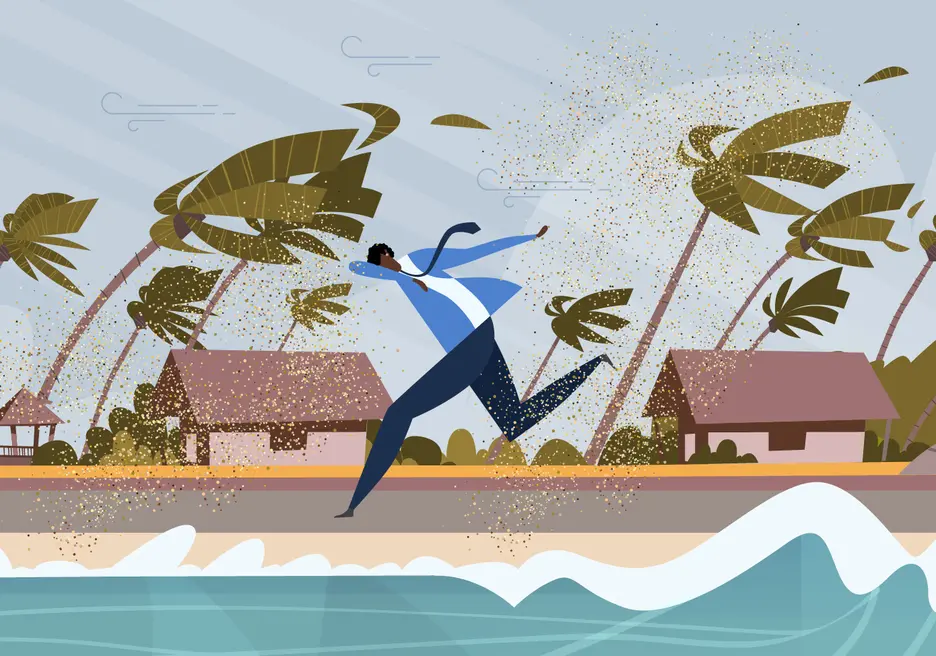
Imagine waking up one morning expecting a clear tropical sunrise, only to find that it was replaced by a dense dust haze that traveled 5000 thousand miles from the Sahara desert.
Although they sound like the stuff of dystopian fiction, Saharan dust plumes have been a reality for many living in the Caribbean and along the Gulf Coast for years. The annual phenomenon has recently ramped up in intensity, threatening the health of humans and coral reefs, and highlighting the exposure of the region to global climate trends.
According to the National Oceanic and Atmospheric Administration (NOAA), this trans-Atlantic disturbance is called "Saharan Air Layer," or SAL. It usually escalates in mid-June, peaks from late June to mid-August and rapidly declines thereafter. Interestingly, the dust itself is comprised of the “skeletons” of diatoms (single-celled algae) that existed in a mega-lake system over 7000 years ago in the area we now call the Sahara Desert.
You may also like:
- Extreme Outlier: The Pandemic’s Unprecedented Shock to Tourism in Latin America and the Caribbean
- Climate Change is a Threat to Economic Growth and to Reducing Income Inequality in Latin America and the Caribbean
- How exposed is Latin America to the trade effects of COVID-19?
This dust is rich in essential macronutrients and micronutrients that are highly beneficial to plants and acts as a source of nutrients to phytoplankton in the ocean; in addition, Saharan dust is believed to be the main mineral source that fertilizes the Amazon Basin, so it would seem that it takes an arid desert to nourish a lush tropical forest. The dust may have also helped build beaches in the Bahamas after being deposited over thousands of years.
Now, for the downsides. Recently, dust clouds have brought dangerously high levels of fine particulate pollution that can compromise the health of local residents with COVID-19 and other serious respiratory illnesses.
Dust leads to additional complications such as dry skin, asthma and desert lung syndrome. A recent IDB paper found that, in the case of Kingston, Jamaica, a mere 10% reduction in ambient air particulates could potentially improve health and reduce mortality with cost savings for the city starting at $6 million per year and rising to as much as $110 million per year.
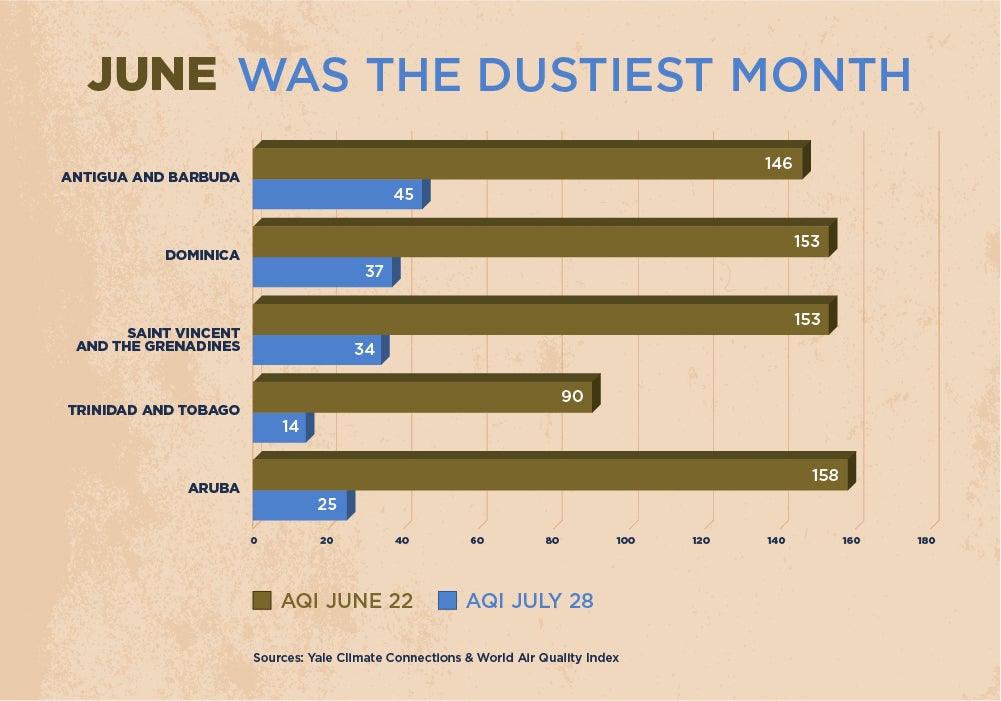
Still, in many Caribbean territories, the Air Quality Index (AQI) – a scale that runs from 0 to 500 – stayed in “unhealthy” levels, above 100, for much of last month.
The same territories have had an added visibility problem over the last two decades, an issue highlighted by the World Meteorological Organization (WMO) that affects worker safety in in multiple industries, of particular concern for BID Invest. Dust hazes are also a hindrance for the all-important tourism sector.
On top of that, the dust can contain hazardous materials: researchers at the United States Geologic Survey (USGS) have detected chemical contaminants (pesticides, microbial pathogens and more than 1000 taxa of bacteria in dust sampled within the U.S. Virgin Islands and Trinidad and Tobago.

Local coral is at risk because the samples included a strain of fungi known to cause disease and mortality in sea fans, a type of soft coral. In fact, SAL has been linked to a decline in the health of coral reefs across the Caribbean as far back as the 1970s and additional research has revealed that iron from the dust plays an essential role in triggering red tides (harmful algal blooms) along the west coast of Florida.
The obvious question is whether climate change is to blame. Locally, dust production is strongly influenced by surface wind patterns and can be excited by any weather phenomenon that affects wind speeds, such as the North Atlantic Oscillation, the El Nino/Southern Oscillation and the West African Monsoon.
It would make sense that a warming planet could produce more intense dust storms as research has shown that major dust episodes are linked to Northern African drought. But other studies have suggested that changes in wind patterns may decrease the transport of dust, so it's too early to tell if climate change will have an impact on future dust storms. What is certain is that the current episode has not been average.
The good news is that Saharan dust can temporarily suppress hurricane formation or keep storms from getting stronger since hot, dusty air tends to put a stop to thunderstorm development. With the Atlantic Hurricane season already started (it runs from June to November), this is welcome information for those living in the Caribbean and along the Gulf Coast.
Overall, SAL seems to be a global phenomenon that, as a planet, we cannot live without but, as a species, we are vulnerable to.■
LEARN HOW IDB INVEST CAN OFFER YOU SOLUTIONS HERE.
SUBSCRIBE AND RECEIVE RELATED CONTENT |
| [mc4wp_form] |
Escrito por

Chitralekha Deopersad
Chitralekha Deopersad es oficial social y ambiental de BID Invest con sede en la Oficina de País de Jamaica. Trabaja con clientes del sector privado en América Latina y el Caribe en los requisitos de protección ambiental (ambiental, social, de salud y seguridad) en apoyo de la evaluación del proyecto y el cumplimiento de las normas locales e internacionales. También participa en la racionalización del cambio climático y la gestión del riesgo de desastres y la adaptación a proyectos del sector privado. En su capacidad anterior, apoyó al sector público dentro de la División de Cambio Climático y Sostenibilidad del BID en la Oficina de País de Bahamas. Chitralekha también fue científico ambiental / costero en Trinidad y Tobago durante varios años y tiene una maestría en ingeniería y gestión costera de la Universidad de West Indies, St. Augustine.

Gabriel Azevedo
Luiz Gabriel Todt de Azevedo (Gabriel Azevedo) is Head of the IDB Group Amazon Coordination Unit. During his 35+ year career in international development, the private sector, academia, and civil society, he has developed a unique perspective on strategic leadership, political economy, partnerships, and collective action. He has held various leadership positions, including seven years as Managing Director of the Environmental, Social and Corporate Governance (ESG) Division at IDB Invest. He has worked in development projects in more than forty-five countries, focusing on areas such as energy, water supply and sanitation, natural resource management, agribusiness, social innovation, and environmental management. He has worked in renowned institutions such as the World Bank, the World Wildlife Fund for Conservation (WWF), and Construtora Norberto Odebrecht.
Gabriel served as Board Member and Member of the Financing and Audit Committee of the Brazilian Biodiversity Fund (FUNBIO). He was Vice Presidente and President of Brazilian Water Resources Association (ABRHidro) and seats on its Consultative Board. He is also an observer to the Board of the International Hydropower Association (IHA). He has received numerous awards in recognition of his professional achievements. Additionally, he has published numerous articles, short papers, blogs, and book chapters in his field of expertise.
Gabriel is a civil engineer from the Federal University of Bahia in Brazil and holds a M.Sc. and a Ph.D. in Civil Engineering - Hydrology and Water Resources Management from Colorado State University.
¿TE GUSTA LO QUE ACABAS DE LEER?
Suscríbase a nuestra newsletter para mantenerse informado sobre las últimas noticias de BID Invest, publicaciones de blog, próximos eventos y para obtener más información sobre áreas específicas de interés.
SuscribirseDigital Economy
Posts Relacionados

Financiamiento para la conectividad: cómo BID Invest y Nokia impulsan la infraestructura digital
Una solución de financiamiento que alinea la inversión en infraestructura con los ingresos futuros, permitiendo a los operadores ampliar el acceso a los servicios digitales.

Tecnología e innovación para modernizar el mercado de vivienda usada en Colombia
Habi moviliza con mayor eficiencia la oferta de vivienda disponible, ampliando las opciones habitacionales cuando más se necesitan.
Las torres de telecomunicaciones que sostienen la economía digital
IDB Invest financia infraestructura de torres de telecomunicaciones en América Latina y el Caribe para ampliar la conectividad y apoyar el despliegue de las redes 5G.