How we incentivize social inclusion through Sustainable Infrastructure? The case of Villa 31
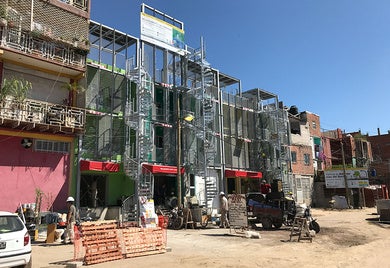
Recently I visited the Villa 31 in Buenos Aires, Argentina. It is a poor and informal neighborhood located at approximately 500 meters from La Recoleta, one of the most sophisticated areas of the Argentinian capital. Despite this proximity, near 45,000 residents at Villa 31 have lived in isolation, not accepted as true “porteños” by their neighbors due to the social and economic characteristic of their community. My hope is that a new development project of sustainable infrastructure in the area changes this scenario. During my visit, I met fantastic people, but I experienced a strong mix of feelings. 20 years ago, I worked on an urban rehabilitation project in Brazil, which provided new homes, electricity, water, and sanitation to hundreds of low income people. By the end of the project, high-level dignitaries from the Government and other entities visited the new homes. One of them approached a woman benefited by the project and asked: “Are you happy? Is your life better?” She looked at him and said: “No, I am much worse off today. Before the project, I lived in a shack, I had no light, no water, no job, but no bills either. Now I have been given this nice house with bills to pay, but I still do not have a job. I do not know what to do”. 20 years after, I still carry this experience with me, even though we have learned a lot about urban development and inclusion projects ever since. The number of success stories has been growing, but its nature remains rather complex and represents a significant challenge to governments, policy makers, and financiers alike. According to an Inter-American Development Bank report: “Poverty-targeted projects that did not include specific objectives to reach excluded populations often reinforced their exclusion”. We must avoid this at all cost and work on the inclusion since the beginning. From Villa 31 to Villa “Thirty and Everyone” Working on sustainable infrastructure is not only about building new houses, but to improve the entire ecosystem around them to mobilize more human and economic resources that help people to break the poverty cycle. Villa 31 is not an isolated case. In Latin American and the Caribbean cities, informal areas can concentrate up to 50% of its habitants, and according the estimates, these number will keep rising. Development processes must include habitants’ perspective. Local communities have a voice, and the fact that we are listening to them makes a huge difference in terms of long-term acceptance, appropriation and viability. During my days at the Villa, I saw the construction taking place and the physical infrastructure being implemented. The work on water, sanitation, accessible roads, energy and electrified systems at Villa 31 is allowing its inclusion into Buenos Aires. More importantly, I saw people smiling and the pride on their eyes not only for the new structures, but for having a voice and being really included. So much that the initiative has been called Treinta y Todos (“Thirty and Everyone”) by Horacio Rodríguez Larreta, Buenos Aires city Mayor. This project has renewed people’s belief that their children would have the opportunity to live a different and better life, which is an essential success factor in such complex situation. Walking the talk at the Villa The feeling when leaving Villa 31 was completely different to what I felt 20 years ago, after our conversation with that woman in Brazil. I saw a high sense of trust and hope, so high that residents are already investing their own capital on improving their homes and establishing new business, such as: restaurants or beauty shops. Complementary initiatives like these are key, considering near 70% of the urban population of Latin America and the Caribbean works in the services sector, according UN-Habitat. A new socio-economic dynamic is developing, and some important external factors are fueling the process forward. The decision to establish a major government office building from the Education Ministry at the Villa provides a strong signal. However, it is not the only one. At the Inter-American Development Bank Group (IDB Group) we firmly believe in ‘walking the talk’, and the construction of the new Argentinian representation in Villa 31 shows it. This is a bold sign of commitment to the country and, more importantly, to the people. As part of the IDB Group, IDB Invest (formerly known as Inter-American Investment Corporation) is mobilizing resources and creating financial tools to stimulate private investments on these projects. Other public and private institutions should learn about the changes at the Villa, and hopefully decide to stand up and support this process too. [gallery type="slideshow" link="file" size="full" ids="7752,7753,7755,7757,7758,7759"] Subscribe to receive more content like this! [mc4wp_form]
How airports are making traveling more sustainable
By Christian Mirabella In 2015, almost 39 million people traveled through São Paulo-Guarulhos International Airport. Located in Brazil’s southeast, Guarulhos is not only the largest hub in the country, but in the entire region. The amount of passengers transiting here follows an important global trend: air travel is continuing its dizzying rise. Only five years earlier, Guarulhos had recorded a mere 27 million passengers.
The issues that marked the private sector in 2017
For the private sector, 2017 was a year marked by major changes and a call to prepare for the future. From the damages done by natural phenomena to the adoption of new technologies, several factors made this the year of adaptation, for both businesses and people. In this context, many Latin American and Caribbean countries began to explore new ways to grow, invest and even generate energy. Here we share the most discussed issues in 2017: 1. Solar energy took off In 2017, the constant increase in oil prices and the reduced cost of photovoltaic panels helped to spur notable growth in solar power, both in the developed markets and in Latin America and the Caribbean. The growth of this industry has gone hand in hand with the public and private sectors in the region, which have worked on procurement policies and programs to incentivize the use of clean energies, to transform the energy matrix and stimulate private investment. Review once again which countries are leading in solar energy in the region. 2. Natural disasters demand sustainable buildings Hurricanes and floods produced millions in losses, in Latin America and the Caribbean and the rest of the world during 2017. Hurricane Irma devastated the Caribbean, while other phenomena also left their mark in various countries of the region. For all of them, the lesson was clear: sustainable buildings are required. In all sectors, climate change is expected to continue causing havoc, and for this reason infrastructure must be increasingly more resilient. After the storm, many have already made the decision to adapt. We leave you with the case of Peru and its model of Reconstruction with Changes following the floods that swept through the north of the country. 3. Bitcoin whets investors’ appetite Bitcoin was another main issue in 2017. The cryptocurrency achieved fame when it entered the market, with prices above US$17,000, awakening crowds’ appetite. Although there are still many experts who warn about the risks of investing in digital currency, the imminent bubble it can cause in the markets, and the lack of regulation, it quickly became widespread. For many, investing in Bitcoin is a new way to diversify funds and even offset inflation in their countries. Also for this reason, every day there are more who seek to dabble in digital mining. Here we share the opportunities and dangers of Bitcoin mining in our region. 2017 was a year for adapting to new forms of construction, new ways to generate energy and even new ways to save and invest. For companies in Latin America and the Caribbean, this capacity will be key to continuing to have an impact on development and growing sustainably. As Peter Druker says: “the entrepreneur always searches for change, responds to it and exploits it as an opportunity.” What changes do you think will occur in 2018? Discover the rest of most searched terms during the year in Google Year in Search 2017.