
Posts by Development Impact
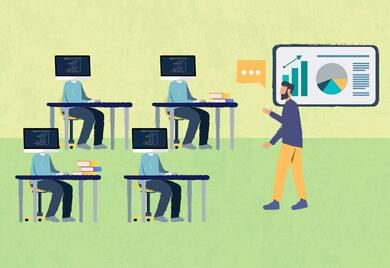
Do you speak the universal language of the Sustainable Development Goals?
Aligning to the SDGs does not have to mean colossal change. Firms must recognize that the SDGs provide a framework for communicating progress in a globally-recognized language.

Can your trip to the beach help reduce poverty?
As summer comes to an end in the Northern Hemisphere, many of us have been asking and answering the same question: how was your vacation? Our responses typically include anecdotes about the food, people, and places we encountered along the way. Perhaps we could also be asking ourselves how our vacation impacted those people and places.

Why is mobile broadband quality so important for development?
Latin America and the Caribbean is a region of contrasts. Almost everyone has a cell phone, as evidenced by the exponential increase in mobile phone subscribers from 10% of the population in 2000 to over 70% in 2017. And, the region is home to some of the most advanced mobile internet and avid social media users in the world, led by Mexico, Argentina, and Brazil. Yet coverage varies across countries and millions of people still do not have access to reliable mobile broadband connections, particularly in rural areas. And, even for those with access, service quality is often poor, limiting their potential to take full advantage of the latest technologies and making it difficult to bridge the digital divide.
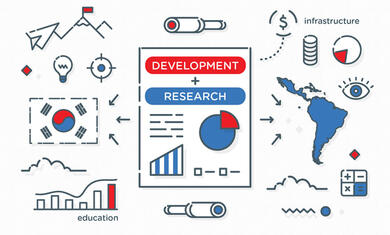
What can the private sector in Latin America and the Caribbean learn from Korea’s economic miracle?
They say that Korea achieved in three decades what it took the Western industrialized countries more than a century to do. But, how did it do that?
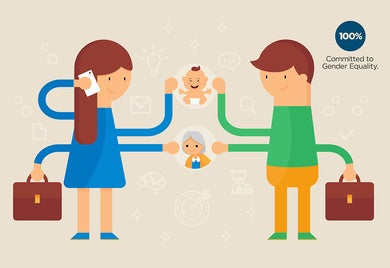
How men and women sharing the workload can promote regional growth
Women do more unpaid work than men, with significant consequences for the economy. From India to Denmark, the pattern is the same. While women invest an average of 4.5 hours per day in unpaid work, men invest barely 1.5 hours. It is estimated that the unpaid work that women do worldwide is equal to $12 trillion a year, or 11% of global GDP for the year 2025. In the case of small businesses in Ecuador, which we analyzed in a study I published recently, we found that the most important factor explaining the differences between the profitability of companies managed by men and women is precisely the time dedicated to unpaid work: household tasks and caring for children and the elderly. This does not mean that women work less in their professions than men. In the sample I studied, men and women invest the same number of hours per day and the same number of days per week in their businesses. But women dedicate a larger number of hours to unpaid work in the home and, to a greater extent than men, also tend to perform many tasks at the same time ― multitasking―combining business activities with household work. There is extensive literature in psychology showing the negative effects of multitasking on performance. The greater the cognitive demand and the effort required to perform a task, the greater these effects. For this reason, we automatically stop talking to our passenger (task 1) when trying to pass a truck on a narrow road or merge onto a highway (task 2). However, when in the study we compare companies with the same characteristics (age of the business, capital, number of employees, sector of economic activity, age and years of education of the manager, etc.), including the time managers devote to the business and to unpaid work, we see that companies managed by men and women are equally profitable. This means that there is enormous economic growth potential if we resolve these disparities. Companies led by women in Latin America and the Caribbean could be an engine of growth for the region if men and women shared household tasks in a more balanced way, but it is difficult to imagine this change happening from one day to the next. On International Women’s Day we want to emphasize the importance of gender equality in the productivity of the region’s companies. Each of us has the task of contributing to this change. At IDB Invest, along with the Inter-American Development Bank, we have been working for more than a year on our campaign 100% Committed to Gender Equality, in which we have explored how public and private sector projects become more productive when they invest in equality. Similarly, at IDB Invest, we have created instruments, like the Women’s Empowerment Principles Gender Gap Analysis Tool (WEPs business gender tool); knowledge products, like our study “The Power of Gender Equality in the Workplace;” and we provide advisory services to help companies improve their gender equality standards. The time for sharing the burden is now and it is key to the growth of our region. Subscribe to receive more content like this! [mc4wp_form]
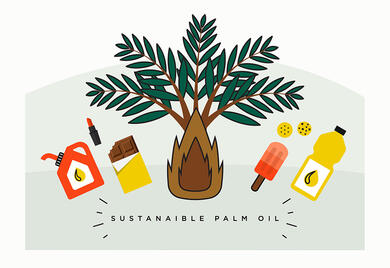
Supporting sustainable palm oil in Latin America and the Caribbean
African palm oil accounts for the bulk of vegetable oil sales in the world, and it is estimated that demand for this oil will grow significantly in the near future. But how is palm oil used? Although many of us are unaware of all its potential uses in industry, we use palm oil daily in a great variety of products, such as processed foods (ice creams, cookies, spreads, etc.), cosmetics, and automobile fuel. Review the labels on the products you use frequently and you will be surprised.